

Views: 0
Learn how to build an effective social media marketing content calendar for your startup in 2026, with a step-by-step framework, tools, and common mistakes to avoid.
Table of Contents
- 1 Introduction
- 2 What Is a Social Media Content Calendar?
- 3 Why Startups Need a Content Calendar in 2026
- 4 Key Components of an Effective Content Calendar
- 5 Step 1: Define Your Goals and KPIs
- 6 Step 2: Know Your Audience and Platforms
- 7 Step 3: Choose the Right Tools for 2026
- 8 Step 4: Plan Content Pillars and Themes
- 9 Step 5: Map Out Posting Frequency and Timing
- 10 Step 6: Build a Monthly and Weekly Structure
- 11 Step 7: Build In Flexibility for Trends and Real-Time Content
- 12 Step 8: Assign Roles and Workflow
- 13 Step 9: Track, Analyze, and Optimize
- 14 Common Mistakes Startups Make With Content Calendars
- 15 A Sample Weekly Content Calendar Framework
- 16 Frequently Asked Questions (FAQs)
- 17 Conclusion
- 18 Need a Social Media Marketing Content Calendar for Your Business?
Introduction
For most startups, social media isn’t optional anymore — it’s where customers discover you, evaluate you, and decide whether to trust you. But posting randomly whenever inspiration strikes rarely builds an audience. What actually moves the needle is consistency, and consistency only happens with a plan.
That plan is your content calendar. In 2026, with algorithms favoring consistent, high-quality posting and audiences scattered across multiple platforms, a well-structured content calendar isn’t just a nice-to-have organizational tool — it’s the backbone of a startup’s entire marketing engine. This guide walks you through exactly how to build one from scratch, step by step.
What Is a Social Media Content Calendar?
A social media content calendar is a planning document that outlines what content you’ll post, on which platform, and when. Instead of scrambling to think of something to post each morning, you work from a pre-planned schedule that maps content to your business goals, audience needs, and key dates.
A good content calendar typically includes the platform, the content format, the caption or topic, the publish date and time, any relevant hashtags or links, and the goal each post is meant to serve, whether that’s brand awareness, engagement, lead generation, or community building.
For a startup, this isn’t just about looking organized. It’s about making sure every post earns its place in your marketing strategy rather than existing just to fill space.
Why Startups Need a Content Calendar in 2026
Startups often operate with lean teams and limited time, which makes a content calendar even more valuable, not less. Without one, social media tends to become reactive and inconsistent, with long gaps followed by bursts of activity that confuse the algorithm and the audience alike.
A content calendar solves several problems at once. It saves time by allowing batch content creation instead of daily scrambling. It ensures consistency, which platforms increasingly reward with better organic reach. It aligns social content with broader business goals like product launches, sales, or campaigns. It also makes collaboration easier, since founders, marketers, and freelancers can all see what’s planned and avoid duplication or last-minute chaos.
In 2026, with short-form video, AI-generated content, and multi-platform presence becoming standard expectations, the startups that win attention are the ones operating with a clear, repeatable system rather than improvising every day.
Key Components of an Effective Content Calendar
Before building your calendar, it helps to understand what elements it actually needs to contain. These typically include your content pillars, which are the core themes you’ll consistently post about, your posting schedule across each platform, the content format for each post such as video, carousel, or static image, your captions or scripts, any relevant calls-to-action, and performance tracking fields to log how each post performed after publishing.
Missing any of these elements usually leads to a calendar that looks organized on the surface but doesn’t actually drive results, because there’s no clear link between what you’re posting and why.
Step 1: Define Your Goals and KPIs
Every content calendar should start with clarity on what you’re actually trying to achieve. Are you building brand awareness, driving website traffic, generating leads, building a community, or supporting customer retention? Each goal changes what kind of content belongs on your calendar.
Once your goal is clear, attach measurable key performance indicators to it. Awareness goals might track reach and impressions, engagement goals might track comments and shares, and lead generation goals might track click-through rates and sign-ups. Without this step, you’ll end up creating content that looks good but doesn’t move any real business metric forward.
Step 2: Know Your Audience and Platforms
Not every platform deserves equal attention. A B2B SaaS startup might find far more value on LinkedIn and Twitter/X than on Instagram, while a D2C consumer brand might see the opposite. Spend time understanding where your specific audience actually spends time, rather than spreading thin across every platform just because it exists.
For each platform you choose, research the content formats that perform best there in 2026. Short-form video continues to dominate reach across Instagram Reels, YouTube Shorts, and TikTok, while LinkedIn rewards text-based storytelling and carousel posts for B2B audiences. Building your calendar around platform-specific strengths, rather than posting identical content everywhere, significantly improves performance.
Step 3: Choose the Right Tools for 2026
You don’t need an expensive enterprise tool to manage a content calendar, especially as a startup. Spreadsheet templates work perfectly well in the early stages, offering full flexibility at zero cost. As your content volume grows, dedicated scheduling and planning tools can save significant time by allowing batch scheduling, approval workflows, and performance tracking in one place.
When choosing a tool, prioritize ease of use for your team size, integration with the platforms you actually use, and built-in analytics so you’re not constantly switching between tools to measure performance. In 2026, many tools also offer AI-assisted caption writing and optimal posting time suggestions, which can be a useful starting point, though they should always be refined with your brand voice rather than used as-is.
Step 4: Plan Content Pillars and Themes
Content pillars are the three to five core themes your brand will consistently post about. For a startup, these might include product education, customer success stories, behind-the-scenes culture content, industry insights, and community engagement posts.
Having defined pillars prevents the common trap of posting whatever feels relevant in the moment, which often leads to inconsistent messaging. Instead, you can rotate through your pillars on a predictable rhythm, ensuring your audience gets a balanced mix of value, while still recognizing a consistent brand voice and identity across every post.
Step 5: Map Out Posting Frequency and Timing
Frequency depends heavily on your platform, audience, and available resources. As a general guide for startups in 2026, three to five posts per week works well for Instagram and LinkedIn, daily posting tends to perform best for short-form video platforms, and two to three posts per week is often sufficient for Twitter/X and Facebook, depending on engagement levels.
Timing matters almost as much as frequency. Rather than guessing, review your platform’s native analytics to identify when your specific audience is most active, and schedule posts around those windows. Consistency in timing, not just frequency, helps train both the algorithm and your audience’s expectations.
Step 6: Build a Monthly and Weekly Structure
Once your pillars and frequency are set, break planning into two layers. At the monthly level, map out major themes, campaigns, product launches, or seasonal moments you want to highlight. At the weekly level, assign specific content pillars to specific days, creating a repeatable rhythm your team can follow without reinventing the plan every week.
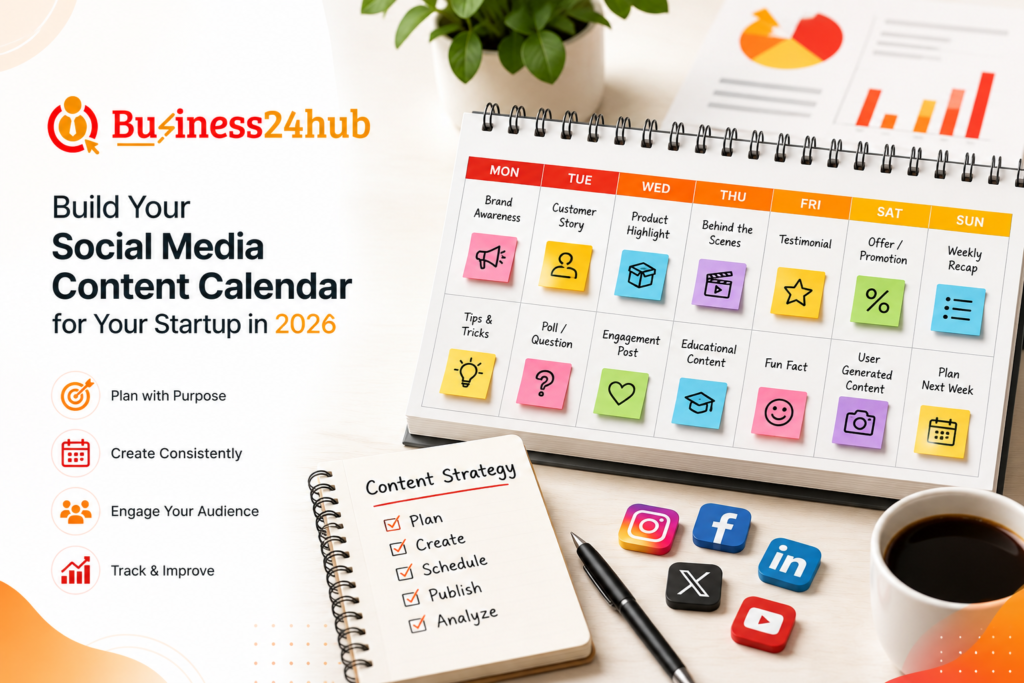
For example, a startup might dedicate Mondays to industry insights, Wednesdays to product education, Fridays to community or culture content, and reserve flexible slots for trending topics or timely announcements. This structure removes decision fatigue while still leaving room for spontaneity when needed.
Step 7: Build In Flexibility for Trends and Real-Time Content
A content calendar shouldn’t be so rigid that it ignores what’s happening in real time. Some of the highest-performing posts come from jumping on relevant trends, news, or cultural moments quickly. Leave deliberate gaps in your calendar, sometimes called flex slots, that can be filled with timely content when something relevant emerges.
This balance between planned and reactive content is especially important in 2026, where algorithms across most platforms continue to favor timely, native-feeling content over content that feels overly scripted or delayed.
Step 8: Assign Roles and Workflow
Even small startup teams benefit from a clear workflow around the content calendar. Define who is responsible for ideation, who handles content creation, who reviews and approves before publishing, and who is responsible for actually scheduling and monitoring engagement after posts go live.
Without clear ownership, content calendars often fall apart within a few weeks, not because the plan was wrong, but because no single person felt accountable for execution. A simple weekly check-in to review the upcoming week’s content can prevent this breakdown.
Step 9: Track, Analyze, and Optimize
A content calendar isn’t a one-time document — it’s a living system that should evolve based on performance data. At the end of each week or month, review which posts performed best against your KPIs, and identify patterns in format, timing, or topic that drove stronger results.
Use these insights to continuously refine your content pillars and posting strategy. What works for your specific audience in month one may shift by month six, so treat your calendar as an ongoing experiment rather than a fixed plan you set once and forget.
Common Mistakes Startups Make With Content Calendars
Posting without a clear goal behind each piece of content is one of the most frequent mistakes, leading to a feed that looks active but doesn’t drive any measurable business outcome.
Overplanning too far in advance is another common issue, since locking in content months ahead leaves no room to react to trends, news, or real-time audience feedback.
Ignoring platform-specific formatting is also costly. Posting identical content across every platform without adjusting for format, tone, or audience expectations usually underperforms compared to platform-tailored content.
Failing to leave room for engagement is another oversight. A calendar focused purely on publishing, without time allocated for responding to comments and messages, misses one of social media’s biggest opportunities for building genuine relationships with an audience.
Finally, many startups abandon their calendar after a few weeks simply because no one owns the process. Treating the calendar as a core operational tool, not an optional extra, is essential for it to actually work long-term.
A Sample Weekly Content Calendar Framework
Here’s a simple framework a startup could adapt immediately. Monday could focus on an industry insight or trend commentary post. Tuesday could feature a short-form video highlighting a product feature or use case. Wednesday could be reserved for a customer testimonial or success story. Thursday could include a behind-the-scenes or team culture post. Friday could highlight a community question, poll, or user-generated content feature. Weekends can either stay flexible for lighter, more casual content or remain quiet, depending on platform and audience behavior.
This structure can be adapted weekly based on campaigns, launches, or trending opportunities, while still maintaining the underlying rhythm and consistency that makes a content calendar effective.
Frequently Asked Questions (FAQs)
1. What is a social media content calendar?
A social media content calendar is a planned schedule that outlines what content you will publish, on which platform, and when. It helps businesses stay organized, maintain consistency, and achieve their marketing goals.
2. Why does a startup need a social media content calendar in 2026?
A content calendar helps startups save time, maintain a consistent posting schedule, improve audience engagement, support marketing campaigns, and align content with business objectives.
3. How often should startups post on social media?
The ideal posting frequency depends on the platform and audience. Most startups benefit from posting 3–5 times per week on platforms like LinkedIn, Facebook, and Instagram while maintaining consistent quality.
4. Which tools can I use to create a social media content calendar?
Popular tools include Google Sheets, Trello, Notion, Asana, Buffer, Hootsuite, and Meta Business Suite. These tools help plan, schedule, and track social media content efficiently.
5. What type of content should be included in a startup’s social media calendar?
A balanced content calendar should include educational posts, promotional content, customer testimonials, industry news, product updates, behind-the-scenes content, videos, infographics, and interactive posts such as polls or Q&A sessions.
6. How can I measure the success of my social media content calendar?
Track key performance metrics such as reach, engagement, follower growth, click-through rate (CTR), website traffic, lead generation, and conversions. Regular analysis helps optimize your content strategy for better results.
Conclusion
A social media content calendar isn’t just an organizational nicety for startups in 2026 — it’s a strategic necessity. It transforms social media from a reactive, time-draining task into a structured system that consistently supports your broader business goals, whether that’s brand awareness, lead generation, or community building.
The startups that build real momentum on social media aren’t necessarily the ones with the biggest budgets or the flashiest content. They’re the ones with a clear, consistent system behind their posting — one that’s planned with intention, flexible enough to adapt to real-time opportunities, and reviewed regularly enough to keep improving. Building that system today is one of the highest-leverage moves a startup can make for its marketing in 2026.
Need a Social Media Marketing Content Calendar for Your Business?
🟡 Business24Hub provides complete IT, web development, software development, digital marketing, branding, SEO, mobile app development, and business consulting services to startups, entrepreneurs, SMEs, and enterprises across India.
🟡For other Legal and Trademark related services Visit
👉 Money Recovery Cases
👉 Property Disputes
👉 Business & Licence Registrations
🟡 Protect Your Rights
👉 Domestic Violence Legal Support
👉 Stridhan Recovery
👉 Mutual Consent Divorce
👉 Contested Divorce Filing
👉 Child Custody and Maintenance
👉 Matrimonial Property Settlement
👉 NRI Divorce Services
👉 Alimony and Maintenance
📞 Call Now: +91 8595439395
🕐 Free Consultation: Monday to Saturday, 10 AM to 6 PM

I’m Aryan Yadav, passionate about SEO and Digital Marketing with a strong interest in helping businesses grow online. I enjoy learning new strategies, exploring digital trends, and creating ideas that deliver value. I believe in continuous growth, creativity, and building meaningful results through smart work and dedication.

