

Views: 0
A complete on-page SEO checklist for startup websites in 2026, covering technical fixes, content optimization, and ranking factors most founders miss.
Table of Contents
- 1 Introduction
- 2 Why On-Page SEO Still Matters in 2026
- 3 Section One: Pre-Publish Content Foundations
- 4 Section Two: Title Tag and Meta Description
- 5 Section Three: Heading Structure
- 6 Section Four: Content Body Optimization
- 7 Section Five: Internal Linking
- 8 Section Six: Images and Visual Content
- 9 Section Seven: URL Structure
- 10 Section Eight: Mobile Optimization
- 11 Section Nine: Page Speed and Core Web Vitals
- 12 Section Ten: Structured Data and Schema Markup
- 13 Section Eleven: User Experience Signals
- 14 Section Twelve: E-E-A-T Signals
- 15 Section Thirteen: Pre-Publish Final Review
- 16 Common On-Page SEO Mistakes Startups Make
- 17 How to Use This Checklist Practically
- 18 Frequently Asked Questions
- 19 Conclusion
- 20 Need a Social Media Marketing Content Calendar for Your Business?
Introduction
Most startups eventually learn that publishing content isn’t the same as ranking for it. You can write a genuinely useful blog post or build a well-designed product page, and still watch it sit on page three of Google indefinitely, simply because the on-page fundamentals weren’t handled correctly. Keyword research tells you what to target. On-page optimization is what actually gives that content a fair chance to rank once it’s live.
In 2026, with Google’s algorithms increasingly evaluating pages on depth, structure, experience, and technical health all at once, on-page SEO has become less about ticking a few obvious boxes and more about systematically covering dozens of smaller details that compound into real ranking differences. This checklist walks through exactly what startups need to get right on every page they publish, organized in the order it actually matters.
Why On-Page SEO Still Matters in 2026
It’s tempting to assume that with AI-driven search experiences and increasingly sophisticated algorithms, the old fundamentals of on-page SEO have become less relevant. The opposite is closer to true. As Google’s systems get better at understanding content deeply, pages with genuinely strong structure, clarity, and technical health are rewarded more precisely than ever, while pages relying on superficial keyword placement without real substance are filtered out more effectively too.
For startups specifically, on-page SEO remains one of the few growth levers fully within your control. You can’t control your competitors’ domain authority or budget, but you can absolutely control whether your own pages are technically sound, genuinely useful, and structured in a way that both search engines and real visitors can easily understand. This checklist is designed to make that control concrete and actionable.
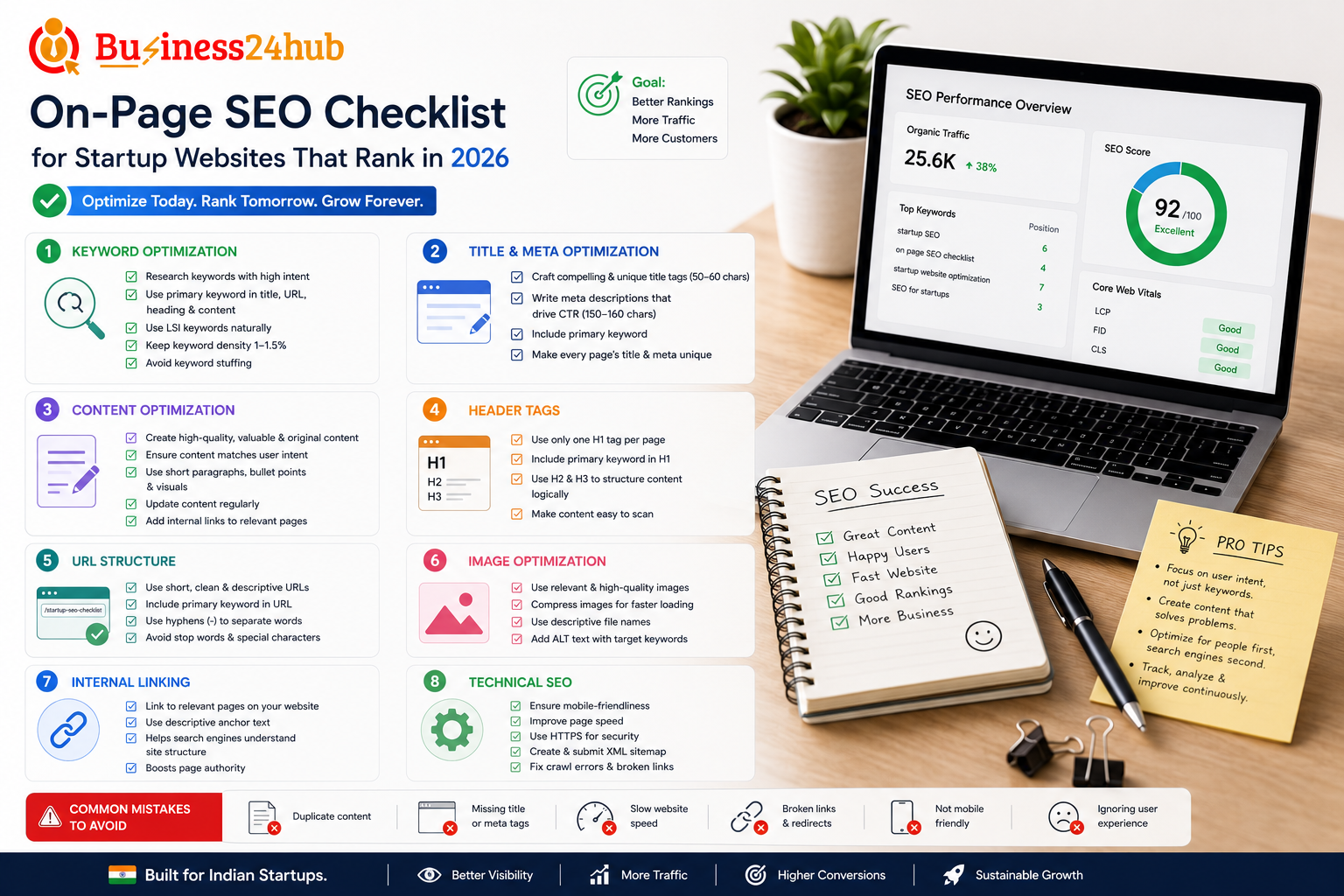
Section One: Pre-Publish Content Foundations
Target keyword clearly defined. Every page should have one primary keyword it’s built around, identified through proper keyword research before writing begins, not added in as an afterthought once a draft is finished.
Search intent matched precisely. Confirm your content format and angle actually matches what’s currently ranking for your target keyword. If top results are detailed guides and your page is a short product pitch, intent mismatch will likely prevent ranking regardless of other optimization.
Content genuinely more useful than competitors. Review the top five ranking pages for your target keyword and identify gaps, outdated information, or missing depth your page can address more thoroughly, rather than simply rewriting the same points in different words.
Word count appropriate to intent, not arbitrary. Longer isn’t automatically better. A transactional page needs to be concise and conversion-focused, while an informational guide often benefits from comprehensive depth. Match length to what genuinely serves the searcher’s intent.
Section Two: Title Tag and Meta Description
Primary keyword included naturally in the title tag. Place your target keyword as close to the beginning of the title as naturally possible, without forcing awkward phrasing purely to front-load the keyword.
Title tag length kept within display limits. Keep titles under roughly sixty characters where possible to avoid truncation in search results, which can cut off important context or your call-to-action.
Meta description written to earn the click, not just describe the page. Treat your meta description as ad copy, clearly communicating the value of clicking through rather than simply summarizing content in a flat, unpersuasive way.
Unique title and meta description for every page. Duplicate titles or descriptions across multiple pages confuse both search engines and searchers comparing results, and should be checked specifically across your site, not just within individual page edits.
Section Three: Heading Structure
Single, clear H1 per page. Every page should have exactly one H1 tag, typically matching or closely reflecting the page’s primary topic and target keyword, never multiple competing H1s on the same page.
Logical H2 and H3 hierarchy. Structure subheadings in a clear hierarchy that reflects actual content organization, rather than randomly assigning heading levels based on font size preferences in your editor.
Keywords woven naturally into subheadings where relevant. Secondary keywords and related terms should appear naturally in H2 and H3 tags where they genuinely fit the content’s structure, not forced in artificially.
Headings genuinely describe the content beneath them. Avoid vague, generic subheadings like “More Information” in favor of specific, descriptive headings that help both readers and search engines understand exactly what each section covers.
Section Four: Content Body Optimization
Primary keyword appears naturally within the first hundred words. This helps confirm topical relevance early, both to search engines and to readers deciding whether to keep reading, but should read naturally rather than feeling forced.
Related and semantic keywords included throughout. Rather than repeating your exact primary keyword excessively, use natural variations, synonyms, and related terms a search engine would expect to see in genuinely comprehensive content on the topic.
Content broken into scannable sections. Use short paragraphs, bullet points, and clear subheadings throughout, since most visitors scan content before deciding to read in depth, and overly dense blocks of text increase bounce rates.
No keyword stuffing or unnatural repetition. If a sentence sounds awkward purely because it’s trying to include a keyword, rewrite it. Modern algorithms penalize this pattern rather than rewarding it.
Content reviewed for accuracy and freshness. Outdated statistics, broken processes, or stale examples hurt both user trust and rankings over time, making periodic content reviews and updates an essential, ongoing part of on-page SEO rather than a one-time task.
Section Five: Internal Linking
Relevant internal links included naturally within content. Link to related pages on your own site where it genuinely helps the reader, using descriptive anchor text rather than generic phrases like “click here.”
Important pages linked from multiple places. Pages you want to rank well should receive internal links from several relevant pages across your site, signaling their importance both to visitors navigating your content and to search engines crawling your structure.
No orphaned pages. Every important page on your site should be reachable through internal links from at least one other page, since orphaned pages with no internal links pointing to them are significantly harder for search engines to discover and prioritize.
Anchor text varied and descriptive. Avoid using identical anchor text repeatedly across different links pointing to the same page, instead varying phrasing naturally while keeping it descriptive of the destination page’s content.
Section Six: Images and Visual Content
Descriptive, keyword-relevant file names. Rename image files from generic names like “IMG1234.jpg” to descriptive names reflecting actual content, such as “startup-seo-checklist-diagram.jpg,” before uploading to your site.
Alt text added for every image. Write clear, descriptive alt text for accessibility and search engine understanding, avoiding both empty alt attributes and obviously keyword-stuffed descriptions that don’t genuinely describe the image.
Images compressed for fast loading. Large, uncompressed images are one of the most common causes of slow page speed, directly affecting both user experience and search rankings, especially significant given India’s variable mobile network conditions.
Appropriate image dimensions used. Avoid uploading oversized images and relying on CSS to shrink them visually, since this wastes loading resources unnecessarily. Resize images to their actual needed display dimensions before uploading.
Section Seven: URL Structure
Clean, readable URL slugs. Use short, descriptive URLs reflecting page content, avoiding long strings of numbers, special characters, or unnecessary stop words that add length without adding clarity.
Primary keyword included in the URL where natural. Including your target keyword in the URL slug provides a small but consistent relevance signal, as long as it doesn’t result in an awkward, overly long URL.
Consistent URL structure across the site. Maintain a logical, consistent pattern for how URLs are structured across different content types, making your site easier to navigate and understand for both users and search engines.
Avoid unnecessary URL changes after publishing. Changing URLs after a page has gained some ranking history can disrupt accumulated authority unless proper redirects are implemented immediately, so plan URL structure carefully before initial publishing rather than after.
Section Eight: Mobile Optimization
Fully responsive design confirmed on real devices. Test every page directly on actual mobile devices, not just a browser’s responsive preview mode, since rendering can differ meaningfully between simulated and real device environments.
Tap targets sized appropriately. Buttons, links, and form fields should be large enough and spaced sufficiently apart to be easily tappable on a small touchscreen without accidental misclicks.
Text readable without zooming. Body text should be comfortably readable at default mobile zoom levels, avoiding the common mistake of font sizes that look fine on desktop but become uncomfortably small on mobile screens.
No intrusive pop-ups blocking mobile content. Avoid full-screen interstitial pop-ups that block content immediately on mobile page load, since these create poor user experience and have been specifically flagged as a negative ranking signal.
Section Nine: Page Speed and Core Web Vitals
Loading speed tested and optimized. Use tools like Google PageSpeed Insights to identify specific bottlenecks slowing down your page, particularly on mobile connections, and address the highest-impact issues first rather than chasing a perfect score across every minor metric.
Unnecessary scripts and plugins minimized. Each additional script or plugin adds loading overhead, so regularly audit and remove anything no longer genuinely necessary for site functionality.
Core Web Vitals monitored regularly. Track metrics related to loading performance, interactivity, and visual stability through Google Search Console, addressing flagged issues promptly rather than only checking occasionally.
Reliable hosting infrastructure in place. Slow or unreliable hosting can undermine even well-optimized individual pages, making hosting quality a foundational technical SEO consideration worth investing in properly from early on.
Section Ten: Structured Data and Schema Markup
Relevant schema markup implemented where applicable. Adding structured data for content types like articles, FAQs, products, or reviews helps search engines understand your content more precisely and can enable enhanced search result features.
Schema markup tested for errors. Use Google’s structured data testing tools to confirm your markup is implemented correctly, since broken or incomplete schema can fail silently without obvious symptoms unless specifically checked.
FAQ schema added to genuinely relevant content. Pages containing clear question-and-answer content, like FAQ sections, benefit from FAQ schema markup, which can sometimes earn additional visibility directly within search results.
Section Eleven: User Experience Signals
Bounce rate and time on page monitored. While not direct ranking factors in isolation, poor engagement metrics often indicate underlying content or experience issues that do affect rankings indirectly over time.
Clear, logical navigation maintained. Visitors should be able to intuitively understand how to move through your site and find related content, supporting both usability and the kind of internal linking structure search engines favor.
Readable typography and sufficient contrast. Confirm text remains easily readable across different devices and lighting conditions, since poor readability quietly increases bounce rates regardless of how strong the underlying content actually is.
Clear calls-to-action without being intrusive. Guide visitors toward a clear next step without resorting to aggressive pop-ups or dark patterns that frustrate users and can also trigger negative experience signals.
Section Twelve: E-E-A-T Signals
Author information included where relevant. For content where expertise matters, such as health, finance, or technical topics, include clear author information establishing relevant credibility and experience.
Sources and claims properly supported. Back up significant claims or statistics with credible sources, since this supports both reader trust and the broader expertise and trustworthiness signals search engines increasingly weigh.
Contact and business information clearly accessible. Ensure your site clearly displays legitimate business information, building the kind of trust signals particularly important for transactional or service-based startup websites.
Content reflects genuine first-hand knowledge where possible. Where applicable, incorporate genuine experience, case studies, or original insights rather than purely aggregating information already available elsewhere, since this increasingly differentiates strong content from generic, easily replicated material.
Section Thirteen: Pre-Publish Final Review
Spelling and grammar thoroughly checked. Basic errors undermine credibility and professionalism, making a careful final proofread an essential last step before publishing.
All links tested and functional. Click through every internal and external link before publishing to confirm none are broken, since broken links create poor user experience and waste valuable crawl budget.
Page previewed on multiple devices and browsers. Confirm formatting, images, and functionality all display correctly across different combinations of devices and browsers your actual audience uses.
Indexing settings confirmed correct. Double-check that the page is set to be indexed and isn’t accidentally marked with a “noindex” tag, a surprisingly common and completely avoidable mistake that silently prevents an otherwise well-optimized page from ever appearing in search results.
Common On-Page SEO Mistakes Startups Make
Publishing content without clearly defined target keywords is one of the most fundamental and frequent mistakes, leading to vague, unfocused pages that don’t clearly signal relevance for any specific search query.
Treating on-page SEO as a one-time task completed at launch, rather than an ongoing process, causes many startup websites to gradually fall behind as competitors continue refining and updating their own content over time.
Over-optimizing for keywords at the expense of natural, readable content remains a persistent issue, even though modern algorithms are specifically designed to recognize and penalize this pattern rather than reward it.
Neglecting mobile experience, despite the overwhelming majority of traffic for most startups arriving through mobile devices, continues to undermine otherwise solid on-page optimization efforts.
Skipping technical fundamentals like page speed and structured data, while focusing exclusively on content and keywords, leaves significant ranking potential unrealized, since technical health and content quality work together rather than independently.
How to Use This Checklist Practically
Rather than treating this as an exhaustive list to memorize, build it directly into your content workflow as a pre-publish checklist every team member follows before any page goes live. Many startups find it useful to convert this into a simple shared document or project management checklist template, checked off systematically for every new page or major content update.
For existing pages already published, conduct a periodic audit using this same checklist, prioritizing your highest-traffic or highest-potential pages first, since improvements here typically deliver the most meaningful ranking and traffic impact relative to the time invested.
Frequently Asked Questions
How often should startups revisit on-page SEO for existing content? A quarterly review of top-performing and high-potential pages is a reasonable baseline, though pages showing declining performance in Google Search Console may warrant more immediate attention.
Is on-page SEO still important given AI-driven search experiences in 2026? Yes, arguably more than before. AI-driven systems still rely on understanding content structure, relevance, and technical health, meaning well-optimized pages remain better positioned to be surfaced and cited within these evolving search experiences.
What’s the single highest-impact item on this checklist for a startup just starting out? Matching content genuinely to search intent typically has the largest impact, since even perfectly executed technical optimization can’t compensate for content that doesn’t actually serve what searchers are looking for.
Can on-page SEO alone get a startup website to rank well? On-page SEO is essential but works alongside other factors like backlinks and overall domain authority. Strong on-page optimization significantly improves your competitive position, but rarely guarantees rankings entirely on its own, particularly for highly competitive keywords.
Should every single page on a startup website follow this entire checklist? The full checklist is most relevant for content and key landing pages intended to rank in organic search. Some pages, like internal-only or low-priority utility pages, may reasonably skip certain items without meaningful impact.
Conclusion
On-page SEO isn’t a single technical fix or a box checked once before forgetting about it entirely — it’s a comprehensive discipline covering everything from keyword placement to page speed to genuine content quality, all working together to give your pages a real, fair chance at ranking. For startups in 2026, where competing against established players with stronger domain authority is already difficult, getting these fundamentals consistently right is one of the few areas where careful, deliberate effort directly and reliably translates into better results.
The startup websites that consistently rank well aren’t necessarily publishing more content than their competitors. They’re the ones treating on-page optimization as a genuine, repeatable system, checked thoroughly before every page goes live and revisited regularly afterward, rather than relying on hope and a few scattered best practices remembered inconsistently from one page to the next.
Need a Social Media Marketing Content Calendar for Your Business?
🟡Business24Hub provides complete IT, web development, software development, digital marketing, branding, SEO, mobile app development, and business consulting services to startups, entrepreneurs, SMEs, and enterprises across India.
🟡For other Legal and Trademark related services Visit
👉 Money Recovery Cases
👉 Property Disputes
👉 Business & Licence Registrations
🟡 Protect Your Rights
👉 Domestic Violence Legal Support
👉 Stridhan Recovery
👉 Mutual Consent Divorce
👉 Contested Divorce Filing
👉 Child Custody and Maintenance
👉 Matrimonial Property Settlement
👉 NRI Divorce Services
👉 Alimony and Maintenance
📞 Call Now: +91 8595439395
🕐 Free Consultation: Monday to Saturday, 10 AM to 6 PM

I’m Aryan Yadav, passionate about SEO and Digital Marketing with a strong interest in helping businesses grow online. I enjoy learning new strategies, exploring digital trends, and creating ideas that deliver value. I believe in continuous growth, creativity, and building meaningful results through smart work and dedication.

