

Views: 5
A practical 2026 guide to Social Media Marketing Budget Planning for cash-strapped Indian startups, covering free strategies, paid allocation, tools, and a realistic framework.
Table of Contents
- 1 Introduction
- 2 Why “Shoestring” Doesn’t Mean “No Strategy”
- 3 Step 1: Get Honest About What “Shoestring” Actually Means for You
- 4 Step 2: Choose One or Two Platforms, Not Five
- 5 Step 3: Maximize Organic Content Before Spending on Ads
- 6 Step 4: Allocate a Small, Consistent Budget to Boosting Top-Performing Content
- 7 Step 5: Use Free and Low-Cost Tools Strategically
- 8 Step 6: Prioritize User-Generated and Repurposed Content
- 9 Step 7: Run Small, Highly Targeted Paid Campaigns Instead of Broad Ones
- 10 Step 8: Build a Simple Monthly Allocation Framework
- 11 Step 9: Track Cost-Per-Result, Not Just Total Spend
- 12 Step 10: Reinvest Wins Before Scaling Spend
- 13 Free Strategies That Cost Time, Not Money
- 14 Common Shoestring Budget Mistakes Indian Startups Make
- 15 A Practical Example: A Shoestring Budget in Action
- 16 How AI Tools Are Helping Shoestring Budgets in 2026
- 17 Frequently Asked Questions
- 18 Conclusion
- 19 Need Social Media Marketing Budget Planning for Your Business?
Introduction
Every founder has heard the advice to “be active on social media,” but very few are told how much that should actually cost, or where the money should go once a budget exists at all. For startups operating with limited runway, this gap between advice and execution often leads to one of two extremes — spending nothing and hoping organic reach magically appears, or spending impulsively on boosted posts without any clear strategy behind the spend.
In 2026, with organic reach continuing to shrink across most major platforms and paid promotion becoming increasingly central to visibility, Indian startups need a deliberate, realistic approach to social media budgeting, even when that budget is genuinely tiny. This guide breaks down exactly how to plan social media marketing spend on a shoestring, without wasting money or giving up on the channel entirely.
Why “Shoestring” Doesn’t Mean “No Strategy”
A limited budget is often treated as a reason to skip planning altogether, as if strategy only matters once there’s significant money involved. The opposite is actually true. When resources are scarce, every rupee and every hour spent needs to work harder, which makes a clear plan more important, not less.
Shoestring budgeting isn’t about doing social media marketing for free — it’s about being deliberate regarding where your limited time and money go, distinguishing between activities that genuinely drive results and those that simply feel productive without moving the needle. For early-stage Indian startups, this distinction often determines whether social media becomes a genuine growth channel or a time-consuming distraction with little to show for it.
Step 1: Get Honest About What “Shoestring” Actually Means for You
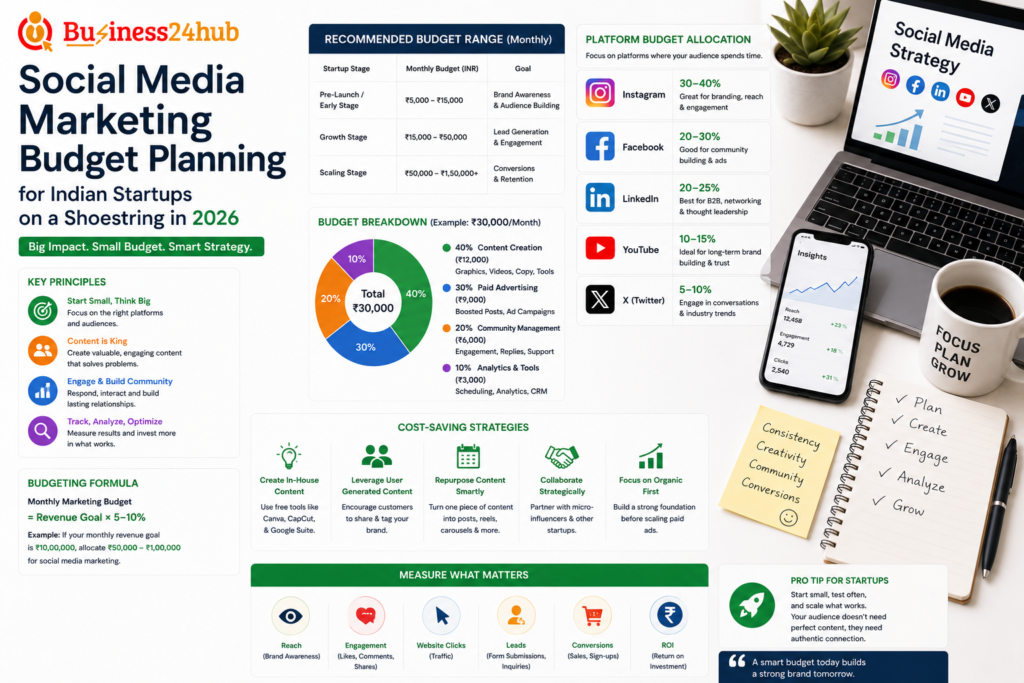
Before planning anything, define your actual available budget in concrete numbers, not vague intentions. For many early-stage Indian startups in 2026, a realistic shoestring social media budget falls somewhere between five thousand and twenty thousand rupees per month, sometimes even less in the very earliest pre-revenue stage.
This number should account for both direct ad spend and any tools or resources needed to support content creation, even simple ones like stock photo subscriptions or basic design software. Being specific here prevents the common trap of mentally lumping “social media marketing” together as an abstract, unbudgeted activity that founders handle personally without ever tracking actual cost, including the very real cost of their own time.
Step 2: Choose One or Two Platforms, Not Five
One of the most common shoestring budget mistakes is trying to maintain a presence across every major platform simultaneously, spreading limited time and money so thin that none of them receive enough consistent effort to actually perform. Instead, identify the one or two platforms where your specific target audience genuinely spends time, and commit your limited resources there exclusively.
A B2B SaaS startup targeting decision-makers might find LinkedIn delivers significantly more value than Instagram, while a D2C fashion or lifestyle brand might see the reverse. Research your specific audience’s platform habits rather than assuming you need a presence everywhere, since concentrated effort on the right one or two platforms consistently outperforms diluted effort spread across many.
Step 3: Maximize Organic Content Before Spending on Ads
With a tight budget, organic content should be your foundation, not an afterthought squeezed in around paid promotion. Strong organic content does double duty — it builds genuine audience trust over time, and it also performs better as a foundation for paid promotion later, since boosting already-engaging content typically costs less and converts better than boosting weak content from the start.
Focus organic efforts on content that requires minimal production cost but high genuine value, such as behind-the-scenes startup journey content, quick educational tips relevant to your industry, customer testimonials and success stories, and timely commentary on relevant industry trends or news. This kind of content can often be created using just a smartphone and basic editing apps, keeping production costs close to zero while still building real audience connection.
Step 4: Allocate a Small, Consistent Budget to Boosting Top-Performing Content
Rather than running broad, expensive ad campaigns from day one, a shoestring-friendly approach is identifying organic posts that are already performing well, based on engagement and reach, and putting a small amount of budget behind boosting them further. This approach lets real audience response guide where your limited paid budget goes, rather than guessing which content might perform well before it’s even published.
A modest allocation, even as little as five hundred to two thousand rupees per boosted post, spread across your best-performing weekly content, often delivers stronger results than a single larger spend on unproven content created specifically for an ad campaign without any organic validation first.
Step 5: Use Free and Low-Cost Tools Strategically
Several genuinely useful tools exist at no or minimal cost, making professional-looking content creation accessible even with zero design budget. Free design tools allow startups to create polished graphics, video content, and templates without hiring a dedicated designer. Free or low-cost scheduling tools allow batch content planning, reducing the daily time cost of manual posting and helping maintain the consistency that platforms increasingly reward.
Native platform analytics, available for free directly within Instagram, Facebook, and LinkedIn business accounts, provide enough data to make informed decisions about content performance and posting timing without needing to invest in expensive third-party analytics platforms, at least in these early, budget-constrained stages.
Step 6: Prioritize User-Generated and Repurposed Content
Creating fresh, original content for every single post quickly becomes expensive and time-consuming. A more sustainable shoestring approach leans heavily on repurposing existing content across formats and encouraging genuine user-generated content from early customers.
A single customer testimonial, for example, can become a quote graphic, a short video clip, a written case study post, and a story highlight, multiplying the value extracted from one piece of original content. Similarly, encouraging satisfied early customers to share their own experience, then resharing that content with permission, provides genuinely authentic material at essentially zero production cost, while also carrying more credibility than branded content alone.
Step 7: Run Small, Highly Targeted Paid Campaigns Instead of Broad Ones
When you do allocate budget to paid promotion beyond simply boosting organic posts, resist the urge to run broad, generic campaigns targeting a wide audience in hopes of casting a wide net. With a small budget, broad targeting simply spreads spend too thin to gather meaningful data or drive real results.
Instead, run narrow, highly specific campaigns targeting a clearly defined audience segment, ideally one closely matching your most likely early customers. A campaign with a tight, relevant audience and a clear, specific offer will typically outperform a broad campaign with vague messaging, even when both use the exact same total budget.
Step 8: Build a Simple Monthly Allocation Framework
A practical way to structure a genuinely tight monthly social media budget, say ten thousand rupees, might look like this: roughly forty percent allocated toward boosting proven, already-performing organic content, thirty percent allocated toward small, narrowly targeted campaigns testing specific offers or messaging, twenty percent allocated toward basic tools supporting content creation and scheduling, and the remaining ten percent kept as a flexible buffer for timely, opportunistic spend, such as boosting a piece of content that unexpectedly goes viral or responding to a sudden relevant trend.
This allocation isn’t rigid, but it provides a starting structure that prevents the common shoestring budget trap of spending reactively without any underlying logic guiding where the money actually goes each month.
Step 9: Track Cost-Per-Result, Not Just Total Spend
With a limited budget, every rupee needs to be accountable. Rather than simply tracking total monthly spend, track specific cost-per-result metrics relevant to your goals, such as cost per engagement, cost per click, cost per lead, or cost per follower gained, depending on what you’re actually trying to achieve with each campaign.
This granular tracking reveals which specific content types, platforms, or targeting approaches deliver the most value per rupee spent, allowing you to gradually shift your already-limited budget toward what’s genuinely working and away from approaches that look active but don’t deliver proportional results.
Step 10: Reinvest Wins Before Scaling Spend
As certain content types, campaigns, or platforms begin showing consistent, measurable results, resist the temptation to immediately scale spend significantly across the board. Instead, gradually reinvest a portion of any early revenue or funding specifically back into the channels and content approaches already proven to work with your initial shoestring budget.
This disciplined, incremental scaling approach reduces the risk of suddenly increasing budget into untested territory, while building on a foundation of approaches already validated with real, if limited, data from your earlier shoestring spending.
Free Strategies That Cost Time, Not Money
Beyond direct spending decisions, several genuinely free strategies can meaningfully extend a tight social media budget’s impact. Engaging authentically in relevant online communities, forums, and comment sections, without overtly self-promoting, builds genuine visibility and credibility over time at zero direct cost, though it does require consistent time investment.
Collaborating with other early-stage startups or small creators for cross-promotion, where both parties share each other’s content to their respective audiences, can meaningfully extend reach without any direct monetary cost, particularly valuable when both parties have similarly sized but distinct audiences.
Consistent posting timing, aligned with when your specific audience is most active based on free native analytics, costs nothing extra but can meaningfully improve organic reach and engagement compared to posting at random, less optimal times throughout the day.
Common Shoestring Budget Mistakes Indian Startups Make
Spreading minimal budget across too many platforms simultaneously is one of the most frequent mistakes, resulting in weak, inconsistent presence everywhere rather than meaningful traction anywhere.
Treating organic content as an afterthought while focusing primarily on paid promotion is another common error, missing the foundational trust-building and content validation that strong organic content provides, even on a tight budget.
Boosting content or running ads without any clear, specific goal attached often leads to spend that feels active but produces no measurable business outcome, simply because success was never clearly defined before money was spent.
Ignoring genuine audience engagement, such as responding to comments and messages, in favor of purely focusing on publishing new content, wastes one of social media’s most cost-effective relationship-building opportunities, one that requires only time rather than budget.
Abandoning the effort entirely after a few weeks of unclear results is a particularly damaging pattern, since social media growth, especially organic growth, typically compounds gradually over months rather than producing dramatic results within the first few weeks of consistent effort.
A Practical Example: A Shoestring Budget in Action
Consider an early-stage Bangalore startup selling an affordable home fitness equipment line, operating with a strict fifteen thousand rupee monthly social media budget. They choose Instagram as their primary platform, based on research showing their target audience of young urban fitness enthusiasts spends significant time there, while deliberately skipping platforms like LinkedIn and Twitter/X that wouldn’t serve this particular audience well.
Their organic content strategy centers on short workout demonstration videos shot on a smartphone, customer transformation stories shared with permission, and quick, practical fitness tips, all produced at minimal cost. Each week, they identify their single best-performing organic post based on engagement and allocate around four thousand rupees to boost it to a narrowly targeted audience of fitness-interested users in their primary delivery cities.
A separate, smaller portion of budget, around three thousand rupees, tests a specific limited-time offer through a tightly targeted campaign aimed exclusively at people who’ve previously engaged with their content but haven’t yet purchased. Tracking cost-per-click and cost-per-lead across these campaigns reveals their boosted organic content consistently outperforms their direct offer campaigns in cost efficiency, leading them to gradually shift more of next month’s budget toward boosting strong organic content rather than running as many standalone offer campaigns.
How AI Tools Are Helping Shoestring Budgets in 2026
AI-powered content creation and scheduling tools have meaningfully lowered the cost of maintaining a consistent social media presence for resource-constrained startups. AI-assisted caption writing, automated video editing from raw smartphone footage, and AI-generated content ideas based on trending topics in your industry all reduce the time investment required to produce consistent, decent-quality content without hiring a dedicated team.
However, these tools work best as accelerators for a clear strategy already in place, rather than replacements for genuine audience understanding and brand voice. Startups that blend AI-assisted efficiency with authentic, carefully considered messaging tend to outperform those relying entirely on automated content that lacks genuine personality or relevance to their specific audience.
Frequently Asked Questions
1. What is Social Media Marketing Budget Planning?
Social Media Marketing Budget Planning is the process of allocating funds for content creation, paid advertising, marketing tools, and campaign management to achieve business goals while maximizing return on investment (ROI).
2. Why is Social Media Marketing Budget Planning important for Indian startups?
Social Media Marketing Budget Planning helps Indian startups control marketing expenses, prioritize high-performing campaigns, improve lead generation, and make the best use of limited resources without overspending.
3. How much should startups allocate for Social Media Marketing Budget Planning in 2026?
There is no fixed amount for Social Media Marketing Budget Planning. Startups should determine their budget based on business objectives, target audience, competition, and expected ROI, then adjust spending based on campaign performance.
4. What should be included in Social Media Marketing Budget Planning?
An effective Social Media Marketing Budget Planning strategy should include expenses for content creation, graphic design, video production, paid social ads, influencer marketing, social media management tools, analytics, and campaign optimization.
5. Which platforms should be prioritized during Social Media Marketing Budget Planning?
When creating a Social Media Marketing Budget Planning strategy, startups should prioritize platforms where their target audience is most active, such as Instagram, LinkedIn, Facebook, YouTube, or X, depending on their business model.
6. How often should businesses review their Social Media Marketing Budget Planning strategy?
Businesses should review their Social Media Marketing Budget Planning every month or quarter to analyze campaign performance, optimize ad spend, eliminate underperforming campaigns, and invest more in high-converting channels.
7. What are the common mistakes in Social Media Marketing Budget Planning?
Common Social Media Marketing Budget Planning mistakes include setting unrealistic budgets, ignoring analytics, focusing only on paid ads, failing to test campaigns, and not adjusting the budget based on performance data.
8. How can AI improve Social Media Marketing Budget Planning in 2026?
AI-powered tools can enhance Social Media Marketing Budget Planning by predicting campaign performance, automating budget allocation, identifying high-performing audiences, optimizing ad spending, and improving overall marketing ROI.
Conclusion
A shoestring budget doesn’t have to mean an ineffective social media presence — it simply demands more deliberate, disciplined decision-making about where limited time and money actually go. For Indian startups in 2026, the businesses building genuine traction on social media aren’t necessarily the ones spending the most. They’re the ones being strategic with whatever budget they do have, prioritizing organic content as a foundation, testing paid spend in small, trackable increments, and consistently reinvesting in whatever the data proves is actually working.
Growing on social media with limited resources is less about finding shortcuts and more about removing waste, focusing relentlessly on what genuinely moves the needle, and being patient enough to let consistent, deliberate effort compound over time rather than expecting dramatic results from a budget that was never meant to deliver them overnight.
Need Social Media Marketing Budget Planning for Your Business?
🟡Business24Hub provides complete IT, web development, software development, digital marketing, branding, SEO, mobile app development, and business consulting services to startups, entrepreneurs, SMEs, and enterprises across India.
🟡For other Legal and Trademark related services Visit
👉 Money Recovery Cases
👉 Property Disputes
👉 Business & Licence Registrations
🟡 Protect Your Rights
👉 Domestic Violence Legal Support
👉 Stridhan Recovery
👉 Mutual Consent Divorce
👉 Contested Divorce Filing
👉 Child Custody and Maintenance
👉 Matrimonial Property Settlement
👉 NRI Divorce Services
👉 Alimony and Maintenance
📞 Call Now: +91 8595439395
🕐 Free Consultation: Monday to Saturday, 10 AM to 6 PM

I’m Aryan Yadav, passionate about SEO and Digital Marketing with a strong interest in helping businesses grow online. I enjoy learning new strategies, exploring digital trends, and creating ideas that deliver value. I believe in continuous growth, creativity, and building meaningful results through smart work and dedication.

