

Views: 0
A complete 2026 guide to React website development for startups, covering when it makes sense, costs, architecture choices, SEO considerations, and a practical build process.
Table of Contents
- 1 Introduction
- 2 What Is React, and Why Do Startups Use It?
- 3 React vs Traditional Website Development
- 4 When React Genuinely Makes Sense for a Startup
- 5 When React Might Be More Than a Startup Needs
- 6 Core Architecture Decisions for React Websites
- 7 Step 1: Define Your Product’s Actual Interactivity Needs
- 8 Step 2: Choose the Right Framework Built on React
- 9 Step 3: Plan Your Content Management Approach
- 10 Step 4: Address SEO Requirements From the Start
- 11 Step 5: Build a Component-Based Design System
- 12 Step 6: Optimize Performance From the Start
- 13 Step 7: Implement Proper Testing and Quality Assurance
- 14 Step 8: Plan for Ongoing Development and Maintenance
- 15 React Website Development Cost Breakdown for Startups in 2026
- 16 Common Mistakes Startups Make With React Development
- 17 React Combined With Traditional Platforms: The Hybrid Approach
- 18 A Quick Decision Framework
- 19 Frequently Asked Questions
- 20 Conclusion
- 21 Need Website for Your Business?
Introduction
As startups increasingly build products that feel less like static websites and more like interactive applications, React has become one of the most common technology choices behind that shift. Real-time dashboards, smooth multi-step onboarding flows, and app-like user experiences are far easier to build with React than with traditional content management systems, which is exactly why so many growth-stage startups eventually move toward it.
But React isn’t automatically the right starting point for every founder, and using it well requires understanding what it actually involves beyond the buzz around it. This guide walks through what React website development genuinely means for a startup, when it makes sense, what it costs, and how to approach the build process correctly from the start.
What Is React, and Why Do Startups Use It?
React is a JavaScript library, originally built by Meta, used to construct fast, interactive user interfaces. Unlike a content management system such as WordPress, React doesn’t come with built-in page templates, content storage, or admin dashboards out of the box. Instead, it’s a foundational tool developers use to build custom web experiences, typically combined with additional frameworks and tools to form a complete application.
Startups choose React primarily for its ability to create highly responsive, dynamic user interfaces that update smoothly without requiring full page reloads. This makes it particularly well-suited to products like dashboards, booking systems, real-time collaboration tools, or any interface where the user experience needs to feel closer to a native app than a traditional, static website.
React vs Traditional Website Development
Traditional website platforms typically render each page on the server, sending a largely complete page to the browser for each new request. React generally works differently, often rendering content directly in the browser using JavaScript, allowing pages to update dynamically without a full reload, which produces the smooth, app-like interactions React is known for.
This architectural difference is precisely why React often “beats” traditional sites for certain use cases, particularly where interactivity and speed of interaction genuinely matter to the user experience. For a simple content website that doesn’t need this level of interactivity, though, this added complexity often isn’t necessary, and a traditional platform can achieve a comparable or better result with significantly less development effort.
When React Genuinely Makes Sense for a Startup
React tends to be the right choice when your product is fundamentally interactive rather than primarily informational, such as a SaaS dashboard, a booking or scheduling platform, or any tool involving real-time updates and complex user interactions. It also makes sense when your long-term product roadmap clearly involves increasing complexity, since building on React from the start can avoid a costly platform migration later as features grow more sophisticated.
React is also a strong fit when you have access to skilled development resources, both for the initial build and ongoing maintenance, since unlike more visually-managed platforms, React-based sites typically require developer involvement for most meaningful changes after launch.
When React Might Be More Than a Startup Needs
For startups building primarily informational or content-driven websites, such as a brochure site, a blog-focused marketing site, or a simple lead generation page, React often introduces more complexity and cost than the actual requirements justify. These use cases are frequently better served by simpler, faster-to-launch platforms that don’t require ongoing developer involvement for routine content updates.
Founders without a confirmed product direction or validated demand should also think carefully before committing to a React build, given its typically higher upfront cost and development timeline compared to faster, more flexible alternatives better suited to early-stage testing and iteration.
Core Architecture Decisions for React Websites
Building a React website involves several foundational architecture decisions beyond simply choosing React itself. Rendering strategy matters significantly, since pure client-side rendering can create SEO and initial load speed challenges, while server-side rendering or static site generation, often implemented through frameworks built on top of React, addresses these concerns directly by rendering content on the server before sending it to the browser.
Content management also needs deliberate planning, since React itself doesn’t include any built-in system for managing content. Many startups pair React with a separate content management system, often called a headless content management system, allowing non-technical team members to update content while the React frontend handles the actual user-facing presentation and interactivity.
Step 1: Define Your Product’s Actual Interactivity Needs
Before committing to React, clearly map out exactly which parts of your product genuinely require the kind of dynamic, app-like interactivity React excels at, versus which parts are primarily informational content that could be served just as well, and far more cheaply, through a simpler platform.
Many startups find a hybrid approach works well, using React specifically for interactive product areas like dashboards or onboarding flows, while handling marketing pages, blog content, and informational sections through a more lightweight, content-focused solution. Being honest about this distinction upfront prevents over-investing in complexity that doesn’t genuinely serve your actual product needs.
Step 2: Choose the Right Framework Built on React
Few startups build directly with raw React alone, since this requires assembling routing, rendering strategy, and numerous other foundational pieces manually. Most modern React projects in 2026 are built using a framework layered on top of React, providing built-in solutions for routing, server-side rendering, and performance optimization, significantly reducing the foundational setup work required compared to building everything from scratch.
Choosing the right framework depends on your specific project needs, including how important SEO and initial load speed are to your use case, whether you need server-side rendering or static generation, and how your development team’s existing experience aligns with different framework options available in the ecosystem.
Step 3: Plan Your Content Management Approach
Since React doesn’t include built-in content management, decide early how non-technical team members will be able to update content without requiring developer involvement for every change. This typically involves integrating a headless content management system, which provides a familiar, visual content editing interface while feeding that content into your React frontend through an application programming interface.
Skipping this planning often results in a website where even minor content updates require developer time, creating ongoing friction and cost that a properly planned content management integration would have avoided from the start.
Step 4: Address SEO Requirements From the Start
If organic search visibility matters for your startup, SEO considerations need to be built into your React architecture from the beginning, not added as an afterthought once development is largely complete. This typically means implementing server-side rendering or static site generation to ensure search engines can properly crawl and index your content, since purely client-side rendered pages can face genuine indexing challenges.
Beyond rendering strategy, standard SEO fundamentals still apply, including proper meta tag management, clean URL structures, fast page load speeds, and a logical site structure supporting both user navigation and search engine crawling, all of which need deliberate implementation within your specific React framework choice rather than being automatically handled the way some traditional platforms manage by default.
Step 5: Build a Component-Based Design System
One of React’s genuine strengths is its component-based architecture, allowing reusable interface elements to be built once and used consistently across your entire application. Investing time early in building a clean, well-organized component library, covering buttons, forms, navigation elements, and other recurring interface pieces, pays off significantly as your product grows, since new pages and features can be built faster using these existing, tested components rather than building each new screen from scratch.
This disciplined approach also produces more visual and functional consistency across your product, compared to an ad-hoc approach where similar elements are built slightly differently each time they’re needed across different parts of the application.
Step 6: Optimize Performance From the Start
While React offers strong performance potential, this potential is only realized through deliberate optimization, not automatically by virtue of using the technology. This includes minimizing unnecessary re-renders, properly managing how and when components fetch data, optimizing image loading, and keeping your JavaScript bundle size reasonable by avoiding unnecessary dependencies.
Poorly optimized React applications can perform worse than well-built traditional websites, making performance optimization a genuine, ongoing development priority rather than an assumption that comes built into the technology choice itself.
Step 7: Implement Proper Testing and Quality Assurance
Given React’s flexibility and the complexity that often comes with more interactive applications, establishing proper testing practices becomes increasingly important as your product grows beyond a simple initial build. This typically includes automated testing for critical functionality, ensuring new feature additions don’t inadvertently break existing functionality elsewhere in the application.
Startups often skip this in the earliest stages to move faster, which is sometimes a reasonable trade-off for genuine early-stage speed, but becomes increasingly risky as the application grows more complex and a broken feature could meaningfully affect real users and revenue rather than just an early testing audience.
Step 8: Plan for Ongoing Development and Maintenance
Unlike a WordPress site that a non-technical founder can largely manage independently after launch, a React website typically requires ongoing developer involvement for most meaningful updates, new features, and dependency maintenance. Budget and plan for this ongoing development relationship from the start, rather than assuming the website will require minimal attention after initial launch the way a simpler platform might.
This often means either maintaining an ongoing relationship with the development team or agency that built your initial site, or building genuine internal development capability if your startup’s product roadmap depends heavily on continued, frequent technical iteration.
React Website Development Cost Breakdown for Startups in 2026
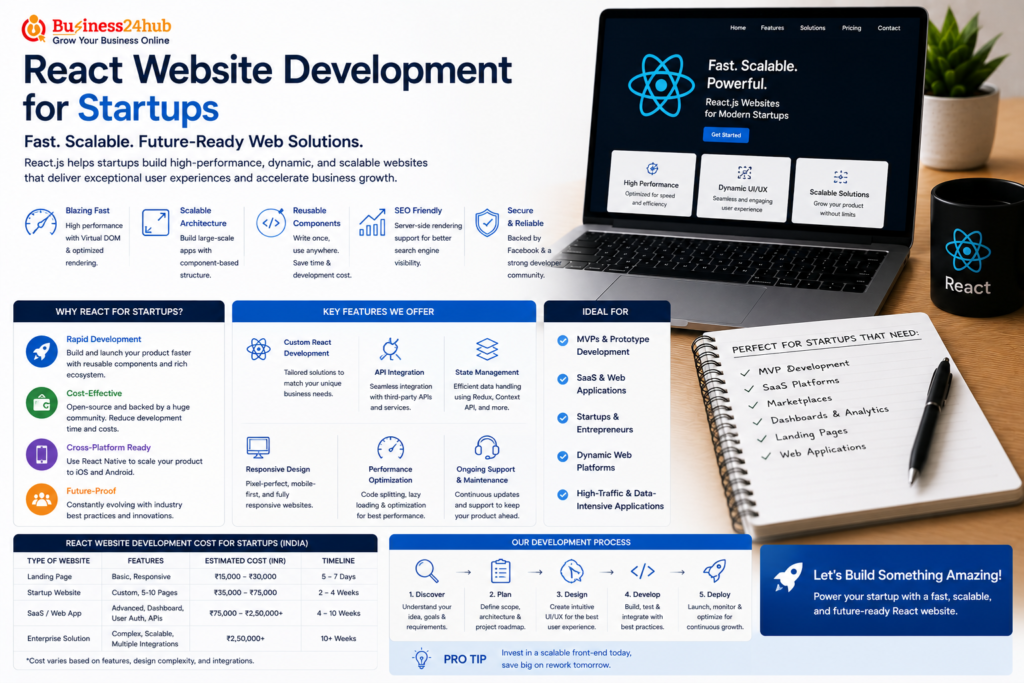
A basic React-based marketing or landing site, without complex interactivity, typically costs between eighty thousand and two lakh rupees when built by a freelancer or small development team, generally more expensive than an equivalent WordPress site due to the additional architectural setup involved even for relatively simple use cases.
For a more substantial React application with genuine interactive functionality, such as user dashboards or real-time features, costs typically range from three to eight lakh rupees for an initial, reasonably complete build, depending on specific feature complexity. More sophisticated, fully custom applications with extensive functionality and integrations can range well beyond ten lakh rupees, particularly when built by an experienced development agency rather than a smaller freelance team.
Ongoing costs include hosting, which varies depending on your specific infrastructure choices and traffic volume, plus ongoing developer time for maintenance, updates, and new feature development, which represents a more significant recurring cost than the relatively minimal ongoing technical involvement many traditional platforms require.
Common Mistakes Startups Make With React Development
Choosing React primarily because it feels more modern or technically impressive, without an actual product need for its interactivity, frequently results in unnecessarily high development costs and timelines for what could have been a simpler, faster, and cheaper traditional website build.
Neglecting SEO considerations from the start, then attempting to retrofit server-side rendering or proper meta tag management after significant development has already occurred, often proves considerably more difficult and costly than addressing these requirements from the initial architecture planning stage.
Underestimating ongoing development and maintenance needs, assuming the website will require minimal attention after launch the way a simpler platform might, frequently leads to budget and timeline surprises once the genuine ongoing technical involvement React applications typically require becomes apparent.
Skipping performance optimization under the assumption that React is inherently fast regardless of implementation quality often results in a sluggish, poorly performing application despite using a technology genuinely capable of excellent performance when properly built.
Building without a clear component and design system strategy from the start often leads to inconsistent, harder-to-maintain code as the application grows, compared to the efficiency gains a properly planned component library provides over time.
React Combined With Traditional Platforms: The Hybrid Approach
Increasingly, startups don’t have to choose entirely between React and a traditional platform. A growing number use what’s called a headless approach, where a traditional content management system like WordPress manages content in the backend, while a React-based frontend handles the actual user-facing experience and interactivity, combining the content management strengths of one approach with the performance and interactivity advantages of the other.
This hybrid approach requires more development expertise than either pure option alone, but it’s becoming an increasingly popular middle ground for startups wanting genuine content management flexibility without sacrificing the highly interactive, app-like frontend experience React enables, particularly relevant for content-driven startups whose product also requires meaningful interactive functionality beyond what a traditional platform handles well on its own.
A Quick Decision Framework
Ask yourself a few direct questions before committing. Does your product require genuinely dynamic, app-like interactivity, such as real-time updates or complex user dashboards, or is it primarily informational content? Interactivity needs lean toward React; informational content often doesn’t require it. Do you have reliable access to skilled development resources for both initial build and ongoing maintenance? Without this, React’s ongoing requirements may prove challenging to sustain. Is your product direction confirmed and validated, or are you still testing early demand? Earlier-stage validation often favors faster, cheaper alternatives before committing to React’s typically higher upfront investment.
If your answers point toward genuine interactive product needs, available development resources, and a confirmed product direction, React is likely a strong, justified choice. If they point toward primarily informational content, limited ongoing development resources, or early-stage validation needs, a simpler platform may serve you better, at least for now.
Frequently Asked Questions
1. Why is React Website Development a smart choice for startups in 2026?
React Website Development is ideal for startups that need fast, interactive, and scalable web applications. React offers excellent performance, reusable components, and a modern user experience, making it perfect for growing businesses.
2. What are the benefits of React Website Development over traditional websites?
React Website Development provides faster page rendering, smooth navigation, improved user experience, reusable code components, and easier maintenance compared to many traditional website development approaches.
3. Is React Website Development good for SEO?
Yes. React Website Development can be highly SEO-friendly when implemented with technologies like server-side rendering (SSR), static site generation (SSG), or frameworks such as Next.js, helping websites rank well in search engines.
4. How much does React Website Development cost for startups?
The cost of React Website Development depends on project complexity, custom UI/UX design, API integrations, backend requirements, and advanced features. A simple website costs less than a feature-rich web application.
5. Can React Website Development handle future business growth?
Absolutely. React Website Development is built for scalability, allowing startups to add new features, dashboards, user portals, payment systems, and integrations without rebuilding the entire application.
6. Is React Website Development suitable for SaaS and startup platforms?
Yes. React Website Development is widely used for SaaS products, startup platforms, customer dashboards, marketplaces, and enterprise web applications because of its flexibility and high performance.
7. How long does React Website Development take?
A basic React Website Development project may take 2–4 weeks, while more advanced applications with custom functionality, backend integration, and authentication can take several months depending on the scope.
8. Why should startups hire experts for React Website Development?
Professional React Website Development ensures clean architecture, optimized performance, secure coding practices, seamless API integration, responsive design, and long-term maintainability, helping startups launch reliable and high-performing web applications.
Conclusion
React genuinely does beat traditional website development for a specific, important category of startup needs — products requiring real interactivity, complex user dashboards, or smooth, app-like user experiences that traditional content management systems simply weren’t built to handle well. But for startups whose actual needs are primarily informational or content-driven, that same power often introduces unnecessary cost and complexity rather than genuine advantage.
The startups that get real value from React in 2026 aren’t choosing it because it’s currently popular or technically impressive sounding. They’re choosing it because their actual product genuinely requires the kind of interactivity React excels at, they have the development resources to support it properly, and they’ve validated enough about their direction to justify the more substantial investment React development typically requires compared to faster, simpler alternatives.
Need Website for Your Business?
🟡Business24Hub provides complete IT, web development, software development, digital marketing, branding, SEO, mobile app development, and business consulting services to startups, entrepreneurs, SMEs, and enterprises across India.
🟡For other Legal and Trademark related services Visit
👉 Money Recovery Cases
👉 Property Disputes
👉 Business & Licence Registrations
🟡 Protect Your Rights
👉 Domestic Violence Legal Support
👉 Stridhan Recovery
👉 Mutual Consent Divorce
👉 Contested Divorce Filing
👉 Child Custody and Maintenance
👉 Matrimonial Property Settlement
👉 NRI Divorce Services
👉 Alimony and Maintenance
📞 Call Now: +91 8595439395
🕐 Free Consultation: Monday to Saturday, 10 AM to 6 PM

I’m Aryan Yadav, passionate about SEO and Digital Marketing with a strong interest in helping businesses grow online. I enjoy learning new strategies, exploring digital trends, and creating ideas that deliver value. I believe in continuous growth, creativity, and building meaningful results through smart work and dedication.

