

Views: 0
A detailed React vs WordPress cost breakdown for 2026, comparing upfront development, hosting, maintenance, and hidden long-term expenses to help startups budget accurately.
Table of Contents
- 1 Introduction
- 2 Why a Simple “Which Is Cheaper” Answer Is Misleading
- 3 Category One: Initial Development Cost
- 4 Category Two: Design and Theme Costs
- 5 Category Three: Hosting and Infrastructure Costs
- 6 Category Four: Plugin, License, and Third-Party Tool Costs
- 7 Category Five: Content Management and Update Costs
- 8 Category Six: Security and Maintenance Costs
- 9 Category Seven: Scaling and Feature Addition Costs
- 10 Total Cost of Ownership: A Realistic Year-One Comparison
- 11 Where WordPress Wins on Cost
- 12 Where React Wins on Cost
- 13 A Practical Cost Scenario: Two Startups, Two Outcomes
- 14 Common Cost-Related Mistakes Startups Make
- 15 A Quick Decision Framework Based on Cost
- 16 Frequently Asked Questions
- 17 Conclusion
- 18 Need Website for Your Business?
Introduction
When founders ask whether to build on React or WordPress, the question underneath is almost always about money: which one actually costs less, both today and a year from now? The honest answer is that it depends on which cost categories you’re measuring, because React and WordPress front-load and distribute expenses very differently across the life of a website.
This guide breaks the React vs WordPress cost question into every meaningful expense category, from initial development through ongoing maintenance, so you can budget based on real numbers rather than a vague sense that “WordPress is cheaper” or “React scales better.” Both statements are true in certain contexts and misleading in others, and the difference matters a great deal for a startup deciding where to spend limited capital.
Why a Simple “Which Is Cheaper” Answer Is Misleading
Comparing React vs WordPress cost purely on initial build price tells an incomplete story. WordPress typically costs less upfront because it arrives with most functionality already built, while React typically costs more upfront because nearly everything, from content management to routing, needs to be built or integrated deliberately.
But upfront cost is only one part of the picture. Ongoing maintenance, the cost of making future changes, hosting requirements, and how each platform handles scaling traffic or features all carry their own separate cost implications that shift the total picture considerably once you look beyond the initial invoice.
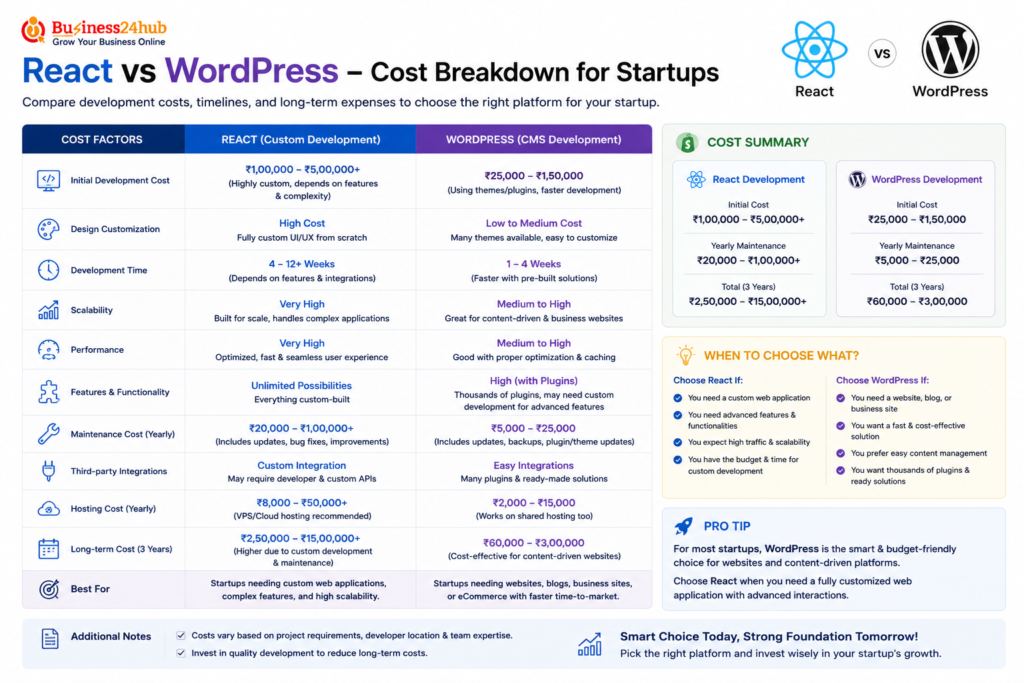
Category One: Initial Development Cost
For a basic five-to-ten-page business website, WordPress development using an existing premium theme with standard customization typically costs between forty thousand and one and a half lakh rupees through a freelancer, or one and a half lakh to three lakh rupees through an agency with more thorough design and SEO setup included.
The equivalent scope built in React, even without complex interactivity, typically costs between eighty thousand and two and a half lakh rupees, since a developer needs to build page routing, basic content structures, and styling largely from scratch, or integrate a separate content management system, rather than starting from an existing, ready-made foundation the way WordPress themes provide.
For more complex, interactive functionality, such as a user dashboard or real-time features, WordPress generally requires significant custom plugin development or workarounds that push costs into the two to five lakh rupee range and often produce a less elegant result than purpose-built code. The equivalent React application, while typically starting from a higher baseline of three to eight lakh rupees, handles this kind of interactivity far more naturally, meaning the cost gap narrows considerably, and React can become the more cost-effective choice once genuine interactivity is involved.
Category Two: Design and Theme Costs
WordPress design costs benefit from a mature theme marketplace, where premium themes typically range from two thousand to ten thousand rupees as a one-time purchase, providing a substantial design foundation that then needs customization to match specific branding, usually adding another fifteen thousand to fifty thousand rupees in design and implementation work depending on how extensive the customization is.
React doesn’t have an equivalent theme marketplace in the same sense, since most React websites are designed and built custom from the ground up, or use a component library as a starting foundation. This typically means design costs for a comparable level of polish run from thirty thousand to over one lakh rupees, reflecting the more bespoke nature of React-based design work compared to customizing an existing WordPress theme.
Category Three: Hosting and Infrastructure Costs
WordPress hosting is widely available and competitively priced, with basic shared hosting starting around a few hundred rupees monthly, and quality managed WordPress hosting, recommended for any business-critical site, typically ranging from one to five thousand rupees monthly depending on traffic and performance needs.
React applications often require different hosting infrastructure, particularly if using server-side rendering, which can range from similar costs to WordPress hosting for smaller projects, up to significantly higher costs for applications with substantial server-side processing needs or high traffic volumes. Static React sites without server-side rendering can actually be hosted very cheaply, sometimes even free on certain platforms for smaller projects, making hosting cost comparison genuinely dependent on your specific React architecture choice rather than a fixed, predictable difference.
Category Four: Plugin, License, and Third-Party Tool Costs
WordPress’s reliance on plugins for extended functionality means ongoing licensing costs for premium plugins, which can add up meaningfully depending on how many advanced features your site needs. A typical business website might spend three thousand to fifteen thousand rupees annually across a handful of premium plugins covering SEO, security, forms, and performance optimization.
React applications instead typically rely on open-source libraries, most of which are free, though more complex applications may require paid third-party services for specific functionality like authentication, payment processing, or content management systems, often costing anywhere from free to several thousand rupees monthly depending on usage volume and the specific services integrated.
Category Five: Content Management and Update Costs
This is one of the most significant, frequently underestimated differences in the React vs WordPress cost comparison. WordPress’s visual editing interface allows non-technical team members to update content, publish blog posts, and make minor design adjustments without paying for developer time for every small change, representing substantial ongoing savings over a website’s lifetime.
React websites, unless specifically paired with a separate content management system, typically require developer involvement for most content updates, meaning every blog post, page change, or minor copy edit potentially carries an hourly developer cost, often two thousand to five thousand rupees per hour depending on the developer’s experience level. Over a year of regular content updates, this difference alone can represent a meaningful recurring cost gap between the two platforms, often tens of thousands of rupees depending on how frequently your site needs updates.
Category Six: Security and Maintenance Costs
WordPress requires consistent core, theme, and plugin updates to stay secure, given its popularity as a target for automated attacks. Many startups budget for either a maintenance retainer with a developer, typically three thousand to ten thousand rupees monthly, or invest the internal time to handle these updates regularly themselves.
React applications carry a different maintenance profile, with periodic dependency updates and security patches needed for the various libraries used, generally requiring similar or sometimes less frequent attention than WordPress’s plugin ecosystem, though when updates are needed, they may require more specialized developer expertise to implement correctly compared to WordPress’s typically more straightforward update process.
Category Seven: Scaling and Feature Addition Costs
As a startup grows and needs new features, the React vs WordPress cost comparison shifts again. Adding moderate new functionality to a WordPress site, such as a booking system or membership area, can often be achieved through existing plugins, typically costing five thousand to thirty thousand rupees for integration and customization, assuming a suitable plugin already exists for the specific need.
Adding equivalent functionality to a React application generally means custom development work, which costs more per feature, often thirty thousand to over one lakh rupees depending on complexity, but produces functionality built specifically for your exact requirements rather than adapted from a generic plugin. For startups anticipating many such custom features over time, React’s higher per-feature cost can actually become more cost-effective in aggregate, since you avoid the compounding inefficiency and potential conflicts of stacking many third-party WordPress plugins together.
Total Cost of Ownership: A Realistic Year-One Comparison
For a basic business website with moderate content updates and no complex interactive features, year-one total cost of ownership for WordPress, including development, hosting, plugins, and reasonable maintenance, typically lands between sixty-five thousand and two lakh rupees. The equivalent React site, given its higher development cost and ongoing developer-dependent content updates, typically lands between one and a half lakh and four lakh rupees for comparable scope and update frequency.
For a startup building a genuinely interactive product, such as a dashboard-driven SaaS application, year-one total cost of ownership for React typically ranges from four to ten lakh rupees, reflecting both the appropriate initial build complexity and ongoing feature development. Attempting the equivalent functionality through WordPress, while sometimes technically possible through extensive custom plugin development, often produces comparable or even higher costs due to the platform fighting against its own architecture, while delivering a less robust, harder-to-maintain result.
Where WordPress Wins on Cost
WordPress consistently wins on cost for primarily content-driven websites, situations requiring frequent content updates by non-technical team members, projects needing to launch quickly on a tight budget, and businesses without ongoing access to dedicated development resources for routine maintenance and updates.
Where React Wins on Cost
React tends to win on cost, despite higher upfront investment, for genuinely interactive products requiring complex, custom functionality that would otherwise require extensive, expensive WordPress plugin workarounds, situations anticipating significant feature growth and complexity over time, and products where performance and user experience quality directly and significantly affect business outcomes enough to justify the additional investment.
A Practical Cost Scenario: Two Startups, Two Outcomes
Consider two Indian startups launching around the same time. The first sells an online course platform with a primarily content-driven marketing website, blog, and simple course catalog. They choose WordPress, spending roughly one lakh rupees on initial development, and budget around eight thousand rupees monthly for hosting, plugins, and occasional content updates handled mostly in-house by a non-technical team member, keeping their first-year total cost around two lakh rupees.
The second startup builds a project management tool with real-time collaboration features, requiring genuine interactive dashboards and live updates. They choose React, spending roughly five lakh rupees on initial development given the complexity involved, and budget around twenty-five thousand rupees monthly for hosting and ongoing developer-led feature development, bringing their first-year total cost to roughly eight lakh rupees. For their specific product, attempting this functionality through WordPress would have likely cost similarly or more while producing a noticeably worse user experience, making React the genuinely more cost-effective choice despite its higher absolute number.
Common Cost-Related Mistakes Startups Make
Choosing React for a primarily content-driven website, then discovering ongoing content updates require expensive, recurring developer involvement that a WordPress site would have allowed non-technical staff to handle independently at no additional cost.
Choosing WordPress for a genuinely complex, interactive product, then spending heavily on custom plugin development and workarounds that ultimately approach or exceed what a properly architected React build would have cost from the start, while delivering a less reliable result.
Focusing only on initial development quotes without factoring in ongoing hosting, maintenance, and update costs, leading to budget surprises once the true first-year total cost of ownership becomes clear well after the initial decision has already been made.
Underestimating how frequently a website will need content updates or new features, leading to a platform choice that looked cost-effective based on initial assumptions but proves expensive once real, ongoing usage patterns emerge.
A Quick Decision Framework Based on Cost
If your website is primarily content-driven, needs frequent updates by non-technical staff, and you’re working with a tight initial budget, WordPress will almost always be the more cost-effective choice, both upfront and over time. If your product requires genuine, complex interactivity, anticipates significant ongoing feature development, and you have access to development resources to support it, React’s higher upfront cost often pays for itself by avoiding the compounding cost and limitations of forcing complex functionality onto a platform not designed for it.
Frequently Asked Questions
1. Which is more affordable in the React vs WordPress Cost Breakdown in 2026?
In the React vs WordPress Cost Breakdown, WordPress is generally more affordable for small business websites, blogs, and startup websites. React usually requires custom development, making it more expensive for complex projects.
2. Why is React often more expensive than WordPress?
According to the React vs WordPress Cost Breakdown, React projects involve custom frontend development, API integration, and skilled developers, whereas WordPress offers ready-made themes and plugins that reduce development time and costs.
3. What factors affect the React vs WordPress Cost Breakdown?
The React vs WordPress Cost Breakdown depends on website complexity, custom features, UI/UX design, hosting, third-party integrations, maintenance, and the experience of the development team.
4. Is WordPress better for startups with limited budgets?
Yes. In the React vs WordPress Cost Breakdown, WordPress is usually the better choice for startups with limited budgets because it offers lower development costs, faster deployment, and easier content management.
5. Is React worth the higher development cost?
Yes. The React vs WordPress Cost Breakdown shows that React is worth the investment for businesses needing highly interactive web applications, custom dashboards, SaaS platforms, or applications that require excellent performance and scalability.
6. Which has lower maintenance costs: React or WordPress?
The React vs WordPress Cost Breakdown varies based on the project. WordPress may require ongoing plugin, theme, and security updates, while React applications often need developer support for feature updates and maintenance.
7. Does hosting cost differ in the React vs WordPress Cost Breakdown?
Yes. In the React vs WordPress Cost Breakdown, WordPress can run on affordable shared hosting, whereas React applications may require VPS, cloud hosting, or dedicated infrastructure depending on the backend and traffic requirements.
8. Which platform offers better long-term value in the React vs WordPress Cost Breakdown?
The best option in the React vs WordPress Cost Breakdown depends on business goals. WordPress offers excellent value for content-driven websites and small businesses, while React provides better long-term value for scalable, feature-rich, and highly interactive web applications.
Conclusion
The React vs WordPress cost comparison doesn’t have a single universal winner — it depends entirely on what kind of website or product you’re actually building, and how that cost unfolds across initial development, ongoing maintenance, and future scaling. WordPress consistently offers lower total cost for content-driven websites needing frequent, non-technical updates, while React can become genuinely more cost-effective for complex, interactive products despite its higher upfront price tag.
The startups that budget most accurately aren’t the ones chasing the platform with the lowest headline development cost. They’re the ones honestly evaluating their actual content and interactivity needs, then calculating realistic total cost of ownership across the full first year and beyond, rather than making a decision based on initial development price alone.
Need Website for Your Business?
🟡Business24Hub provides complete IT, web development, software development, digital marketing, branding, SEO, mobile app development, and business consulting services to startups, entrepreneurs, SMEs, and enterprises across India.
🟡For other Legal and Trademark related services Visit
👉 Money Recovery Cases
👉 Property Disputes
👉 Business & Licence Registrations
🟡 Protect Your Rights
👉 Domestic Violence Legal Support
👉 Stridhan Recovery
👉 Mutual Consent Divorce
👉 Contested Divorce Filing
👉 Child Custody and Maintenance
👉 Matrimonial Property Settlement
👉 NRI Divorce Services
👉 Alimony and Maintenance
📞 Call Now: +91 8595439395
🕐 Free Consultation: Monday to Saturday, 10 AM to 6 PM

I’m Aryan Yadav, passionate about SEO and Digital Marketing with a strong interest in helping businesses grow online. I enjoy learning new strategies, exploring digital trends, and creating ideas that deliver value. I believe in continuous growth, creativity, and building meaningful results through smart work and dedication.

