

Views: 0
A complete payment gateway integration guide for businesses in 2026. Learn how to choose, integrate, and secure payment gateways for smooth, high-converting transactions.
Table of Contents
- 1 Introduction
- 2 What Is a Payment Gateway?
- 3 Why Payment Gateway Integration Matters
- 4 Types of Payment Gateways
- 5 Popular Payment Gateways for Businesses in India
- 6 Key Factors to Consider Before Choosing a Payment Gateway
- 7 Step-by-Step Payment Gateway Integration Process
- 8 Security Best Practices for Payment Gateway Integration
- 9 Common Mistakes to Avoid During Integration
- 10 The Role of Payment Gateways in Reducing Cart Abandonment
- 11 Payment Gateway Integration for Different Business Models
- 12 Future Trends in Payment Gateway Technology
- 13 FAQ’s
- 14 Conclusion
- 15 Contact our Experts
Introduction
For any online business, the moment a customer clicks “Buy Now” is the most critical point in the entire sales journey. Everything leading up to that click — the marketing, the product pages, the trust-building — culminates in a single transaction. If the payment process is slow, confusing, or fails to work properly, all that effort goes to waste. This is why payment gateway integration is not just a technical checkbox but one of the most important decisions an online business will make.
A payment gateway acts as the digital equivalent of a point-of-sale terminal, securely transmitting payment information between your customer, your website, your bank, and the customer’s bank. Choosing the right gateway and integrating it correctly can mean the difference between a smooth checkout experience that converts visitors into paying customers, and a frustrating process that drives them straight to your competitor.
In this comprehensive guide, we’ll walk through everything you need to know about payment gateway integration — from understanding how gateways work, to choosing the right provider, to the technical integration process, security considerations, and common mistakes to avoid. Whether you’re building an e-commerce store, a SaaS platform, or a service-based business website, this guide will help you navigate the process with confidence.
What Is a Payment Gateway?
A payment gateway is a technology that authorizes and processes payments for online and offline businesses. It acts as a bridge between your website or app and the financial institutions involved in a transaction — the customer’s bank (issuing bank), your business’s bank (acquiring bank), and card networks like Visa, Mastercard, or RuPay.
When a customer enters their card details or chooses a payment method at checkout, the payment gateway encrypts this sensitive information and securely transmits it to the payment processor, which then communicates with the relevant banks to approve or decline the transaction. This entire process typically happens within a few seconds, creating a seamless experience for the customer despite the complex behind-the-scenes communication.
How Payment Gateways Differ from Payment Processors
Many people use these terms interchangeably, but there’s a technical distinction worth understanding:
- Payment Gateway – The technology layer that captures and encrypts payment data at the point of sale.
- Payment Processor – The company that actually moves the money between banks and settles transactions.
Many modern providers, such as Razorpay, Stripe, and PayU, offer both gateway and processing services combined, simplifying integration for businesses that don’t want to manage multiple vendor relationships.
Why Payment Gateway Integration Matters
Before diving into the technical process, it’s worth understanding the business impact of getting this right:
- Conversion Rates – A smooth, fast checkout process directly impacts how many visitors complete their purchase instead of abandoning their cart.
- Customer Trust – Recognizable, secure payment options reassure customers that their financial data is safe.
- Global Reach – The right gateway allows you to accept international payments, opening doors to global customers.
- Reduced Cart Abandonment – Studies consistently show that complicated or limited payment options are a leading cause of abandoned carts.
- Regulatory Compliance – Proper integration ensures you meet legal and financial compliance standards, avoiding penalties and account suspensions.
Types of Payment Gateways
Understanding the different types of payment gateways available helps you choose the right fit for your business model.
Hosted Payment Gateways
With hosted gateways, customers are redirected to the payment provider’s own secure page to complete their transaction before being redirected back to your website.
- Easier and faster to integrate since you don’t handle sensitive card data directly.
- Reduces your PCI DSS compliance burden significantly.
- Slightly less control over the checkout experience and branding.
Self-Hosted Payment Gateways
In this model, customers enter their payment details directly on your website, but the actual data transmission happens through the gateway’s secure servers.
- Offers a more seamless, branded checkout experience.
- Requires stricter PCI DSS compliance since card data passes through your site.
- Provides greater control over the user interface and customer journey.
API-Based (Direct) Payment Gateways
This approach involves integrating the gateway’s API directly into your website or app, giving you full control over the payment flow.
- Offers maximum customization and flexibility for developers.
- Requires more technical expertise and stronger security implementation.
- Best suited for businesses with dedicated development resources.
Local Bank Integration Gateways
Some businesses, especially larger enterprises, integrate directly with their bank’s payment infrastructure rather than using a third-party gateway.
- Often results in lower transaction fees for high-volume businesses.
- Requires more complex setup and negotiation directly with banking partners.
- Less common for small and medium-sized businesses due to complexity.
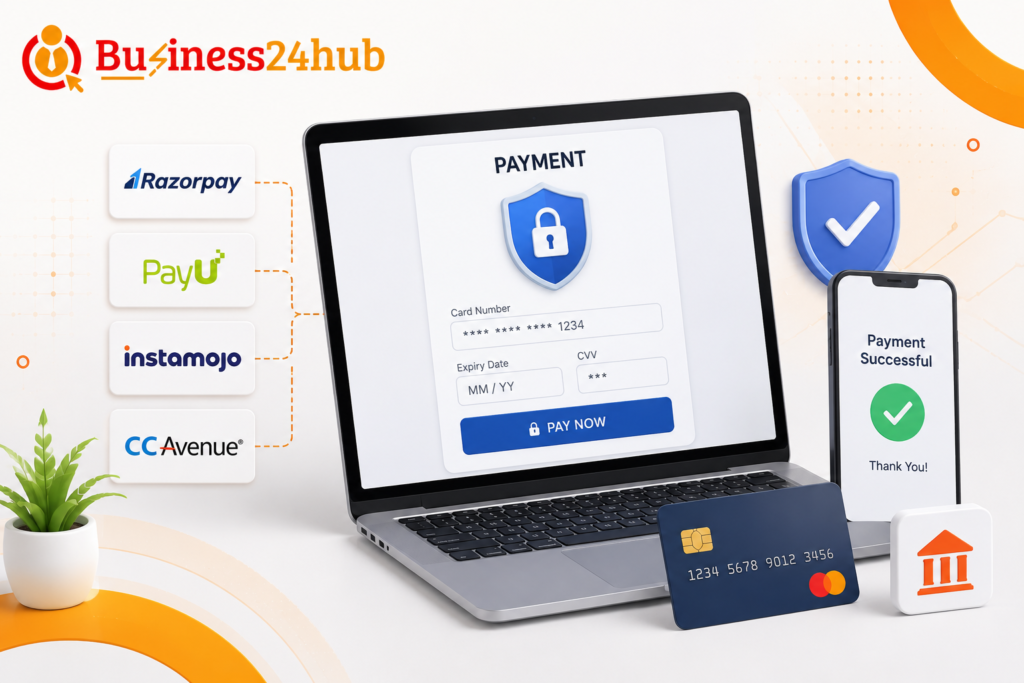
Popular Payment Gateways for Businesses in India
India’s digital payment ecosystem has grown rapidly, offering businesses several reliable options to choose from.
Razorpay
One of India’s most popular payment gateways, especially favored by startups and growing businesses.
- Supports UPI, credit/debit cards, net banking, and popular wallets.
- Offers easy integration with detailed developer documentation and SDKs.
- Provides additional business tools like payment links, invoicing, and subscription billing.
PayU
A widely used gateway known for its flexibility and strong presence across Indian and global markets.
- Supports a broad range of payment methods including EMI options.
- Offers robust fraud detection and risk management tools.
- Suitable for both small businesses and large enterprises.
CCAvenue
One of the older and most established payment gateways in India, known for supporting an extensive range of payment options.
- Supports over 200 payment options including international cards.
- Well-suited for businesses needing extensive currency support.
- Interface and integration process can feel slightly outdated compared to newer competitors.
Stripe
While globally dominant, Stripe has also expanded its presence in India for businesses with international customers.
- Exceptional developer documentation and API flexibility.
- Strong support for subscription billing and SaaS business models.
- Ideal for businesses planning to scale internationally.
PayPal
A globally recognized payment option that adds credibility for international customers, particularly for freelancers and export-oriented businesses.
- Widely trusted by international customers, especially in the US and Europe.
- Simple integration process with plugins available for most platforms.
- Transaction fees can be higher compared to some regional alternatives.
Paytm Payment Gateway
Leveraging its strong brand recognition in India, Paytm’s gateway is a popular choice for businesses targeting Indian consumers.
- Deep integration with the Paytm wallet ecosystem, popular among Indian users.
- Supports UPI, cards, net banking, and EMI options.
- Competitive pricing structure for domestic transactions.
Key Factors to Consider Before Choosing a Payment Gateway
Selecting the right payment gateway requires evaluating several important factors specific to your business needs.
1. Transaction Fees
Different gateways charge varying percentages per transaction, along with potential setup fees, monthly fees, or withdrawal charges. Compare these costs carefully against your expected transaction volume.
2. Supported Payment Methods
Ensure the gateway supports the payment methods your target audience prefers, whether that’s UPI, credit cards, digital wallets, or international payment options.
3. Settlement Time
Check how quickly funds are transferred to your bank account after a successful transaction. Some gateways offer same-day settlement, while others take several business days.
4. Security and Compliance
Verify that the gateway is PCI DSS compliant and offers robust fraud protection features like 3D Secure authentication and AI-based fraud detection.
5. Integration Complexity
Consider your technical resources and choose a gateway with documentation and SDKs that match your development team’s capabilities.
6. Customer Support
Reliable customer support becomes crucial when payment issues arise, as delays can directly impact your revenue and customer satisfaction.
7. International Payment Support
If you plan to sell to customers outside your home country, ensure the gateway supports multi-currency transactions and international card networks.
Step-by-Step Payment Gateway Integration Process
Now let’s walk through the general process of integrating a payment gateway into your website or application.
Step 1: Register and Complete KYC Verification
Most payment gateways require businesses to complete a Know Your Customer (KYC) verification process, submitting documents like business registration proof, bank account details, and identity verification documents.
Step 2: Choose Between Test and Live Modes
Reputable payment gateways provide a sandbox or test environment, allowing developers to simulate transactions without processing real money. Always thoroughly test your integration here before going live.
Step 3: Obtain API Keys and Credentials
Once your account is set up, the gateway provides API keys (usually a public key and a secret key) needed to authenticate requests between your website and their servers.
Step 4: Choose Your Integration Method
Depending on your technical setup, you can integrate through:
- Ready-made plugins for platforms like WooCommerce, Shopify, or Magento.
- SDKs provided for various programming languages.
- Direct REST API integration for custom-built websites or applications.
Step 5: Implement the Checkout Flow
Design and build the checkout experience, ensuring it captures necessary customer and order information before initiating the payment request through the gateway’s API.
Step 6: Handle Webhooks and Callbacks
Payment gateways typically send webhook notifications to confirm transaction status (success, failure, or pending). Your backend system needs to listen for these events and update order statuses accordingly.
Step 7: Test Thoroughly Across Scenarios
Before going live, test various scenarios including successful payments, failed transactions, timeouts, and refund processes to ensure your system handles each case gracefully.
Step 8: Go Live and Monitor Performance
Once testing is complete, switch to live mode and closely monitor initial transactions for any unexpected issues. Set up alerts for failed payments or technical errors.
Security Best Practices for Payment Gateway Integration
Security should be at the forefront of any payment integration project, given the sensitive nature of financial data involved.
- Never store raw card details on your own servers unless absolutely necessary and fully PCI DSS compliant.
- Use tokenization wherever possible, replacing sensitive card data with secure tokens for recurring transactions.
- Implement 3D Secure authentication to add an extra layer of verification for card payments, reducing fraud risk.
- Encrypt all data transmissions using HTTPS and TLS protocols throughout the checkout process.
- Regularly update your integration to align with the latest API versions and security patches released by your gateway provider.
- Monitor for suspicious activity using the fraud detection tools most gateways provide as part of their service.
Common Mistakes to Avoid During Integration
Even experienced development teams can run into pitfalls during payment gateway integration. Being aware of these common mistakes can save significant time and prevent costly errors.
- Skipping Thorough Testing – Rushing to go live without testing edge cases like failed payments or network timeouts can lead to poor customer experiences.
- Ignoring Mobile Optimization – With a significant portion of transactions happening on mobile devices, ensure your checkout flow is fully responsive.
- Overcomplicating the Checkout Process – Adding too many steps or requiring unnecessary information increases cart abandonment rates.
- Neglecting Webhook Reliability – Failing to properly handle webhook failures can result in orders being marked incorrectly, causing fulfillment issues.
- Not Planning for Refunds and Disputes – Ensure your integration includes a smooth process for handling refunds, chargebacks, and disputed transactions.
- Overlooking Currency and Localization – If targeting international customers, ensure proper currency conversion and localized payment method support.
The Role of Payment Gateways in Reducing Cart Abandonment
Cart abandonment remains one of the biggest challenges for online businesses, and payment friction is a major contributing factor. A well-integrated payment gateway can directly address this issue by:
- Offering multiple payment options that cater to diverse customer preferences.
- Reducing the number of redirects and steps required to complete a purchase.
- Displaying trust signals like security badges and recognizable payment logos.
- Providing fast, reliable transaction processing without unnecessary delays.
- Supporting saved payment methods for returning customers, speeding up repeat purchases.
Payment Gateway Integration for Different Business Models
Different types of businesses have unique payment integration needs worth considering.
E-Commerce Stores
Need support for one-time payments, multiple payment methods, and often integration with inventory and order management systems.
SaaS and Subscription Businesses
Require robust support for recurring billing, automatic retries for failed payments, and easy subscription management for customers.
Service-Based Businesses
Often benefit from payment links or invoicing features that allow customers to pay without needing a full e-commerce checkout system.
Marketplaces
Need more complex integrations supporting split payments, where funds are distributed between the marketplace and multiple sellers automatically.
Future Trends in Payment Gateway Technology
The payment gateway landscape continues to evolve, shaped by changing consumer preferences and technological advancements.
- Increased UPI Adoption – In markets like India, UPI-based payments continue to dominate due to their speed and zero transaction fees for consumers.
- Buy Now, Pay Later (BNPL) Integration – More gateways are incorporating BNPL options, appealing to younger consumers seeking flexible payment terms.
- AI-Driven Fraud Detection – Machine learning models are becoming increasingly sophisticated at identifying and preventing fraudulent transactions in real time.
- One-Click Checkout Experiences – Streamlined, saved-payment checkout flows continue to reduce friction and improve conversion rates.
- Cryptocurrency Payment Options – While still niche, some businesses are beginning to explore crypto payment gateway integrations for specific customer segments.
FAQ’s
1. What is payment gateway integration?
Payment gateway integration is the process of connecting a website or mobile application with a secure payment gateway to accept online payments through credit cards, debit cards, UPI, net banking, wallets, and other digital payment methods.
2. Why is payment gateway integration important for businesses in India?
Payment gateway integration enables businesses to accept secure online payments, improve the customer checkout experience, reduce payment failures, increase conversion rates, and support multiple payment options for customers across India.
3. What are the steps involved in payment gateway integration?
The payment gateway integration process typically includes selecting a payment gateway provider, creating a merchant account, completing KYC verification, obtaining API credentials, integrating the payment gateway with the website or app, testing transactions, and going live.
4. What documents are required for payment gateway integration in India?
The documents commonly required for payment gateway integration include business registration proof, PAN card, GST registration (if applicable), bank account details, identity and address proof of the business owner, and the business website or application details.
5. How long does payment gateway integration take?
The timeline for payment gateway integration depends on the provider, completion of KYC verification, and the complexity of the website or application. Basic integrations can often be completed within a few days, while custom implementations may take longer.
6. Is payment gateway integration secure?
Yes. A properly implemented payment gateway integration uses encryption, SSL/TLS certificates, secure APIs, fraud detection mechanisms, and PCI DSS compliance measures to protect customer payment information and reduce security risks.
7. How do I choose the right payment gateway for my business?
When selecting a payment gateway, consider transaction fees, supported payment methods, settlement time, security features, API documentation, ease of integration, customer support, and compatibility with your website or e-commerce platform.
Conclusion
Payment gateway integration is far more than a technical formality — it’s a critical component of your overall customer experience and business success. From choosing the right provider based on your specific business needs, to ensuring a secure, well-tested integration process, every decision along the way impacts how smoothly your customers can complete their purchases.
As digital payments continue to evolve with new technologies and changing consumer expectations, staying informed about best practices and emerging trends will help your business remain competitive. Whether you’re launching a new e-commerce store or upgrading your existing payment infrastructure, investing time in proper research, testing, and security implementation will pay dividends in customer trust, conversion rates, and long-term business growth.
Take the time to evaluate your options carefully, test thoroughly before going live, and prioritize security throughout the process. A well-integrated payment gateway isn’t just a technical achievement — it’s a foundational piece of a trustworthy, high-converting online business.
Contact our Experts
🟡Business24Hub provides complete IT, web development, software development, digital marketing, branding, SEO, mobile app development, and business consulting services to startups, entrepreneurs, SMEs, and enterprises across India.
🟡For other Legal and Trademark related services Visit
👉 Money Recovery Cases
👉 Property Disputes
👉 Business & Licence Registrations
🟡 Protect Your Rights
👉 Domestic Violence Legal Support
👉 Stridhan Recovery
👉 Mutual Consent Divorce
👉 Contested Divorce Filing
👉 Child Custody and Maintenance
👉 Matrimonial Property Settlement
👉 NRI Divorce Services
👉 Alimony and Maintenance
📞 Call Now: +91 8595439395
🕐 Free Consultation: Monday to Saturday, 10 AM to 6 PM

I’m Aryan Yadav, passionate about SEO and Digital Marketing with a strong interest in helping businesses grow online. I enjoy learning new strategies, exploring digital trends, and creating ideas that deliver value. I believe in continuous growth, creativity, and building meaningful results through smart work and dedication.

