

Views: 0
Discover the most effective lead magnet ideas for Indian startups in 2026, with a step-by-step framework for creating, promoting, and optimizing lead magnets that actually convert.
Table of Contents
- 1 Introduction
- 2 Why Lead Magnets Matter More Than Ever in 2026
- 3 The Core Principles of an Effective Lead Magnet
- 4 Lead Magnet Ideas for Different Indian Startup Categories
- 5 Platform-Specific Lead Magnet Delivery for India
- 6 Creating a Lead Magnet That Actually Converts
- 7 Promoting Your Lead Magnet Effectively
- 8 A/B Testing Your Lead Magnet Offer
- 9 Measuring Lead Magnet Performance
- 10 Common Lead Magnet Mistakes Indian Startups Make
- 11 Frequently Asked Questions
- 12 Conclusion
- 13 Contact our SEO and Marketing Experts
Introduction
Getting traffic to your website is one challenge. Converting that traffic into people who’ve willingly shared their contact details and expressed genuine interest in what you offer is an entirely different, and far more valuable, challenge. This is exactly the problem a well-crafted lead magnet solves.
A lead magnet is a free resource or offer given to a potential customer in exchange for their contact information, typically their email address. Done correctly, it transforms anonymous website visitors into identifiable prospects your startup can nurture toward becoming paying customers. Done poorly, it produces a list of unengaged email addresses from people who were never genuinely interested in your product to begin with.
For Indian startups specifically, lead magnets need to account for a uniquely diverse audience with varying levels of digital sophistication, different platform preferences, and in many cases, a healthy skepticism about handing over contact details without a compelling, clearly relevant reason to do so. This guide covers the most effective lead magnet formats for different Indian startup contexts, and walks through exactly how to build, deploy, and optimize them for genuine results in 2026.
Why Lead Magnets Matter More Than Ever in 2026
Organic reach on social media continues to decline, paid acquisition costs are rising across most Indian digital channels, and inbox competition for consumer attention is fiercer than it’s ever been. In this environment, building a permission-based email list of genuinely interested prospects represents one of the few marketing assets a startup fully owns and controls, independent of algorithm changes or platform policy shifts that can dramatically affect paid and organic channels overnight.
A strong lead magnet is often the primary mechanism through which that list grows. Without it, most visitors leave a website without any lasting connection to the brand, representing traffic that cost either time or money to acquire but produced no lasting marketing asset from the interaction.
The Core Principles of an Effective Lead Magnet
Before exploring specific formats, understanding what makes any lead magnet genuinely effective, regardless of format, helps avoid the common mistake of creating something that technically qualifies as a lead magnet but doesn’t actually convert visitors into subscribers at a meaningful rate.
The most effective lead magnets are highly specific rather than broadly general, addressing a very particular problem or need rather than offering something vaguely useful to a wide audience. They deliver immediate, tangible value rather than promising eventual value, meaning a visitor should be able to use or benefit from the resource essentially right away after downloading or accessing it. They’re closely relevant to the specific product or service being sold, attracting the kind of subscriber who is genuinely likely to become a customer eventually, rather than simply attracting anyone willing to exchange an email address for any free resource regardless of fit.
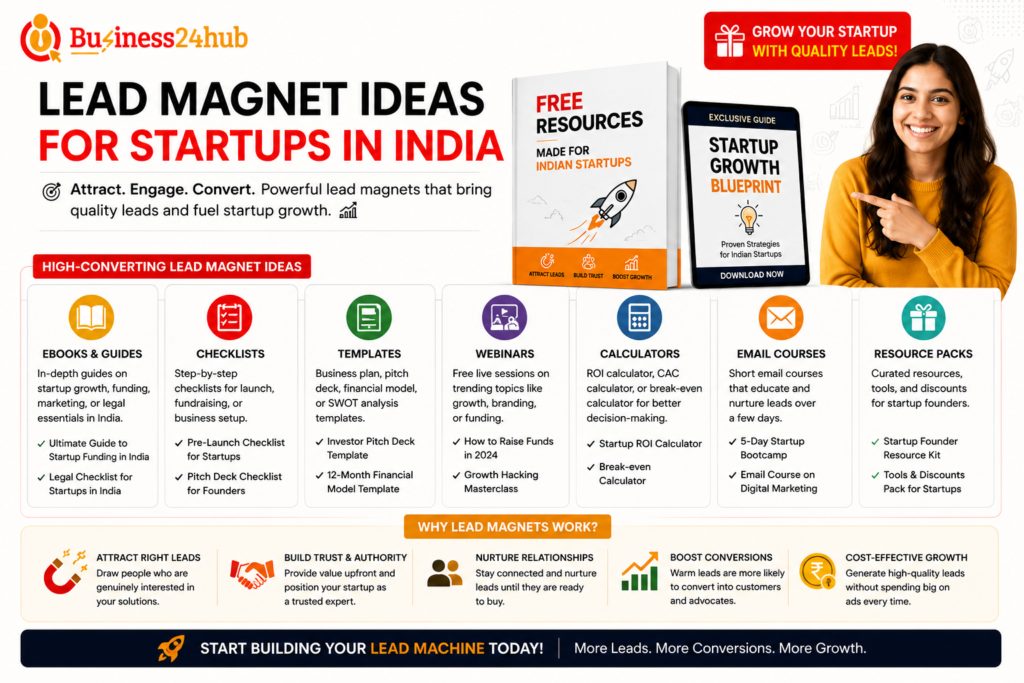
Lead Magnet Ideas for Different Indian Startup Categories
For SaaS and Technology Startups
Free trial or freemium access remains one of the most effective lead magnets for SaaS products, since it lets potential customers experience genuine product value before purchasing rather than simply reading about it. The key is ensuring the free experience is meaningful enough to demonstrate real value without giving away so much that the paid version feels unnecessary.
A detailed checklist or framework addressing a specific problem your software solves works well for SaaS startups whose target customers are actively searching for guidance on a topic related to the product category. A startup selling accounting software might offer a GST filing checklist, attracting exactly the kind of business owner who would benefit from their product while providing immediate, standalone value.
A comparison guide or buyer’s guide, helping potential customers navigate the process of choosing a solution in your category, positions your startup as a trustworthy, knowledgeable resource while naturally introducing your own product as a relevant option within that category.
For E-Commerce and Product Startups
Discount offers and first-purchase vouchers are among the most consistently effective lead magnets for e-commerce startups, since they create immediate, tangible incentive closely tied to an actual purchase decision rather than a more abstract future benefit. A ten to twenty percent first-purchase discount in exchange for an email address simultaneously builds the list and nudges a potentially interested visitor closer to their first conversion.
A product guide or educational resource addressing a relevant consumer question works well when the purchase decision involves meaningful consideration, such as a skincare startup offering a free skin type assessment and personalized product recommendation guide, or a fitness equipment brand offering a home workout program directly relevant to the products they sell.
An exclusive access offer, such as early access to new products, waitlist priority, or members-only pricing, leverages scarcity and exclusivity to drive sign-ups, particularly effective for startups with engaged early-adopter audiences who respond well to feeling like insiders.
For Service-Based and Consulting Startups
A free audit or assessment is one of the highest-converting lead magnets for service-based startups, since it delivers personalized, immediately useful feedback while naturally demonstrating the service provider’s expertise and giving them a concrete opening to follow up with a relevant proposal or consultation offer. A digital marketing agency might offer a free website SEO audit, a financial advisory startup might offer a free investment health check, and a legal startup might offer a free business compliance assessment.
A detailed template or tool relevant to your service area works well for service businesses whose clients regularly face specific, time-consuming tasks your service helps address. A human resources startup might offer a free employee onboarding checklist, while a contracts and legal startup might offer customizable agreement templates covering common business scenarios.
A case study or results report documenting specific, measurable outcomes you’ve achieved for clients serves a dual purpose as a lead magnet, simultaneously building credibility and generating qualified leads, since only prospects genuinely interested in achieving similar results will typically bother downloading industry-specific case study content.
For EdTech and Training Startups
A free sample lesson, module, or mini-course is the natural lead magnet for educational products, giving potential students a direct experience of teaching quality and learning format before committing to a full paid enrollment. This works particularly well when the free sample is genuinely representative of the full course’s quality rather than a deliberately simplified preview designed primarily as a sales pitch.
A skills assessment or readiness quiz, helping potential students identify exactly which skills they need to develop and how your course or program addresses those specific gaps, combines personalization with lead capture effectively, particularly for courses where self-selection and accurate expectation-setting matters for long-term student satisfaction and completion rates.
A free resource library, collecting genuinely useful tools, templates, and reference materials relevant to your subject area, works well for edtech startups serving professionals who appreciate consolidated, organized resources related to their field or learning goals.
For FinTech and Financial Startups
A financial calculator or planning tool, whether a tax savings estimator, investment return calculator, EMI planner, or retirement planning tool, performs exceptionally well in the Indian market, where financial planning remains genuinely underserved and a practically useful tool immediately justifies the email exchange required to access it.
A free guide addressing a specific, commonly confusing financial topic relevant to your startup’s focus area, such as a first-time investor’s guide to mutual funds, a freelancer’s guide to tax filing, or a small business guide to GST compliance, attracts an audience actively seeking the kind of knowledge your product ultimately helps them act on.
A personalized recommendation report, where users answer a few questions and receive a customized financial plan or product recommendation, adds the personalization element that generic, one-size-fits-all financial guides typically lack, often producing significantly stronger conversion rates than purely generic educational content.
Platform-Specific Lead Magnet Delivery for India
How a lead magnet is delivered matters as much as the content itself, particularly given India’s mobile-first digital behavior and the significant portion of Indian users engaging primarily through platforms like WhatsApp rather than email.
WhatsApp-based lead magnet delivery, where subscribers opt in through a WhatsApp message or click-to-WhatsApp button rather than a traditional web form, is increasingly relevant for Indian startups targeting audiences less comfortable with email-first interactions. WhatsApp open rates are dramatically higher than email open rates in the Indian context, making WhatsApp delivery genuinely worth considering for startups whose audience demonstrates stronger platform preference there.
For more traditional email-based delivery, keep the opt-in form simple, typically asking only for a name and email address at minimum, since each additional field required reduces completion rate meaningfully, and additional information can be gathered progressively through subsequent interactions once the initial relationship is established.
Creating a Lead Magnet That Actually Converts
Conversion rate differences between strong and weak lead magnets for the same audience and traffic source can be dramatic, often varying by five times or more, making the quality and relevance of your specific offer arguably more important than almost any other single factor in your list-building strategy.
Start by identifying the single most specific, most immediately painful problem your target customer faces at the exact moment they’re most likely to encounter your content or advertisement. Your lead magnet should feel like the most obvious, most immediately useful solution to that specific problem, not a general resource loosely related to your product category.
Test different formats for the same core topic, since sometimes a checklist outperforms a detailed guide for the same audience, or a video tutorial outperforms a written template, and this preference varies by audience segment, platform, and topic complexity in ways that aren’t always predictable before testing with real traffic.
Promoting Your Lead Magnet Effectively
Creating a strong lead magnet solves only half the problem. Getting it in front of enough relevant potential subscribers to make a meaningful impact on list growth requires deliberate promotion strategy across multiple channels.
Blog content, particularly posts ranking for search queries directly related to your lead magnet’s topic, provides an ideal placement opportunity, since a reader actively seeking information about the topic your lead magnet addresses is a natural candidate for wanting the more detailed resource you’re offering. Strategic placement of your lead magnet offer within or at the end of relevant blog content consistently outperforms generic sidebar or footer placements for conversion rate.
Paid social promotion, running targeted Facebook or Instagram ads specifically promoting your lead magnet to a defined audience segment, can rapidly accelerate list growth beyond what organic traffic alone would produce, particularly effective when the lead magnet itself is used as the ad offer rather than a direct product pitch.
Existing content repurposing, such as sharing key insights from your lead magnet across social media and directing interested followers to download the full resource, extends your promotional reach without requiring separate, additional content creation for every distribution channel.
A/B Testing Your Lead Magnet Offer
Small changes to how your lead magnet is presented, including the headline describing its value, the specific format offered, the visual design of the opt-in form, and the exact wording of your call-to-action button, can produce meaningfully different conversion rates without requiring any change to the underlying resource itself.
Test one element at a time to isolate which specific changes are genuinely driving improvement versus which are irrelevant to actual conversion behavior, since testing multiple elements simultaneously makes it impossible to attribute results to any specific change with confidence.
Measuring Lead Magnet Performance
Track both the lead magnet’s conversion rate, meaning what percentage of visitors who see the offer actually complete the opt-in, and the quality of leads it produces, measured by how those subscribers eventually engage with follow-up emails, progress through your nurture funnel, and ultimately convert to paying customers.
A lead magnet with a high opt-in rate but very low downstream conversion to customers often signals that it’s attracting the wrong audience, perhaps too broadly relevant to people far outside your actual target customer profile, which looks impressive as a list-growth metric while delivering limited genuine business value.
Common Lead Magnet Mistakes Indian Startups Make
Creating a lead magnet that’s too broadly useful, essentially attractive to anyone rather than specifically relevant to your actual target customer, produces a large but poorly qualified list that doesn’t convert well to paying customers regardless of how large the raw subscriber count grows.
Offering something of low or generic value that doesn’t genuinely justify the email exchange required, particularly problematic in the Indian market where audiences are increasingly skeptical about handing over contact information without a genuinely compelling reason to do so.
Building an excellent lead magnet but neglecting to create a strong follow-up email sequence for new subscribers, resulting in immediate post-opt-in engagement but rapidly declining interest as subscribers receive no further relevant communication tying their initial interest to your actual product.
Promoting the lead magnet inconsistently rather than integrating it as a permanent, ongoing fixture within your content and advertising strategy, producing a short burst of list growth followed by a gradual return to baseline rather than the consistent, compounding list growth a well-integrated lead magnet strategy should produce.
Frequently Asked Questions
Q1. What are Lead Magnet Ideas for Startups in India?
Lead Magnet Ideas for Startups in India are free resources or offers that businesses provide in exchange for a visitor’s contact details. They help startups attract potential customers, build trust, and generate qualified leads for future sales and marketing efforts.
Q2. Why are Lead Magnet Ideas for Startups in India important?
Lead Magnet Ideas for Startups in India are important because they increase lead generation, improve email subscriber growth, build brand credibility, and help startups convert website visitors into paying customers without relying solely on paid advertising.
Q3. Which Lead Magnet Ideas for Startups in India work best in 2026?
The best Lead Magnet Ideas for Startups in India in 2026 are those that solve a specific customer problem and provide immediate value. Businesses that create practical and relevant lead magnets generally see higher conversion rates and better customer engagement.
Q4. Can Lead Magnet Ideas for Startups in India help small businesses with limited budgets?
Yes. Lead Magnet Ideas for Startups in India are one of the most cost-effective digital marketing strategies. Even startups with small budgets can generate consistent leads by offering valuable content and promoting it through SEO, social media, and email marketing.
Q5. How do I create effective Lead Magnet Ideas for Startups in India?
To create effective Lead Magnet Ideas for Startups in India, identify your audience’s biggest challenges, offer a practical solution, keep the content easy to consume, and include a clear call to action that encourages users to share their contact information.
Q6. How can I measure the success of Lead Magnet Ideas for Startups in India?
You can measure the success of Lead Magnet Ideas for Startups in India by tracking landing page conversions, lead generation, email sign-ups, engagement rates, and the number of leads that eventually become paying customers.
Conclusion
A well-crafted lead magnet is one of the most cost-effective list-building investments an Indian startup can make in 2026, turning website traffic into a permission-based audience your brand can nurture and convert without ongoing per-visit spend. The difference between a lead magnet that genuinely grows a qualified, engaged list and one that simply inflates subscriber numbers with uninterested contacts comes down almost entirely to specificity, relevance, and immediate value delivered to exactly the right audience at exactly the right moment.
The startups building the most valuable email audiences in India aren’t necessarily the ones offering the most elaborate or expensive lead magnets. They’re the ones that deeply understand exactly what their specific target customer finds immediately useful, create something genuinely delivering that value efficiently, and integrate that offer consistently across their content, advertising, and conversion strategy rather than treating it as a one-time asset created and forgotten.
Contact our SEO and Marketing Experts
🟡Business24Hub provides complete IT, web development, software development, digital marketing, branding, SEO, mobile app development, and business consulting services to startups, entrepreneurs, SMEs, and enterprises across India.
🟡For other Legal and Trademark related services Visit
👉 Money Recovery Cases
👉 Property Disputes
👉 Business & Licence Registrations`
🟡 Protect Your Rights
👉 Domestic Violence Legal Support
👉 Stridhan Recovery
👉 Mutual Consent Divorce
👉 Contested Divorce Filing
👉 Child Custody and Maintenance
👉 Matrimonial Property Settlement
👉 NRI Divorce Services
👉 Alimony and Maintenance
📞 Call Now: +91 8595439395
🕐 Free Consultation: Monday to Saturday, 10 AM to 6 PM

I’m Aryan Yadav, passionate about SEO and Digital Marketing with a strong interest in helping businesses grow online. I enjoy learning new strategies, exploring digital trends, and creating ideas that deliver value. I believe in continuous growth, creativity, and building meaningful results through smart work and dedication.

