

Views: 0
A practical 2026 comparison of Google Ads vs SEO for startups, covering cost, speed, sustainability, and a framework to decide which channel deserves your budget first.
Table of Contents
- 1 Introduction
- 2 Understanding What Each Channel Actually Is
- 3 Speed to Results: Google Ads vs SEO
- 4 Cost Structure: Google Ads vs SEO
- 5 Sustainability and Long-Term Value
- 6 Click-Through Rate and User Trust
- 7 Targeting Precision: Google Ads vs SEO
- 8 Scalability Considerations
- 9 Risk and Volatility
- 10 When Google Ads Should Be the Priority
- 11 When SEO Should Be the Priority
- 12 The Case for Running Both Together
- 13 A Practical Budget Allocation Framework by Stage
- 14 Common Mistakes Startups Make in This Decision
- 15 Frequently Asked Questions
- 16 Conclusion
- 17 Contact our SEO and Marketing Experts
Introduction
Almost every founder eventually asks some version of the same question: should we spend our limited marketing budget on Google Ads, or invest that time and money into SEO instead? It’s framed as an either-or decision, but the honest answer is rarely that simple, since Google Ads and SEO solve different problems on very different timelines, and the right choice depends heavily on your startup’s specific stage, budget, and patience for results.
In 2026, with paid search costs rising in most competitive Indian categories and organic search increasingly shaped by AI-driven results, this decision carries real weight. Choosing wrong doesn’t just mean wasted budget — it can mean months of lost momentum during a stage when momentum matters most. This guide breaks down the Google Ads vs SEO comparison honestly, covering exactly where each channel wins, where each falls short, and how to decide what’s right for your specific situation.
Understanding What Each Channel Actually Is
Google Ads is a paid advertising platform where you bid for placement at the top of search results, paying each time someone clicks your ad. Visibility is immediate but entirely dependent on continued spend — stop paying, and your traffic stops just as immediately.
SEO, or search engine optimization, is the practice of improving your website’s organic, unpaid visibility in search results through content quality, technical optimization, and authority building. Visibility builds gradually over time, but once established, it can continue generating traffic without ongoing per-click cost, fundamentally different from how Google Ads functions.
Speed to Results: Google Ads vs SEO
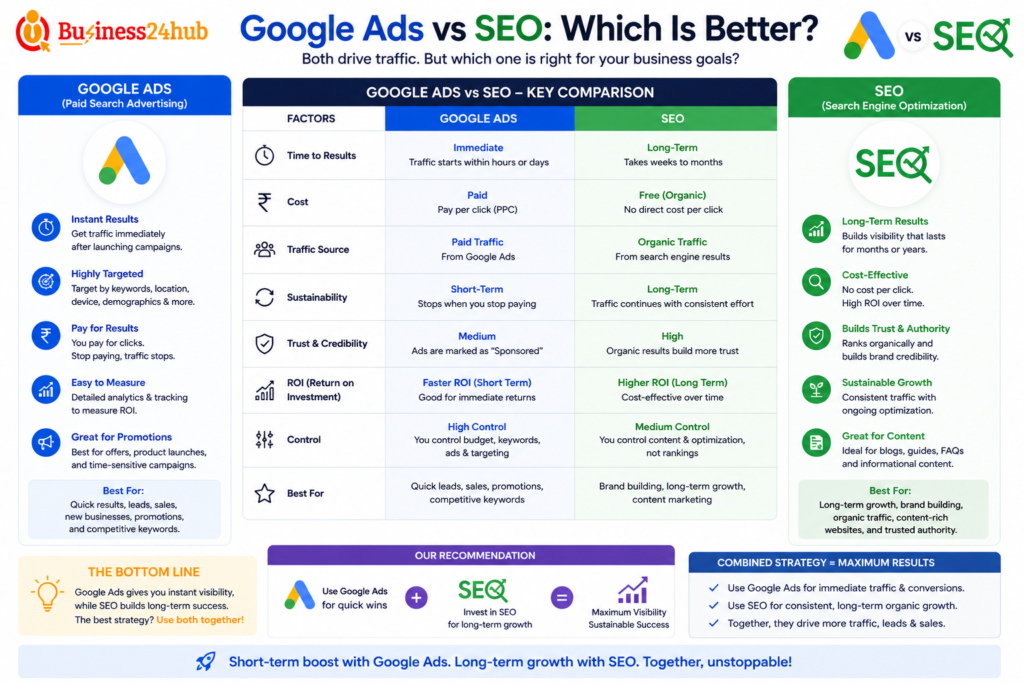
This is one of the starkest differences in the Google Ads vs SEO comparison. Google Ads can generate traffic and leads within hours of a campaign going live, making it the clear choice when a startup needs immediate visibility, such as around a product launch or a time-sensitive promotion.
SEO, by contrast, typically takes three to six months to show meaningful results, and often longer for competitive keywords, since it depends on search engines crawling, indexing, and gradually trusting your content enough to rank it favorably. For startups needing immediate traction, particularly during early validation when waiting months isn’t realistic, this speed difference often makes Google Ads the more practical starting point, regardless of SEO’s longer-term advantages.
Cost Structure: Google Ads vs SEO
Google Ads operates on a direct, ongoing cost structure — you pay for each click, and that cost continues for as long as you want traffic to continue. Depending on industry competition, Indian cost-per-click rates in 2026 typically range from fifteen to over two hundred rupees, meaning a meaningful, sustained campaign requires consistent monthly budget, often starting from twenty thousand rupees for early-stage testing and scaling significantly from there.
SEO costs differently, front-loading investment into content creation, technical optimization, and sometimes link-building efforts, typically ranging from fifteen thousand to eighty thousand rupees monthly depending on whether you’re handling this internally or hiring outside help. While this represents real, ongoing cost too, the key structural difference is that SEO’s traffic doesn’t disappear the moment you pause spending, unlike Google Ads, where traffic stops almost immediately once the budget runs out.
Sustainability and Long-Term Value
This is where SEO’s advantages become most apparent in the Google Ads vs SEO comparison. A well-ranking blog post or product page can continue attracting organic traffic for months or years after the initial investment, without requiring continuous, ongoing spend to maintain that visibility, though periodic updates and maintenance still matter for sustaining rankings over the long term.
Google Ads provides no equivalent compounding value — every month requires fresh budget to maintain the same level of visibility, with no accumulated long-term asset built from previous spend the way SEO content continues working in the background. For startups thinking beyond immediate, short-term traction toward sustainable, lower-cost-per-acquisition growth over time, this fundamental difference makes SEO a genuinely valuable long-term investment despite its slower initial payoff.
Click-Through Rate and User Trust
Organic search results generally receive a meaningfully higher click-through rate than paid ads for the same search query, since many users have developed at least some degree of ad-blindness or skepticism toward sponsored results, particularly for commercial or comparison-style searches where trust matters significantly.
That said, paid ads dominate visibility for highly specific, high-intent, transactional searches, where users actively want to see options and aren’t particularly concerned about whether a result is paid or organic, provided it directly matches what they’re looking for. Understanding this distinction means recognizing that Google Ads vs SEO performance varies considerably depending on the specific type of search query and user intent involved, rather than one channel universally outperforming the other across every scenario.
Targeting Precision: Google Ads vs SEO
Google Ads offers significantly more precise, immediate control over exactly who sees your ads, allowing detailed targeting by location, demographics, device, and even time of day, with the ability to adjust this targeting instantly based on performance data. SEO offers no equivalent direct targeting control — you’re optimizing content to rank for specific search queries, but you can’t directly control who searches those queries or filter visibility by demographic factors the way Google Ads allows.
This makes Google Ads particularly valuable when you need to reach a very specific, narrowly defined audience segment quickly, while SEO works best when your goal is broader visibility for relevant search intent over time, without needing the same granular, immediate targeting precision.
Scalability Considerations
Google Ads scales relatively predictably — increase your budget, and you can generally increase your traffic and leads proportionally, at least until you exhaust available search volume for your target keywords. This predictability makes budget planning and forecasting considerably more straightforward compared to SEO.
SEO scaling works differently, requiring expanded content production, deeper keyword targeting, and accumulated domain authority over time, making it less directly proportional to spend and harder to predict precisely. However, once SEO momentum builds, the marginal cost of additional traffic from new content tends to decrease over time as your site’s overall authority strengthens, an efficiency curve that Google Ads, with its consistent per-click cost regardless of how long you’ve been advertising, doesn’t naturally offer in the same way.
Risk and Volatility
Google Ads carries the risk of algorithm and auction dynamics shifting costs upward over time, particularly as competition in your category increases, directly affecting your cost-per-acquisition even if your campaign management remains unchanged. Stopping spend also means an immediate, complete loss of visibility, creating genuine dependency risk if Google Ads becomes a primary acquisition channel without diversification.
SEO carries different risk, primarily around search algorithm updates that can meaningfully shift rankings, sometimes significantly affecting traffic with little advance warning. While SEO doesn’t disappear the moment you pause active investment the way Google Ads does, neglecting it for extended periods does gradually erode rankings as competitors continue investing and content ages without updates, meaning genuine “set and forget” sustainability is somewhat overstated even for organic search.
When Google Ads Should Be the Priority
Google Ads makes the most sense when your startup needs immediate traffic and leads, such as during early product validation or a time-sensitive launch, when you’re targeting highly specific, transactional search intent where paid placement performs particularly well, when you have budget available for consistent, ongoing spend rather than a one-time investment, and when you need precise control over exactly who sees your campaigns and the flexibility to adjust quickly based on real-time performance data.
When SEO Should Be the Priority
SEO makes more sense when you’re building toward sustainable, long-term growth rather than needing immediate results, when your budget is more constrained for ongoing monthly spend but you can invest meaningful time into content creation, when your product or service benefits from educational, informational content that naturally attracts organic search interest, and when you’re willing to invest in an asset that compounds in value over time rather than requiring continuous spend to maintain visibility.
The Case for Running Both Together
For startups with adequate budget, Google Ads vs SEO doesn’t have to be a strict either-or decision. Running both channels simultaneously, with Google Ads providing immediate traffic and data while SEO builds toward longer-term, lower-cost visibility, often produces the strongest overall results, particularly since data from Google Ads campaigns, such as which keywords and messaging convert best, can directly inform and improve your SEO content strategy.
This combined approach also reduces channel dependency risk, ensuring your startup isn’t entirely reliant on a single acquisition channel that could become more expensive or less effective due to factors outside your control, such as rising competition or algorithm changes specific to either paid or organic search.
A Practical Budget Allocation Framework by Stage
For a pre-validation startup with very limited budget, prioritizing Google Ads for fast market testing and demand validation typically makes more sense than SEO, since you need quick answers about whether your product resonates before investing in content that takes months to show results.
For an early-growth startup with confirmed demand and a moderate budget, splitting investment, perhaps sixty percent toward Google Ads for continued lead flow and forty percent toward SEO content beginning to build long-term organic visibility, balances immediate needs with longer-term foundation building.
For a scaling startup with stronger budget and confirmed unit economics, shifting toward a more balanced or even SEO-weighted split, as accumulated organic content begins delivering increasingly cost-efficient traffic, often makes sense, while maintaining Google Ads for specific high-intent campaigns and precise audience targeting that organic search can’t replicate as effectively.
Common Mistakes Startups Make in This Decision
Choosing SEO exclusively during early-stage validation, then waiting months for results while running out of runway before discovering whether the underlying business model actually works, represents a particularly costly timing mismatch between channel choice and business stage.
Choosing Google Ads exclusively for long-term growth without ever investing in SEO creates permanent dependency on an increasingly expensive channel, missing the opportunity to build a compounding, lower-cost-per-acquisition asset over time.
Treating Google Ads and SEO as completely disconnected efforts, rather than using data and insights from one to inform and improve the other, wastes an obvious opportunity for more efficient, coordinated growth across both channels.
Abandoning SEO investment the moment Google Ads starts performing well, rather than maintaining at least some ongoing organic growth effort, leaves a startup vulnerable if paid acquisition costs rise or campaign performance declines due to factors outside their control later.
Frequently Asked Questions
1. What is the difference between Google Ads vs SEO?
The main difference in Google Ads vs SEO is that Google Ads provides paid visibility at the top of search results, while SEO focuses on improving organic rankings without paying for each click.
2. Which is better for startups: Google Ads vs SEO?
When comparing Google Ads vs SEO, Google Ads is better for immediate traffic and lead generation, while SEO is ideal for long-term growth, brand authority, and sustainable organic traffic.
3. How quickly can I see results with Google Ads vs SEO?
In Google Ads vs SEO, Google Ads can generate traffic almost immediately after your campaign goes live. SEO usually takes several months to achieve consistent rankings and organic traffic.
4. Is Google Ads vs SEO more cost-effective?
The answer to Google Ads vs SEO depends on your goals. Google Ads requires continuous ad spending, whereas SEO involves an upfront investment but can deliver long-term traffic without paying for every visitor.
5. Can I use both Google Ads vs SEO together?
Yes. Combining Google Ads vs SEO is often the best strategy. Google Ads delivers quick results while SEO builds long-term visibility, helping businesses maximize their online presence.
6. Which offers a better ROI in Google Ads or SEO?
In the Google Ads vs SEO comparison, Google Ads often provides faster ROI for short-term campaigns, while SEO generally delivers a higher long-term ROI through consistent organic traffic.
7. Is SEO better than Google Ads for local businesses?
In Google Ads vs SEO, local businesses benefit from both. Google Ads helps attract customers immediately, while local SEO improves visibility in organic search results and Google Maps over time.
8. Does Google Ads or SEO affect website rankings?
Google Ads does not directly improve organic rankings. In the Google Ads vs SEO comparison, SEO is the strategy that helps improve your website’s position in unpaid search results.
9. What factors should businesses consider in Google Ads vs SEO?
When evaluating Google Ads vs SEO, consider your budget, competition, business goals, timeline, target audience, and whether you need immediate leads or long-term online growth.
10. Which should I choose: Google Ads vs SEO?
The right choice in Google Ads vs SEO depends on your objectives. If you need instant traffic and leads, Google Ads is ideal. If your goal is sustainable growth and consistent organic visibility, SEO is the better long-term investment. Many businesses achieve the best results by using both together.
Conclusion
The Google Ads vs SEO debate doesn’t have a single universal winner, because each channel solves a fundamentally different problem on a fundamentally different timeline. Google Ads delivers speed, precision, and immediate visibility at the cost of continuous spend, while SEO delivers compounding, sustainable visibility at the cost of patience and consistent upfront investment before results materialize.
The startups that grow most efficiently in 2026 aren’t necessarily choosing one channel over the other permanently. They’re matching their channel investment to their actual current stage and needs, often starting with Google Ads for fast validation and immediate traction, then gradually building SEO as a longer-term, increasingly cost-efficient growth engine running alongside paid efforts rather than replacing them entirely.
Contact our SEO and Marketing Experts
🟡Business24Hub provides complete IT, web development, software development, digital marketing, branding, SEO, mobile app development, and business consulting services to startups, entrepreneurs, SMEs, and enterprises across India.
🟡For other Legal and Trademark related services Visit
👉 Money Recovery Cases
👉 Property Disputes
👉 Business & Licence Registrations
🟡 Protect Your Rights
👉 Domestic Violence Legal Support
👉 Stridhan Recovery
👉 Mutual Consent Divorce
👉 Contested Divorce Filing
👉 Child Custody and Maintenance
👉 Matrimonial Property Settlement
👉 NRI Divorce Services
👉 Alimony and Maintenance
📞 Call Now: +91 8595439395
🕐 Free Consultation: Monday to Saturday, 10 AM to 6 PM

I’m Aryan Yadav, passionate about SEO and Digital Marketing with a strong interest in helping businesses grow online. I enjoy learning new strategies, exploring digital trends, and creating ideas that deliver value. I believe in continuous growth, creativity, and building meaningful results through smart work and dedication.

