

Views: 1
A practical 2026 guide to Facebook ad targeting India, covering audience types, location and demographic strategies, costs, and a step-by-step targeting framework for startups.
Table of Contents
- 1 Introduction
- 2 Why Targeting Matters More in India Than in Many Markets
- 3 Understanding Facebook’s Core Targeting Categories
- 4 Location Targeting Strategies for India
- 5 Demographic Targeting Considerations
- 6 Interest and Behavior-Based Targeting
- 7 Language Targeting: A Critical India-Specific Consideration
- 8 Custom Audiences: Targeting Your Existing Relationships
- 9 Lookalike Audiences: Scaling Beyond Your Known Customers
- 10 Combining Targeting Layers Effectively
- 11 Avoiding Audience Overlap and Fatigue
- 12 Testing and Refining Your Targeting Strategy
- 13 Budget Considerations for Targeted Campaigns in India
- 14 Common Facebook Ad Targeting Mistakes in India
- 15 A Practical Example: Targeting Strategy for a Real Startup
- 16 How AI Is Changing Facebook Ad Targeting in 2026
- 17 Frequently Asked Questions
- 18 Conclusion
- 19 Do you want us to Run Facebook Ads for your Business?
Introduction
Facebook’s targeting capabilities remain one of the most powerful tools available to startups in 2026, but power without precision often just means wasted budget. Targeting too broadly burns through spend showing ads to people who were never going to convert, while targeting too narrowly can starve your campaigns of the data they need to actually optimize.
For Indian startups specifically, this challenge carries an extra layer of nuance. India’s audience spans massive diversity in language, income level, urban versus rural behavior, and device usage, making generic, one-size-fits-all targeting significantly less effective than it might be in smaller, more homogeneous markets. This guide breaks down exactly how startups should approach Facebook ad targeting in India in 2026, from foundational concepts through advanced strategy.
Why Targeting Matters More in India Than in Many Markets
India’s sheer scale and diversity make targeting decisions disproportionately important compared to smaller, more uniform markets. A campaign targeting “India” broadly, without further refinement, can simultaneously reach a young professional in Bangalore with high purchasing power and a college student in a small town with completely different spending behavior, despite both technically fitting basic demographic criteria.
This diversity means generic targeting in India often produces inconsistent, hard-to-interpret results, since your ad is effectively being tested across audiences with meaningfully different needs, language preferences, and purchasing capacity all at once. Precise, deliberate targeting isn’t just a nice-to-have optimization for Indian campaigns — it’s often the difference between a campaign that performs predictably and one that produces confusing, inconsistent data that’s difficult to learn from or improve.
Understanding Facebook’s Core Targeting Categories
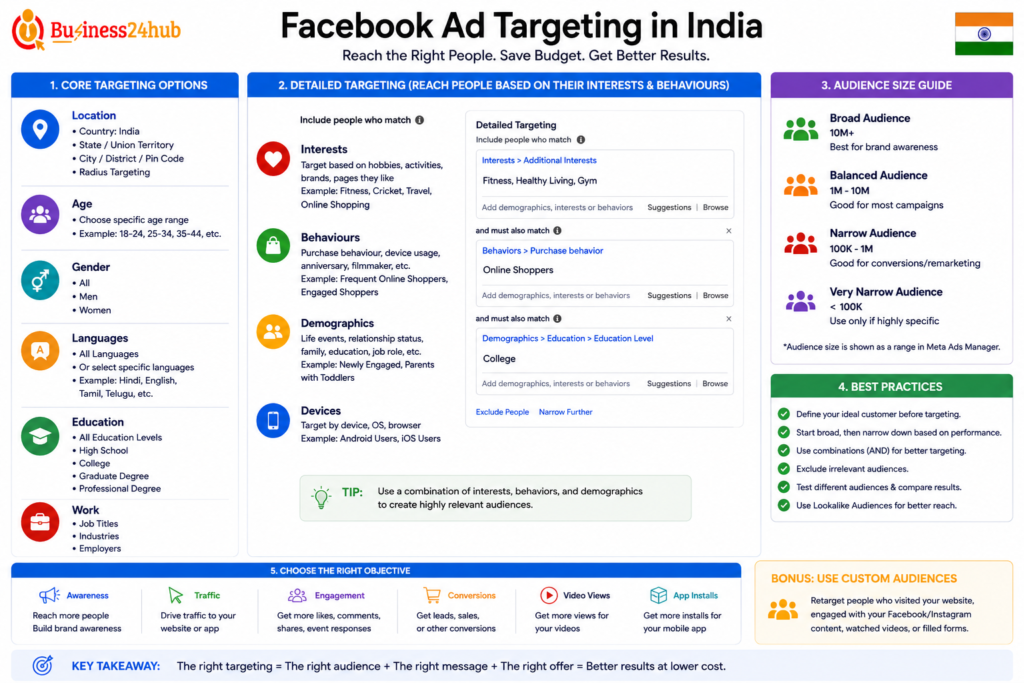
Facebook’s targeting system in 2026 generally falls into three core categories, each serving a different strategic purpose. Core audiences are built from demographic, location, interest, and behavioral data Facebook has collected. Custom audiences are built from your own existing data, such as website visitors or customer lists. Lookalike audiences are built by asking Facebook to find new people who resemble an existing audience you’ve provided, such as your current customers.
Understanding when to use each category, and how they work together, forms the foundation of an effective Indian targeting strategy, rather than relying purely on one approach for every campaign regardless of its specific goal.
Location Targeting Strategies for India
Location targeting in India requires more thought than simply selecting the country as a whole. Major metro cities like Mumbai, Delhi, Bangalore, and Hyderabad typically carry higher purchasing power and different consumer behavior compared to Tier 2 and Tier 3 cities, making city-level or even pin-code-level targeting valuable for startups with products specifically suited to one segment over another.
For startups offering location-dependent services, radius targeting around specific areas allows precise local reach, particularly useful for businesses like local service providers or businesses with physical locations. For startups with national ambitions but limited initial budget, starting with targeted campaigns in two or three specific cities, rather than spreading thin across the entire country, often produces more interpretable results and a clearer initial understanding of which markets respond best before expanding further.
Demographic Targeting Considerations
Age and gender targeting remain available and useful, but should be applied based on genuine audience research rather than assumptions. India’s digital audience skews younger overall compared to some Western markets, but assuming your entire target audience falls into a narrow young demographic without verifying this against your actual customer data can unnecessarily exclude valuable segments.
Income-level targeting, while not directly available as a standalone option, can be approximated through combinations of location, device type, and interest signals, since certain neighborhoods, phone brands, and lifestyle interests correlate reasonably well with purchasing power in the Indian context. This kind of layered, indirect targeting often proves more effective than relying purely on Facebook’s basic demographic filters alone.
Interest and Behavior-Based Targeting
Interest targeting allows you to reach people based on pages they’ve engaged with, content they consume, and activities Facebook has inferred they’re interested in. For Indian startups, this works particularly well when interests are researched specifically for the Indian context rather than assumed from global best practices, since interest categories and their relative popularity can differ meaningfully between Indian and international audiences.
Behavioral targeting, covering signals like device usage, purchase behavior, and travel patterns, adds another layer of precision. A startup selling premium smartphone accessories, for example, might combine interest targeting around technology and gadgets with behavioral targeting around recent high-end device purchases, creating a significantly more relevant audience than either signal would produce alone.
Language Targeting: A Critical India-Specific Consideration
This is an area where Indian-market Facebook targeting genuinely differs from many other countries. Facebook allows targeting based on language preference, and for startups serving audiences who primarily engage with Hindi or regional language content, this targeting layer can significantly improve relevance and engagement compared to assuming all Indian users primarily engage in English.
Running separate ad variations with creative and copy tailored to specific language preferences, rather than a single English-only campaign assumed to work universally, often produces meaningfully better engagement and conversion rates across India’s genuinely multilingual digital audience, particularly for startups targeting audiences beyond major metro, English-comfortable segments.
Custom Audiences: Targeting Your Existing Relationships
Custom audiences allow you to upload existing customer data, such as email lists or phone numbers, letting Facebook find and target those specific people directly on the platform. This is particularly valuable for retargeting past customers with new offers, re-engaging website visitors who didn’t convert, or excluding existing customers from acquisition campaigns to avoid wasting budget showing ads to people who’ve already purchased.
Website-based custom audiences, built from visitor tracking through the Facebook pixel or conversion application programming interface, allow retargeting people who’ve shown specific interest, such as viewing a product page or adding an item to cart without completing purchase, typically representing some of the highest-converting, most cost-efficient audiences available to advertisers.
Lookalike Audiences: Scaling Beyond Your Known Customers
Once you have a meaningful base of existing customers or engaged website visitors, lookalike audiences allow Facebook to identify new potential customers who share similar characteristics and behaviors. For Indian startups, lookalike audience quality depends significantly on the quality and size of your source audience, meaning a small, low-quality customer list typically produces less effective lookalike targeting than a larger, well-qualified source audience.
Given India’s diversity, building separate lookalike audiences based on customers from specific regions or cities, rather than one single lookalike based on a geographically scattered national customer base, often produces more precisely targeted, higher-performing results, since the underlying behavioral patterns being matched are more consistent within a more geographically focused source audience.
Combining Targeting Layers Effectively
The strongest Facebook ad targeting strategies in India typically combine multiple layers rather than relying on a single targeting dimension alone. A well-targeted campaign might combine specific city-level location targeting, an age range based on genuine customer data, relevant interest categories researched specifically for the Indian context, and language preference aligned with your ad creative’s actual language.
This layered approach narrows your audience to genuinely relevant prospects, though it’s worth balancing precision against audience size, since overly narrow combined targeting can sometimes shrink your potential audience too much for Facebook’s algorithm to optimize delivery effectively, particularly relevant for startups with smaller overall ad budgets.
Avoiding Audience Overlap and Fatigue
Running multiple campaigns simultaneously without checking for audience overlap can result in the same users seeing multiple competing ads from your own brand, wasting budget and potentially creating a confusing, repetitive experience. Facebook’s audience overlap tool helps identify when different targeting groups within your account are significantly overlapping, allowing adjustment before this becomes a meaningful efficiency problem.
Ad fatigue, where the same audience sees identical creative repeatedly and engagement gradually declines, is also a genuine consideration for Indian campaigns, particularly when targeting smaller, more specific audience segments. Regularly refreshing ad creative and monitoring frequency metrics helps maintain performance over sustained campaign periods rather than letting an initially strong-performing campaign gradually decline without intervention.
Testing and Refining Your Targeting Strategy
Effective targeting isn’t determined once and left unchanged indefinitely. Run structured tests comparing different targeting approaches, such as broad versus narrow targeting, different city combinations, or varying interest categories, while keeping creative consistent across the test to isolate targeting’s specific impact on performance.
Review performance data regularly, paying attention not just to overall results but to how different audience segments within a broader campaign perform relative to each other, since this often reveals which specific targeting refinements are genuinely driving results versus which are simply present without meaningfully contributing to performance.
Budget Considerations for Targeted Campaigns in India
Cost-per-click and cost-per-result for Facebook ads in India vary significantly by targeting precision, competition, and audience size. Highly specific, well-qualified targeting often costs more per click but produces meaningfully better conversion rates, frequently resulting in a lower overall cost per actual result compared to broader, cheaper-per-click but less relevant targeting.
For startups with limited budgets, starting with narrower, more precisely targeted campaigns focused on your most likely customer segment, rather than broad campaigns attempting to reach a wide, loosely defined audience, typically produces more efficient results and clearer learning, even though the cost per click might initially appear higher in direct comparison.
Common Facebook Ad Targeting Mistakes in India
Targeting all of India uniformly without considering the meaningful behavioral and purchasing power differences between metro cities, smaller cities, and rural areas often produces inconsistent, hard-to-interpret campaign results.
Assuming English-only creative and targeting works universally across India’s genuinely multilingual audience frequently leaves significant engagement and conversion potential untapped among Hindi and regional language-comfortable users.
Targeting too narrowly with overly specific combined criteria can shrink the available audience so much that Facebook’s algorithm struggles to find enough qualified users to optimize delivery effectively, particularly limiting for smaller startup budgets.
Neglecting to build and use custom and lookalike audiences, relying purely on interest and demographic targeting alone, misses some of the platform’s most cost-efficient targeting options, particularly for startups with any existing customer or website visitor data available.
Failing to monitor audience overlap and ad fatigue across multiple simultaneous campaigns often results in wasted budget and gradually declining performance that goes unnoticed until results have already meaningfully suffered.
A Practical Example: Targeting Strategy for a Real Startup
Consider a startup selling affordable skincare products, initially running a single broad campaign targeting all Indian women aged eighteen to forty-five with general beauty and skincare interests. Results were inconsistent, with cost per purchase varying wildly and no clear pattern emerging from the data.
After restructuring, they build three separate, more precisely targeted campaigns: one focused on metro city audiences aged twenty-two to thirty-five with premium beauty brand interests, in English-language creative; one focused on Tier 2 city audiences with broader skincare and beauty interests, using Hindi-language creative emphasizing affordability; and a retargeting campaign built from website visitors who viewed product pages but didn’t purchase. Performance data after several weeks reveals the Tier 2 city campaign, despite a lower average order value, produces a significantly better overall cost per acquisition than the metro campaign, prompting a budget shift toward this previously underestimated segment, an insight the original broad, undifferentiated campaign had completely obscured.
How AI Is Changing Facebook Ad Targeting in 2026
Facebook’s advertising algorithm has become increasingly sophisticated at automated optimization, with tools like Advantage+ audience targeting allowing the system to find relevant users with less manual targeting specification than was traditionally required. This doesn’t eliminate the value of deliberate, India-specific targeting strategy, but it does shift some of the work toward providing the algorithm with high-quality source signals, such as well-qualified custom audiences and conversion data, that it can use to optimize more effectively.
For Indian startups, this means the underlying strategic thinking covered throughout this guide, understanding your actual audience’s location, language, and behavioral patterns, remains essential, even as some of the manual, granular targeting selection work increasingly shifts toward Facebook’s automated systems working from the quality inputs and goals you provide them.
Frequently Asked Questions
1. What is Facebook Ad Targeting India?
Facebook Ad Targeting India is the process of showing your Facebook and Instagram ads to a specific audience based on factors such as location, age, gender, interests, behaviors, language, and demographics. It helps businesses reach potential customers more effectively.
2. Why is Facebook Ad Targeting India important for businesses?
Facebook Ad Targeting India helps businesses reduce wasted ad spend by reaching users who are most likely to be interested in their products or services. Better targeting often leads to higher engagement, quality leads, and improved return on investment (ROI).
3. What targeting options are available in Facebook Ad Targeting India?
With Facebook Ad Targeting India, advertisers can target audiences by city, state, PIN code, age group, gender, interests, online behavior, education, job titles, custom audiences, lookalike audiences, and previous website visitors.
4. Can small businesses benefit from Facebook Ad Targeting India?
Yes. Facebook Ad Targeting India is suitable for businesses of all sizes. Small businesses can start with a modest budget and target local customers, making it a cost-effective way to generate leads and increase brand awareness.
5. How can I improve the results of Facebook Ad Targeting India?
To improve Facebook Ad Targeting India, define your ideal audience clearly, use high-quality creatives, test multiple audience segments, install the Meta Pixel for tracking, and continuously optimize campaigns based on performance data.
6. What industries can use Facebook Ad Targeting India?
Almost every industry can benefit from Facebook Ad Targeting India, including eCommerce, education, healthcare, real estate, legal services, restaurants, travel, finance, software, and local businesses looking to attract customers.
7. How do I choose the right audience for Facebook Ad Targeting India?
The best approach to Facebook Ad Targeting India is to identify your target customer’s location, age, interests, purchasing behavior, and online activity. Regularly analyzing campaign insights and refining your audience helps improve conversions and maximize advertising performance.
Conclusion
Facebook ad targeting in India isn’t a single setting to configure once and forget — it’s an ongoing strategic discipline that needs to account for the country’s genuine diversity in location, language, income, and behavior. Generic, one-size-fits-all targeting consistently underperforms compared to deliberate, layered targeting built around real audience research and continuously refined based on actual campaign data.
The startups getting the strongest results from Facebook advertising in India in 2026 aren’t necessarily the ones with the biggest budgets. They’re the ones building targeting strategies grounded in genuine understanding of their specific audience’s location, language, and behavior, testing systematically rather than guessing, and continuously refining based on what the data actually reveals about which segments genuinely respond, rather than relying on broad assumptions about what “Indian audiences” want as a single, uniform group.
Do you want us to Run Facebook Ads for your Business?
🟡Business24Hub provides complete IT, web development, software development, digital marketing, branding, SEO, mobile app development, and business consulting services to startups, entrepreneurs, SMEs, and enterprises across India.
🟡For other Legal and Trademark related services Visit
👉 Money Recovery Cases
👉 Property Disputes
👉 Business & Licence Registrations
🟡 Protect Your Rights
👉 Domestic Violence Legal Support
👉 Stridhan Recovery
👉 Mutual Consent Divorce
👉 Contested Divorce Filing
👉 Child Custody and Maintenance
👉 Matrimonial Property Settlement
👉 NRI Divorce Services
👉 Alimony and Maintenance
📞 Call Now: +91 8595439395
🕐 Free Consultation: Monday to Saturday, 10 AM to 6 PM

I’m Aryan Yadav, passionate about SEO and Digital Marketing with a strong interest in helping businesses grow online. I enjoy learning new strategies, exploring digital trends, and creating ideas that deliver value. I believe in continuous growth, creativity, and building meaningful results through smart work and dedication.

