

Views: 0
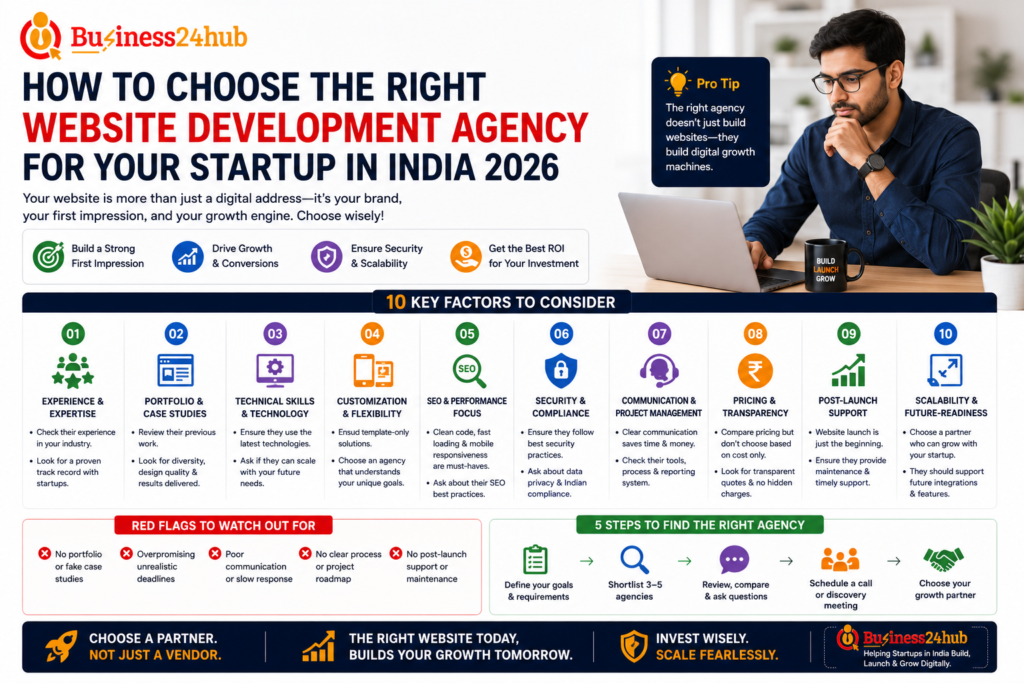
A complete 2026 guide to choosing right website development agency in India for your startup, covering evaluation criteria, red flags, costs, and a practical selection framework.
Table of Contents
- 1 Introduction
- 2 Why Startup Website Projects Go Wrong With Agencies
- 3 Step One: Get Clear on What You Actually Need Before Approaching Anyone
- 4 Step Two: Understand the Indian Agency Landscape
- 5 Step Three: Evaluate Portfolios Beyond Surface Aesthetics
- 6 Step Four: Ask the Right Questions in Initial Conversations
- 7 Step Five: Evaluate Technical Capability Specifically
- 8 Step Six: Understand Pricing Structures and What Drives Variation
- 9 Step Seven: Assess Communication and Process Quality Early
- 10 Step Eight: Understand Ownership, IP, and Exit Clearly
- 11 Common Red Flags to Watch for During Agency Evaluation
- 12 What a Good Agency Relationship Actually Looks Like
- 13 A Practical Evaluation Framework
- 14 Frequently Asked Questions
- 15 Conclusion
- 16 Contact our Experts For Website Develpoment
Introduction
Choosing a website development agency feels deceptively straightforward until you’re three months into a project that was supposed to take six weeks, communicating through a single point of contact who takes days to respond, and watching your budget evaporate on revisions that seem to circle the same unresolved issues indefinitely. By that point, switching agencies means starting over, and staying means continuing down a path that’s already clearly going wrong.
The agency selection decision is one of those foundational startup choices that looks like a tactical vendor decision but functions more like a strategic partnership. Your website often represents the first meaningful interaction potential customers, investors, and partners have with your brand, and the agency that builds it shapes not just how that interaction looks, but how well the underlying technical foundation supports your growth for the next two to three years.
In India’s website development landscape of 2026, the range of available agencies spans an enormous quality and price spectrum, from freelancer-adjacent small shops quoting aggressively to impress with low numbers, through to sophisticated, specialized agencies with proven portfolios and pricing that reflects genuine capability. Navigating this landscape confidently requires a clear, structured evaluation framework rather than relying on the one metric most founders default to first, which is whoever gave the lowest quote. This guide walks through exactly how to choose right.
Why Startup Website Projects Go Wrong With Agencies
Understanding the most common failure patterns before beginning your search helps you recognize warning signs during evaluation rather than only in retrospect. Most website development projects that go wrong with agencies fail for a predictable set of reasons that have very little to do with technical capability alone.
Misaligned expectations about scope represent the most common issue, typically emerging when an initial brief is vague enough that both parties mentally filled gaps differently, then discovered this discrepancy only when specific deliverables began arriving. The agency believed a five-page website meant five simple pages with standard functionality. The startup assumed five pages included custom animations, a blog section, multilingual support, and third-party integrations never explicitly mentioned in writing.
Communication breakdown is the second most frequent problem, often stemming from unclear processes around feedback cycles, approval stages, and revision limits. A startup that expects unlimited revisions and an agency that budgeted for two rounds will inevitably reach a point of friction that no amount of goodwill resolves cleanly without either additional cost or resentment on one or both sides.
Technical quality issues that only become apparent after launch, including slow page speeds, poor mobile optimization, insecure configurations, or code quality that makes future development expensive and complicated, represent a third failure pattern that’s particularly damaging because it often manifests months after the project concluded and payment was made.
Step One: Get Clear on What You Actually Need Before Approaching Anyone
Every meaningful agency evaluation starts with internal clarity that most startups skip entirely, beginning their search by sending the same vague brief to ten agencies and comparing quotes on a project that was never clearly defined. This approach virtually guarantees quote comparisons that don’t reflect equivalent scopes, making the resulting numbers meaningless as actual decision inputs.
Before approaching a single agency, document specifically what your website needs to accomplish, which pages and features it requires, what content you’ll provide versus what needs to be created, what integrations with existing tools are necessary, and what your actual timeline and budget constraints are. This document doesn’t need to be a formal specification, but it needs to be specific enough that two different agencies reading it would quote something genuinely comparable rather than entirely different interpretations of the same vague request.
This clarity also protects you throughout the project, since a well-documented brief becomes the reference point for scope discussions when inevitably some new requirement emerges mid-project that wasn’t part of the original plan.
Step Two: Understand the Indian Agency Landscape
India’s website development agency market in 2026 covers an enormous range of capability, specialization, and pricing, and understanding this landscape helps set appropriate expectations before beginning outreach. The market broadly divides into several categories with distinct characteristics.
Small boutique agencies and freelancer-adjacent studios typically serve startups and small businesses with simpler, faster-turnaround projects, offering competitive pricing and often more direct access to the people actually doing the work rather than primarily communicating through account managers. Quality varies more widely in this tier, making portfolio and reference checking more critical than in more established tiers.
Mid-size specialized agencies with defined industry or technology focus areas represent the most relevant tier for most funded or growth-stage startups, offering more structured project management, dedicated teams, and deeper expertise within their specific focus areas while remaining accessible in pricing relative to larger agencies. Finding an agency in this tier that specializes in your industry or technology stack often produces better results than a generalist agency of equivalent size.
Larger, full-service digital agencies offer more comprehensive capability across web development, design, digital marketing, and content, but typically at pricing that may exceed early-stage startup budgets and with a project management structure that can feel less personal and responsive than smaller agencies provide.
Step Three: Evaluate Portfolios Beyond Surface Aesthetics
Most founders evaluate agency portfolios by looking at screenshots and deciding which ones look good, which is the least useful evaluation approach because visual aesthetics tell you almost nothing about technical quality, SEO performance, page speed, mobile experience, or how the project was actually managed relative to timeline and budget.
When reviewing a portfolio, actively visit the live websites rather than looking only at screenshots, and evaluate how each site actually performs across the dimensions that matter for your business. Test page load speed on a real mobile device rather than a desktop browser. Navigate through the site on both mobile and desktop to evaluate actual usability rather than just visual design. If the site includes a blog or content section, check whether basic SEO fundamentals are correctly implemented. Look up the domain’s search visibility to see whether the agency’s work has actually supported meaningful organic performance or simply produced a visually attractive site that doesn’t perform in search.
Ask specifically about projects most similar to what you’re building, not the most visually impressive pieces in the portfolio, since the skills and processes required for an e-commerce platform differ meaningfully from those needed for a content-focused marketing site, and an agency’s strongest work might be in a category different from what you actually need.
Step Four: Ask the Right Questions in Initial Conversations
Agency discovery calls and initial meetings are where the quality of your questions matters enormously. Most startups arrive at these conversations with too few specific questions and leave having assessed primarily how well the agency’s salesperson presented, which correlates weakly with how well the actual development team executes.
Ask specifically who will be working on your project, whether they’re full-time employees or contracted resources, and whether the specific team members they introduce during the sales process are the same people who will actually execute the work. Significant disconnect between the sales presentation team and the actual execution team is a meaningful red flag in this industry.
Ask how they handle scope changes mid-project, what their process is for managing revision rounds, and what specifically is included and excluded in their standard contract. Ask for two or three client references from projects most similar to yours in scope and technology, and actually contact those references rather than simply accepting that they exist.
Ask about their process for handing over the completed website, including whether you’ll receive full ownership and access to all code, hosting credentials, and assets, and what ongoing support looks like after launch, since a surprising number of startups discover post-project that their agency relationship created implicit dependency without clear exit options.
Step Five: Evaluate Technical Capability Specifically
Visual design quality is relatively easy to assess from a portfolio, but technical capability often isn’t apparent without asking specific, pointed questions about how the agency approaches technical decisions. For non-technical founders, this can feel intimidating, but a few key questions reveal a great deal about genuine capability versus superficial technical vocabulary.
Ask how they approach page speed optimization and what typical Core Web Vitals scores their recent projects achieve. Ask how they handle mobile optimization and what their testing process across different devices and screen sizes looks like. Ask what their approach to security is, particularly around update management and common vulnerability protection for whichever platform your site will run on.
For more technically complex projects, ask about their experience with your specific technology choices, whether React, WordPress, or something else, and request examples of similar technical complexity from their portfolio. An agency that deflects these questions or responds only with vague reassurances rather than specific, concrete answers to technical process questions is signaling something important about their actual technical depth.
Step Six: Understand Pricing Structures and What Drives Variation
Indian website development agency pricing in 2026 spans a genuinely enormous range, from a few thousand rupees for a template-based basic site from a very small studio, through to several lakh rupees for a custom-designed, technically sophisticated platform from a specialized agency. Understanding what drives this variation helps evaluate quotes sensibly rather than simply gravitating toward the middle or assuming the most expensive option is the most capable.
Pricing reflects several factors independently: the agency’s overhead and team structure, the scope of work actually included, the quality and experience level of the specific people working on your project, and how realistic the quoted timeline is relative to the actual work involved. A suspiciously low quote typically reflects either scope assumptions that differ from yours, use of junior or offshore resources not disclosed during the sales process, or a timeline that sets up delay and quality issues almost from the start.
Request itemized quotes breaking down design, development, content, project management, and any third-party costs separately, since this makes quote comparison between agencies meaningful rather than comparing bundled numbers that might represent entirely different scope assumptions and team structures.
Step Seven: Assess Communication and Process Quality Early
How an agency communicates during the evaluation and proposal process is a reasonably reliable predictor of how they’ll communicate during the actual project. An agency that takes days to respond to straightforward pre-sale questions, or whose proposal arrives with errors and inconsistencies, is unlikely to become dramatically more responsive and detail-oriented once they’ve already won your business.
Pay particular attention to how clearly they explain their process, timeline, and deliverables in writing rather than verbally during presentations. Agencies with genuinely strong project management document their process clearly because it makes execution smoother for everyone involved. Agencies with less structured processes often rely on keeping process details vague because specificity would reveal gaps in their planning.
Ask specifically how project communication happens, what tools they use for tracking progress, how often they provide status updates, and what the escalation path is if the assigned project manager becomes unavailable during critical project phases.
Step Eight: Understand Ownership, IP, and Exit Clearly
Before signing any contract, understand specifically what you own when the project concludes. You should receive full ownership of all code, design assets, content, and hosting environments without ongoing dependency on the agency for access to these resources. Any licensing costs for themes, plugins, or third-party tools used in your project should be clearly itemized and transferred to your ownership after project completion.
Contracts that tie ongoing hosting or code access to continued agency engagement, or that retain intellectual property rights to custom code developed specifically for your project, represent a significant red flag worth explicitly addressing before signing rather than discovering only when you eventually want to migrate or extend the work through a different team.
Common Red Flags to Watch for During Agency Evaluation
An agency that cannot provide direct contact references from recent, similar-scope clients, or whose provided references are unavailable or give suspiciously generic responses when contacted, is hiding something about actual client experience that their curated portfolio doesn’t reveal.
Pricing that seems dramatically lower than every other quote you received without a clear, specific explanation of what’s different about their scope assumptions or resource model typically reflects hidden costs, scope gaps, or quality trade-offs that will become apparent during execution rather than beforehand.
Resistance to putting specific timelines, revision processes, and scope details in writing, preferring to keep agreements conversational rather than documented, creates exactly the conditions where scope disputes and timeline disagreements are almost inevitable once the project begins.
Agencies that begin the conversation by asking what your budget is before asking what you’re trying to accomplish, then structuring their proposal primarily around filling that budget rather than solving your specific problem, are optimizing for revenue capture rather than client outcome.
Turnover in key personnel during the evaluation process, or vagueness about who specifically will be accountable for your project’s execution, often signals organizational instability that creates real project risk regardless of how strong the portfolio presented during the sales process appears.
What a Good Agency Relationship Actually Looks Like
The best agency relationships function more like partnerships than vendor transactions, with the agency genuinely invested in your startup’s success rather than simply delivering a specified output and moving to the next client. This manifests in agencies that ask meaningful questions about your business goals before discussing technical solutions, who push back constructively when they believe a requested approach isn’t the strongest one for your specific objectives, and who are transparent about limitations and trade-offs rather than promising whatever they believe you want to hear to close the engagement.
Finding this kind of relationship doesn’t happen purely through portfolio evaluation or pricing comparison. It emerges through the quality of conversation during evaluation, the specificity and honesty of their proposal, and what their existing clients say about how the agency behaved when things got difficult rather than only how they delivered when everything went smoothly.
A Practical Evaluation Framework
After completing the steps above, evaluate shortlisted agencies across four primary dimensions simultaneously rather than any single factor alone. Technical capability, assessed through portfolio performance and technical process questions, tells you whether they can build what you need at the quality level your business requires. Communication and process quality, assessed through their responsiveness and documentation thoroughness during evaluation, predicts how the project will actually be managed. Business fit, assessed through how well they understand your startup’s specific goals beyond website features, indicates whether they’ll bring genuine strategic thinking or purely technical execution. Commercial terms, including pricing, contract clarity, ownership provisions, and ongoing support, determine whether the relationship is set up fairly for both parties across its full duration.
No single dimension should dominate the decision. An agency that scores exceptionally well on technical capability but poorly on communication and process quality will likely frustrate you throughout the project. One that communicates beautifully but lacks the technical capability for your specific requirements will let you down at execution regardless of how pleasant the experience feels before delivery.
Frequently Asked Questions
1. Why is Choosing Right Website Development Agency important for startups?
Choosing Right Website Development Agency is crucial because your website is often the first impression of your business. A reliable agency can create a fast, secure, SEO-friendly, and scalable website that supports your startup’s growth.
2. What should startups look for when Choosing Right Website Development Agency?
When Choosing Right Website Development Agency, consider the agency’s portfolio, industry experience, technical expertise, client reviews, pricing, communication, post-launch support, and ability to understand your business goals.
3. How do I know if a website development agency is experienced?
Before Choosing Right Website Development Agency, review their previous projects, ask for case studies, check client testimonials, and evaluate whether they have experience building websites similar to your business requirements.
4. Should I choose WordPress or custom development for my startup?
While Choosing Right Website Development Agency, discuss your business goals with the agency. WordPress is ideal for content-driven websites and small businesses, whereas custom development using technologies like React is better for highly interactive and scalable web applications.
5. Does Choosing Right Website Development Agency affect SEO performance?
Yes. Choosing Right Website Development Agency can significantly impact SEO because experienced developers build websites with clean code, fast loading speeds, mobile responsiveness, secure architecture, and proper technical SEO practices.
6. How much does it cost when Choosing Right Website Development Agency?
The cost of Choosing Right Website Development Agency depends on your website’s complexity, number of pages, custom features, design requirements, integrations, and ongoing maintenance services. It’s best to request a detailed proposal before starting the project.
7. Why is post-launch support important when Choosing Right Website Development Agency?
Post-launch support is an essential factor when Choosing Right Website Development Agency because your website will require updates, security patches, performance optimization, bug fixes, backups, and technical assistance as your business grows.
Conclusion
Choosing a website development agency in India is genuinely one of the higher-stakes early decisions a startup makes, not because websites are the most important thing a startup builds, but because the wrong agency relationship can drain significant time and money while producing an asset that underperforms the business it was supposed to support.
The startups that navigate this decision well aren’t the ones that found the most impressive portfolio or the lowest price. They’re the ones that got clear on their own requirements first, asked specific and pointed questions during evaluation, read contracts carefully before signing, and chose agencies that demonstrated genuine investment in the startup’s success rather than simply in delivering a specified scope and moving on. That combination of internal clarity and rigorous external evaluation is what consistently produces website development partnerships worth the investment they require.
Contact our Experts For Website Develpoment
🟡Business24Hub provides complete IT, web development, software development, digital marketing, branding, SEO, mobile app development, and business consulting services to startups, entrepreneurs, SMEs, and enterprises across India.
🟡For other Legal and Trademark related services Visit
👉 Money Recovery Cases
👉 Property Disputes
👉 Business & Licence Registrations
🟡 Protect Your Rights
👉 Domestic Violence Legal Support
👉 Stridhan Recovery
👉 Mutual Consent Divorce
👉 Contested Divorce Filing
👉 Child Custody and Maintenance
👉 Matrimonial Property Settlement
👉 NRI Divorce Services
👉 Alimony and Maintenance
📞 Call Now: +91 8595439395
🕐 Free Consultation: Monday to Saturday, 10 AM to 6 PM

I’m Aryan Yadav, passionate about SEO and Digital Marketing with a strong interest in helping businesses grow online. I enjoy learning new strategies, exploring digital trends, and creating ideas that deliver value. I believe in continuous growth, creativity, and building meaningful results through smart work and dedication.

