

Views: 0
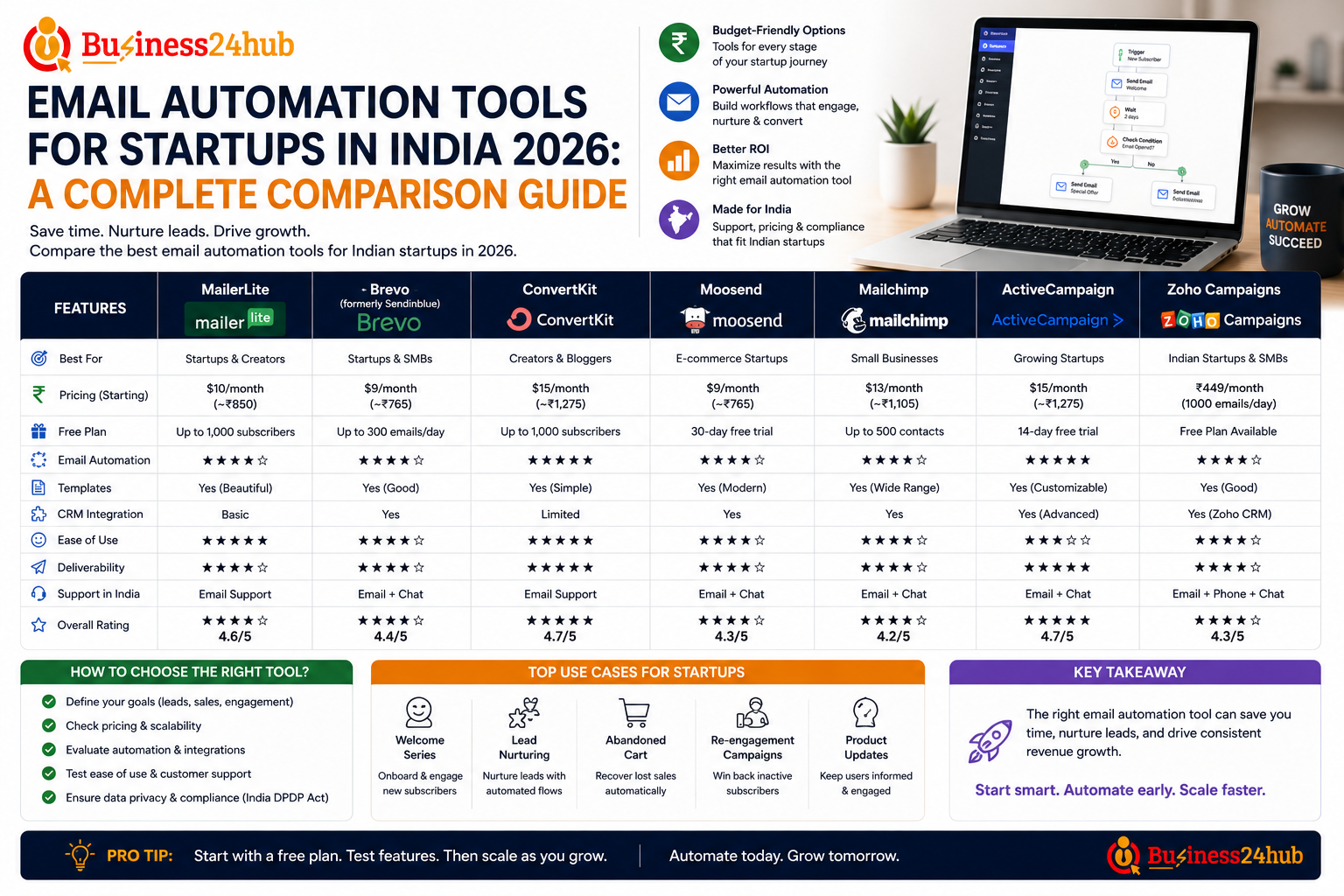
A complete 2026 comparison of the best email automation tools for startups in India, covering features, pricing, local payment support, and a practical selection framework.
Table of Contents
- 1 Introduction
- 2 What Email Automation Actually Means for a Startup
- 3 Key Features Indian Startups Should Evaluate
- 4 Mailchimp
- 5 Brevo (formerly Sendinblue)
- 6 Mailerlite
- 7 ActiveCampaign
- 8 HubSpot Email Marketing
- 9 Zoho Campaigns
- 10 Klaviyo
- 11 How to Choose the Right Tool for Your Stage
- 12 Migration Considerations
- 13 Common Mistakes Indian Startups Make Choosing Email Automation Tools
- 14 Frequently Asked Questions
- 15 Conclusion
- 16 Contact our Experts For any Query about Automation
Introduction
Every Indian startup eventually reaches the same inflection point: manually following up with leads one by one is no longer sustainable, but the prospect of evaluating dozens of email automation platforms, each promising to be the perfect solution, feels equally overwhelming. The wrong choice means either paying for features you won’t use for months, or discovering critical limitations only after migrating your entire contact list and building out your first automation sequence.
Email automation is one of those foundational marketing infrastructure decisions that’s genuinely worth getting right the first time. A well-chosen platform doesn’t just send emails on a schedule — it becomes the central nervous system of your startup’s entire customer communication strategy, connecting lead capture, nurture sequences, transactional messages, and ongoing relationship management into one coordinated system. In 2026, with Indian startups increasingly competing on customer experience quality rather than product features alone, the quality of this underlying communication infrastructure matters more than it used to.
This guide breaks down the most relevant email automation tools available to Indian startups in 2026, what each actually costs in realistic Indian context, where each genuinely excels and falls short, and how to choose without either overpaying for enterprise features you don’t need yet or under-investing in a tool that will create migration headaches within a year.
What Email Automation Actually Means for a Startup
Before comparing specific platforms, it helps to clarify what email automation actually involves at different startup stages, since the term covers a remarkably wide range of capability from simple scheduled newsletters to sophisticated, behaviorally triggered multi-branch sequence logic.
At the most basic level, email automation means sending pre-written emails automatically when a specific trigger occurs, such as a welcome email sent immediately when someone joins your list, without requiring manual action each time. This level of automation is genuinely valuable from day one of list building and is available in essentially every modern email platform.
More sophisticated automation involves branching sequences that behave differently based on what a subscriber does, sending one follow-up if they clicked a specific link and a different one if they didn’t, or adjusting future email content based on which product pages they visited on your website. This kind of behavioral automation becomes increasingly valuable as your list grows and a one-size-fits-all sequence begins visibly underperforming for different subscriber segments.
Understanding which level of automation your startup actually needs right now, versus which level you’ll genuinely need within twelve months, prevents both overpaying for sophistication you won’t use and under-investing in a platform you’ll quickly outgrow.
Key Features Indian Startups Should Evaluate
Several features matter specifically in the Indian market context that generic international platform comparisons sometimes underemphasize. Local payment support is practical and important — many international email platforms charge in dollars, and some offer genuinely limited options for Indian payment methods, creating ongoing friction for startups managing budgets in rupees.
Rupee-denominated pricing or at minimum easy Indian payment method support, including UPI, net banking, or Indian credit and debit cards without international transaction fees, meaningfully affects the true monthly cost of a platform beyond its listed subscription price. This is worth verifying specifically rather than assuming any platform with Indian customers automatically makes Indian payment methods convenient.
WhatsApp integration capability is increasingly relevant for Indian startups whose customer communication strategy includes WhatsApp as a significant channel alongside email, since a platform that connects both channels within the same automation workflow can be meaningfully more powerful than managing email and WhatsApp communication through entirely separate, disconnected tools.
List size pricing structure matters particularly for early-stage startups, since platforms that charge based on the total number of subscribers in your account rather than the number of emails sent can become surprisingly expensive quickly as a list grows, even if most of those subscribers are being contacted infrequently.
Mailchimp
Mailchimp remains one of the most widely used email marketing platforms globally, and its name recognition often makes it the default first choice for founders who haven’t specifically evaluated alternatives. Its free plan supports up to five hundred contacts with basic sending capability, making it genuinely accessible for very early-stage list building, though this free tier has become increasingly limited compared to what it offered in previous years.
For Indian startups, Mailchimp’s primary practical limitation is pricing in US dollars without convenient rupee-denominated billing options, meaning the effective rupee cost fluctuates with currency exchange rates and often carries international transaction fees on top of the listed subscription price. As lists grow beyond a few thousand contacts, Mailchimp’s pricing structure can become comparatively expensive relative to alternatives offering similar capability at better India-friendly pricing.
Mailchimp’s automation capability covers standard welcome sequences, birthday emails, and basic behavioral triggers well, though more sophisticated, multi-branch automation logic requires higher-tier plans that push costs significantly higher than the entry-level pricing. For startups that outgrow Mailchimp’s basic automation and face its higher-tier pricing in dollars, migration to a more India-friendly platform often makes financial sense, though migration itself carries time and data-transfer costs worth factoring into that decision.
Brevo (formerly Sendinblue)
Brevo has become an increasingly strong option for Indian startups specifically, partly because its pricing model charges based on the number of emails sent rather than the size of your subscriber list, which is significantly more cost-efficient for startups with growing lists that send emails less than daily. A startup with ten thousand subscribers sending two weekly emails costs meaningfully less on a send-volume-based pricing model than on a subscriber-count-based model.
Its automation capabilities are genuinely solid for mid-tier complexity, covering behavioral triggers, multi-step sequences, and basic conditional branching within sequences without requiring enterprise-level plans. The platform also supports SMS and WhatsApp messaging within the same workflow system, making it particularly relevant for Indian startups wanting a single tool managing multiple communication channels simultaneously.
Brevo’s interface is reasonably intuitive without requiring significant learning time, and its template library covers most common email design needs without requiring custom design work for every new campaign. For Indian startups looking for a cost-efficient, sufficiently capable platform that covers email alongside SMS and WhatsApp within one system, Brevo represents one of the stronger overall fits in 2026.
Mailerlite
Mailerlite consistently earns strong recommendations for early-stage startups specifically because of how much genuine capability it offers at accessible pricing, including a free plan covering up to one thousand subscribers with automation capability included, which many platforms reserve for paid tiers.
Its automation builder is clean and intuitive, handling multi-step welcome sequences, content-specific follow-ups, and basic behavioral triggers well without requiring technical expertise to configure. Landing page and form building are included within the platform rather than requiring separate tools for these functions, reducing the number of independent tools a startup needs to manage in its early growth stages.
For Indian startups with lists under five to ten thousand subscribers not yet requiring highly sophisticated segmentation or advanced conditional logic, Mailerlite often offers the best balance of cost efficiency and genuine capability available, making it a particularly practical starting point before a startup’s actual automation needs have scaled beyond what a well-priced mid-tier tool handles competently.
ActiveCampaign
ActiveCampaign occupies a distinct position in the email automation landscape as the platform most frequently recommended when a startup’s automation needs genuinely require sophisticated, multi-branch conditional logic rather than linear welcome sequences. Its automation builder is among the most powerful available outside enterprise-level platforms, supporting complex behavioral triggers, dynamic content personalization, lead scoring, and deep customer relationship management integration within the email platform itself.
This power comes with corresponding cost and learning curve. ActiveCampaign is meaningfully more expensive than the platforms discussed above, and its interface takes longer to learn well enough to use its more advanced capabilities effectively, making it harder to justify for startups whose current automation needs don’t actually require this level of sophistication.
For Indian SaaS startups with longer B2B sales cycles, complex lead nurturing requirements, or customer segments needing meaningfully different communication paths based on behavior and characteristics, ActiveCampaign’s investment is often justified by the capability it provides. For simpler, earlier-stage use cases, that same investment is often better directed toward a simpler, cheaper platform while the startup builds the audience and automation complexity that would actually use what ActiveCampaign offers.
HubSpot Email Marketing
HubSpot’s email marketing capability exists within its broader marketing, sales, and customer relationship management platform, making it simultaneously one of the most powerful and most expensive options available. For startups already using HubSpot’s customer relationship management system, adding email automation within the same platform eliminates integration complexity and provides genuinely powerful connected visibility between email engagement and sales pipeline activity.
For startups not already within the HubSpot ecosystem, adopting it specifically for email automation is rarely cost-efficient, since the email functionality alone doesn’t justify the platform’s pricing compared to standalone email automation tools offering comparable email capability at significantly lower cost. HubSpot’s value for Indian startups is most compelling when the email marketing capability is genuinely part of a broader adoption of the platform’s marketing and sales infrastructure rather than a standalone email marketing decision.
Zoho Campaigns
Zoho Campaigns deserves particular mention in the Indian market context given Zoho’s strong presence as an Indian software company with genuinely India-friendly pricing, Indian payment methods, rupee-denominated billing, and customer support more accessible across Indian time zones than many international alternatives.
Its integration with the broader Zoho suite, including Zoho CRM, Zoho Books for invoicing, and other Zoho business tools many Indian startups already use, makes it naturally attractive for businesses already within the Zoho ecosystem, since connected data across these tools provides more useful visibility than managing disconnected platforms with manual integration.
As a standalone email automation tool evaluated purely on its own, Zoho Campaigns is competent for standard use cases without being exceptional in any particular area, but its India-native pricing, payment convenience, and integration with tools many Indian startups already use make it a genuinely practical option that often gets underweighted in comparisons dominated by international platform perspectives.
Klaviyo
Klaviyo is specifically built for e-commerce email marketing, offering deep integration with e-commerce platforms and powerful behavioral segmentation based on purchase history, browsing behavior, and customer lifetime value. For Indian e-commerce startups with meaningful transaction volume and the need for sophisticated, purchase-behavior-driven automation, Klaviyo’s capabilities are genuinely best-in-class for this specific use case.
Outside of e-commerce contexts, Klaviyo’s pricing and e-commerce-first feature set don’t represent the best fit for most startups, since you’re effectively paying for specialized e-commerce capability whether or not your business actually uses those features. For Indian e-commerce startups with growing customer databases needing sophisticated abandoned cart, post-purchase, and repurchase automation, Klaviyo is worth serious evaluation despite its higher price point relative to general-purpose email tools.
How to Choose the Right Tool for Your Stage
For a startup at pre-revenue or very early revenue stage with a list under one thousand contacts and basic automation needs, starting with a platform offering a generous free tier covering fundamental automation capability is almost always the right choice, since the marginal capability difference between tiers rarely justifies early paid subscription costs before your list has grown enough to make automation meaningfully impactful.
For a startup with a list between one thousand and ten thousand contacts with growing content marketing and nurture sequence needs, a paid tier of a mid-market platform offering solid automation capability, reasonable India-friendly pricing, and room to grow covers most needs without overinvesting in enterprise-level features that won’t be used for months or years.
For a scaling startup with a list above ten thousand contacts, sophisticated segmentation needs, or complex multi-path automation requirements, evaluating more capable platforms and accepting the higher cost is justified by the revenue impact strong automation at this scale typically produces, making the platform investment considerably easier to justify than it is at earlier, smaller-list stages.
Migration Considerations
Switching email platforms after significant list and automation investment is considerably more disruptive than getting the initial choice right, since migration involves data transfer complexity, rebuilding existing automation sequences from scratch in a new interface, temporary disruption to active sequences during the transition, and the subscriber engagement data and behavioral history that often doesn’t transfer completely between platforms.
This doesn’t mean the initial choice has to be perfect forever, but it does mean choosing a platform with enough room to grow through your next twelve to eighteen months of realistic scale prevents premature migration more frequently than an extremely conservative, lowest-common-denominator starting choice that becomes genuinely limiting within six months.
Common Mistakes Indian Startups Make Choosing Email Automation Tools
Choosing the most well-known international platform by name recognition without evaluating India-specific pricing, payment convenience, or how that platform’s pricing model scales with list growth in the Indian cost context specifically.
Selecting a platform based on its most advanced features without honestly evaluating whether current automation complexity actually requires those features, often resulting in overpaying for capability unused for the first year of the platform subscription.
Underestimating how much migration disruption costs in time and temporary sequence gaps, leading to premature platform switches that create more disruption than the new platform’s incremental capability improvement justifies.
Ignoring deliverability reputation when comparing platforms, since an email automation tool’s ability to actually land in inboxes rather than spam folders matters more than most feature comparisons, and platforms vary meaningfully in their deliverability track records across different email providers.
Choosing a platform without confirming it supports the specific integrations your current tech stack requires, then discovering that connecting your email tool to your customer relationship management platform, lead capture forms, or e-commerce system requires complex workarounds that weren’t apparent during the initial evaluation.
Frequently Asked Questions
1. What are Email Automation Tools?
Email Automation Tools are software platforms that automatically send emails based on predefined triggers, customer actions, or schedules. They help startups streamline communication, nurture leads, and improve customer engagement.
2. Why should startups use Email Automation Tools?
Email Automation Tools save time by automating repetitive tasks such as welcome emails, follow-ups, abandoned cart reminders, newsletters, and lead nurturing campaigns. They also improve marketing efficiency and customer retention.
3. Which features should startups look for in Email Automation Tools?
When comparing Email Automation Tools, startups should consider features such as email templates, workflow automation, audience segmentation, personalization, analytics, A/B testing, CRM integration, and scalability.
4. Are Email Automation Tools suitable for small businesses?
Yes. Email Automation Tools are ideal for startups and small businesses because they help manage customer communication efficiently without requiring a large marketing team, making them a cost-effective solution.
5. How do Email Automation Tools improve marketing performance?
Email Automation Tools improve marketing performance by sending personalized emails at the right time, increasing open rates, boosting click-through rates, nurturing leads, and improving customer conversions through automated workflows.
6. Can Email Automation Tools integrate with CRM and eCommerce platforms?
Yes. Most modern Email Automation Tools integrate seamlessly with CRM systems, eCommerce platforms, websites, and other business applications, allowing startups to automate customer journeys and track campaign performance.
7. How do I choose the right Email Automation Tools for my startup?
To choose the best Email Automation Tools, evaluate your budget, business goals, required automation features, ease of use, integration capabilities, scalability, customer support, and reporting features. Selecting a tool that can grow with your business will provide the best long-term value.
Conclusion
The right email automation tool for an Indian startup in 2026 isn’t the most feature-rich, the most internationally well-known, or the cheapest available option — it’s the one that genuinely matches your current list size, automation complexity needs, budget constraints, and specific Indian market context, with enough room to grow through your next realistic growth stage without requiring a disruptive migration too soon after getting your sequences properly built.
The startups that get the most value from email automation aren’t necessarily the ones using the most sophisticated platform. They’re the ones that chose a tool appropriate for their actual current needs, built their automation sequences properly within it, and focus their ongoing energy on improving the quality and relevance of what they send rather than constantly evaluating whether a different platform might do it slightly better.
Contact our Experts For any Query about Automation
🟡Business24Hub provides complete IT, web development, software development, digital marketing, branding, SEO, mobile app development, and business consulting services to startups, entrepreneurs, SMEs, and enterprises across India.
🟡For other Legal and Trademark related services Visit
👉 Money Recovery Cases
👉 Property Disputes
👉 Business & Licence Registrations
🟡 Protect Your Rights
👉 Domestic Violence Legal Support
👉 Stridhan Recovery
👉 Mutual Consent Divorce
👉 Contested Divorce Filing
👉 Child Custody and Maintenance
👉 Matrimonial Property Settlement
👉 NRI Divorce Services
👉 Alimony and Maintenance
📞 Call Now: +91 8595439395
🕐 Free Consultation: Monday to Saturday, 10 AM to 6 PM

I’m Aryan Yadav, passionate about SEO and Digital Marketing with a strong interest in helping businesses grow online. I enjoy learning new strategies, exploring digital trends, and creating ideas that deliver value. I believe in continuous growth, creativity, and building meaningful results through smart work and dedication.

