

Views: 0
Compare the best e-commerce website development platform for Indian startups in 2026, including costs, pros and cons, and how business24hub helps you choose and build the right one.
Table of Contents
- 1 Introduction
- 2 Why the Right Platform Choice Matters So Much
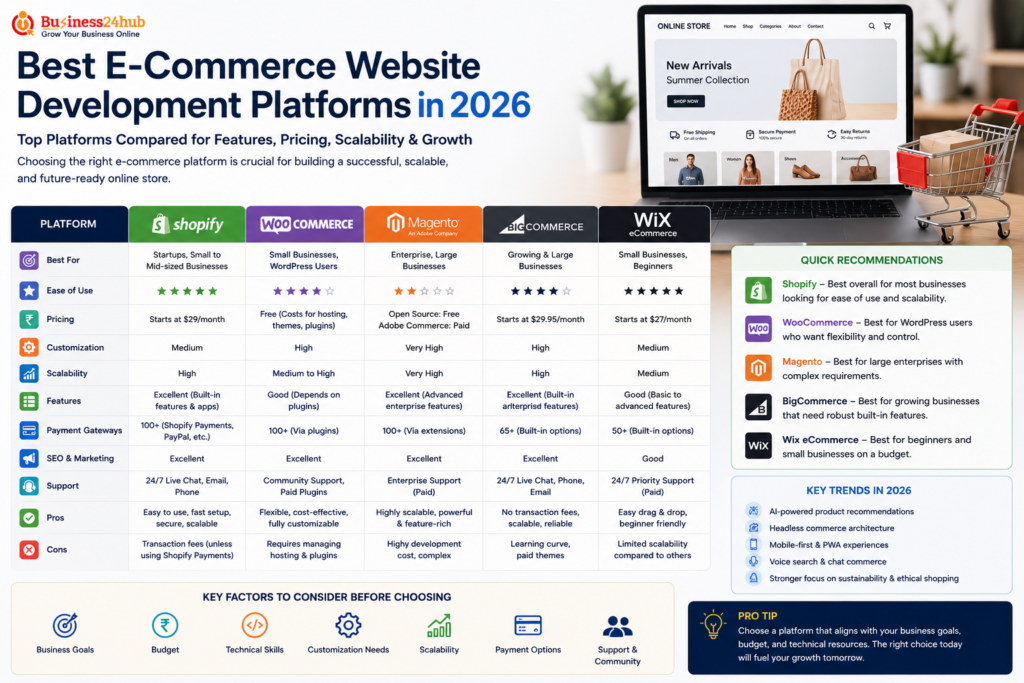
- 3 Shopify
- 4 WooCommerce
- 5 Magento (Adobe Commerce)
- 6 BigCommerce
- 7 Custom-Built E-Commerce (React, Next.js, or Headless Solutions)
- 8 Comparing Platforms by Startup Stage
- 9 Key Factors to Consider Beyond the Platform Name
- 10 Common Mistakes Startups Make Choosing an E-Commerce Platform
- 11 How business24hub Helps Startups Choose and Build the Right Platform
- 12 Frequently Asked Questions
- 13 Conclusion
- 14 Need E-Commerce Website for Your Business?
Introduction
Choosing an e-commerce platform feels like a small technical decision until you’re six months in, realizing your store can’t handle the features you actually need, or that switching platform now means rebuilding everything from scratch. The platform you choose at launch quietly shapes your costs, your flexibility, and how fast you can grow for years afterward.
In 2026, Indian startups have more e-commerce platform options than ever, ranging from beginner-friendly, all-in-one builders to fully custom, developer-driven solutions. The right choice depends entirely on your budget, technical resources, and how complex your store needs to be today versus a year from now. At business24hub, we work with early-stage founders through this exact decision regularly, and this guide breaks down the platform genuinely worth considering, what each one actually costs, and how to choose without guessing.
Why the Right Platform Choice Matters So Much
An e-commerce platform isn’t just where your products live online — it’s the foundation that determines your checkout experience, payment processing, inventory management, SEO performance, and how easily you can add features as your business grows. Choosing the wrong platform early often means hitting a wall later, where the only real fix is a costly, time-consuming migration to something more capable.
For Indian startups specifically, platform choice also affects how well you can handle local payment methods like UPI, regional logistics integrations, and GST-compliant invoicing, none of which every platform supports equally well out of the box. Getting this decision right from the start, ideally with guidance from a team that’s actually built stores across multiple platforms like business24hub, saves significant time and money compared to learning these lessons the hard way mid-growth.
Shopify
Shopify remains one of the most popular e-commerce platforms globally, and for good reason. It’s a fully hosted solution, meaning you don’t need to manage servers, security patches, or technical infrastructure yourself. The platform offers a clean, intuitive interface, a vast app ecosystem for extending functionality, and reliable performance even during high-traffic periods like sales events.
For Indian startups, Shopify now supports local payment gateways, including UPI-based options, making checkout smoother for Indian customers. Pricing typically starts around two thousand rupees per month for basic plans, scaling up significantly for advanced features and higher-volume stores. Shopify works best for startups wanting to launch quickly without managing technical infrastructure, though customization beyond what apps and themes offer can become limiting for highly specific, complex requirements.
WooCommerce
WooCommerce is a plugin that transforms a WordPress website into a fully functional e-commerce store, making it a natural choice for startups already comfortable with or already using WordPress for their main website. Unlike Shopify’s fully hosted model, WooCommerce requires you to manage your own hosting, though this also means significantly more control and flexibility over customization.
Cost-wise, WooCommerce itself is free, but total cost includes hosting, premium themes, and any paid extensions needed for specific functionality, typically ranging from a few thousand to several thousand rupees monthly depending on store complexity and traffic. WooCommerce suits startups wanting deep customization and content marketing integration through WordPress’s blogging capabilities, though it generally requires more technical management than a fully hosted platform like Shopify.
Magento (Adobe Commerce)
Magento, now part of Adobe Commerce, is built for larger, more complex e-commerce operations requiring extensive customization, multi-store management, or handling significant product catalogs and transaction volume. It offers powerful built-in features for complex inventory, multi-currency support, and advanced marketing tools, but comes with a steeper learning curve and higher development cost than more beginner-friendly platforms.
Given its complexity, Magento is generally overkill for early-stage Indian startups just launching their first store, and better suited for businesses with confirmed scale, dedicated technical resources, and genuinely complex requirements that simpler platforms can’t accommodate. Development costs for a properly built Magento store typically start in the lakhs of rupees, making it a consideration for later growth stages rather than initial launch.
BigCommerce
BigCommerce positions itself similarly to Shopify as a fully hosted solution, with particular strength in built-in features that other platforms often require paid apps to achieve, such as advanced product filtering and multi-channel selling across marketplaces. It tends to offer stronger out-of-box capability for stores with larger catalogs or more complex product variations without needing as many third-party app additions.
For Indian startups, BigCommerce’s app ecosystem and local payment support are improving but still generally less mature than Shopify’s, which remains a consideration if integration with specific Indian payment or logistics providers is a priority. Pricing is broadly comparable to Shopify, making the choice between the two often come down to specific feature needs and personal preference for the admin interface.
Custom-Built E-Commerce (React, Next.js, or Headless Solutions)
For startups with very specific requirements, unique user experiences, or plans for significant scale, a custom-built e-commerce solution using modern frontend frameworks paired with a headless commerce backend offers the most flexibility of any option on this list. This approach decouples the customer-facing experience from backend commerce logic, allowing highly tailored design and functionality that pre-built platforms simply can’t replicate.
This level of customization comes with meaningfully higher development cost and timeline, generally starting from several lakh rupees and requiring genuine development expertise to build and maintain properly. Custom solutions make sense once a startup has validated demand, confirmed specific feature needs that off-the-shelf platforms can’t support well, and has the budget to invest in a more substantial, tailored build. This is an area where business24hub’s development team frequently steps in, helping startups move from a validated, simpler platform toward a custom solution once that growth stage genuinely arrives.
Comparing Platforms by Startup Stage
For a startup still validating demand, a fully hosted, quick-to-launch platform like Shopify typically makes the most sense, minimizing both cost and technical complexity while you confirm whether your product genuinely has market demand. For a startup already running a WordPress site with blog content driving traffic, WooCommerce offers a natural extension without needing an entirely separate platform and ecosystem.
For a growing business with confirmed traction needing more complex catalog management or multi-channel selling, BigCommerce or Magento become reasonable considerations depending on the specific complexity involved. For a scaled business with confirmed revenue and very specific, unique requirements, a custom headless solution offers the flexibility needed to differentiate meaningfully from competitors using the same off-the-shelf templates.
Key Factors to Consider Beyond the Platform Name
Payment gateway support for India. Confirm any platform you’re considering supports the specific Indian payment methods your customers actually use, including UPI, popular wallets, and standard card processing, since gaps here directly hurt conversion rates.
Total cost of ownership, not just the headline price. Factor in hosting, apps, plugins, payment processing fees, and any development or design work needed beyond the base platform cost, since the actual total often differs significantly from a platform’s advertised starting price.
Scalability for your specific growth plans. Consider not just your current needs but realistic growth over the next one to two years, since migrating platforms later is considerably more disruptive and costly than choosing slightly ahead of your current needs from the start.
SEO capabilities. If organic search is part of your growth strategy, confirm the platform offers genuine flexibility for SEO optimization, including clean URL structures, proper meta tag control, and fast page load speeds, since some platforms handle this better than others by default.
Mobile performance. Given how much Indian e-commerce traffic arrives through mobile devices, test how each platform’s themes and checkout flow actually perform on real mobile devices, not just desktop previews, before committing.
Common Mistakes Startups Make Choosing an E-Commerce Platform
Choosing the most popular platform without confirming it actually fits specific needs, such as choosing a complex enterprise platform for a simple, small catalog store, often results in overpaying for capability that goes unused.
Underestimating total cost by focusing only on the platform’s base subscription fee, while ignoring apps, payment processing fees, and design or development costs, frequently leads to budget surprises after launch.
Choosing a highly customizable, complex platform too early, before validating genuine product demand, can drain both budget and time that would be better spent confirming whether the business model works at all first.
Ignoring mobile experience during platform and theme selection, despite mobile traffic dominating most Indian e-commerce, often results in a store that looks fine on desktop but underperforms significantly where most actual customers are shopping.
Failing to plan for future scalability, choosing the cheapest, most limited option without considering growth, sometimes results in a costly, disruptive platform migration sooner than necessary, once early limitations become genuine business constraints.
How business24hub Helps Startups Choose and Build the Right Platform
Picking a platform from a list is only the first step — building a store that actually converts, loads fast, and scales properly requires genuine development and design expertise behind it. At business24hub, we work directly with Indian startups to assess their specific product, budget, and growth stage, then recommend and build on the platform that genuinely fits, rather than defaulting to whatever’s currently trending.
Whether that means a fast, cost-effective Shopify or WooCommerce launch for early validation, or a more custom-built solution once a business has confirmed traction and specific scaling needs, our team handles the technical setup, payment gateway integration, mobile optimization, and SEO foundation needed to give your store a genuine chance to perform from day one, rather than launching something that looks fine but quietly underperforms where it matters.
Frequently Asked Questions
1. What is the best e-commerce website development platform for startups in 2026?
The Best E-Commerce Website Development Platform for Startups in 2026 depends on your business needs, budget, and growth plans. Popular choices include Shopify, WooCommerce, Magento, BigCommerce, and custom-built solutions, each offering unique features for online businesses.
2. Which e-commerce platform is the most affordable for startups?
WooCommerce and Shopify are among the most budget-friendly options for new businesses. When choosing the Best E-Commerce Website Development Platform for Startups in 2026, startups should compare subscription fees, hosting costs, and scalability.
3. Is Shopify better than WooCommerce for startups?
Shopify is easier to set up and maintain, while WooCommerce provides greater flexibility and customization. The Best E-Commerce Website Development Platform for Startups in 2026 depends on whether you prioritize ease of use or complete control over your website.
4. Which e-commerce platform is best for SEO?
WooCommerce, when combined with WordPress, is widely recognized for its SEO capabilities. However, Shopify, BigCommerce, and Magento also offer strong SEO features. The Best E-Commerce Website Development Platform for Startups in 2026 should support clean URLs, fast loading speeds, and customizable metadata.
5. What features should startups look for in an e-commerce platform?
The Best E-Commerce Website Development Platform for Startups in 2026 should include mobile responsiveness, secure payment gateways, inventory management, product search, SEO tools, analytics, order tracking, and easy scalability.
6. Can startups switch to another e-commerce platform later?
Yes. Most businesses can migrate to another platform as they grow. However, data migration, SEO preservation, and website redesign should be planned carefully when moving from one Best E-Commerce Website Development Platform for Startups in 2026 to another.
7. Which e-commerce platform is best for scaling a business?
Platforms like Shopify Plus, Magento, and BigCommerce are designed for businesses expecting rapid growth. Choosing the Best E-Commerce Website Development Platform for Startups in 2026 with scalability ensures your website can handle increasing traffic and sales.
8. Does the e-commerce platform affect website speed and performance?
Yes. Website speed depends on hosting quality, platform optimization, themes, and plugins. The Best E-Commerce Website Development Platform for Startups in 2026 should provide fast loading times to improve user experience and search engine rankings.
9. How important is mobile optimization for an e-commerce website?
Mobile optimization is essential because a large percentage of online shoppers use smartphones. The Best E-Commerce Website Development Platform for Startups in 2026 should offer responsive designs and a seamless mobile shopping experience.
10. How do startups choose the best e-commerce website development platform?
To select the Best E-Commerce Website Development Platform for Startups in 2026, evaluate your budget, business goals, expected traffic, customization needs, SEO requirements, payment options, and long-term scalability before making a decision.
Conclusion
There’s no single “best” e-commerce platform for every Indian startup — only the platform that genuinely fits your current stage, budget, and growth plans. Choosing based on hype or what a competitor uses, without evaluating your own specific needs, often leads to either overpaying for unused complexity or hitting frustrating limitations sooner than expected.
At business24hub, we help startups cut through this decision with genuine technical guidance, building stores that aren’t just launched quickly, but built to perform and scale as the business actually grows. Whichever platform fits your stage today, getting it built and optimized properly from the start is what determines whether your e-commerce store becomes a genuine growth engine or just another underperforming website.
Need E-Commerce Website for Your Business?
🟡Business24Hub provides complete IT, web development, software development, digital marketing, branding, SEO, mobile app development, and business consulting services to startups, entrepreneurs, SMEs, and enterprises across India.
🟡For other Legal and Trademark related services Visit
👉 Money Recovery Cases
👉 Property Disputes
👉 Business & Licence Registrations
🟡 Protect Your Rights
👉 Domestic Violence Legal Support
👉 Stridhan Recovery
👉 Mutual Consent Divorce
👉 Contested Divorce Filing
👉 Child Custody and Maintenance
👉 Matrimonial Property Settlement
👉 NRI Divorce Services
👉 Alimony and Maintenance
📞 Call Now: +91 8595439395
🕐 Free Consultation: Monday to Saturday, 10 AM to 6 PM

I’m Aryan Yadav, passionate about SEO and Digital Marketing with a strong interest in helping businesses grow online. I enjoy learning new strategies, exploring digital trends, and creating ideas that deliver value. I believe in continuous growth, creativity, and building meaningful results through smart work and dedication.

