

Views: 0
A complete 2026 breakdown of website development cost in India, covering landing pages, business sites, e-commerce, and custom web apps, with real price ranges and cost factors.
Table of Contents
- 1 Introduction
- 2 Why There’s No Single Answer to This Question
- 3 Website Development Cost by Project Type in 2026
- 4 Cost Comparison: DIY, Freelancer, and Agency
- 5 Key Factors That Drive Website Development Cost Up or Down
- 6 Hidden Costs Startups Often Overlook
- 7 Realistic Budget Ranges by Startup Stage
- 8 How to Get an Accurate Quote
- 9 Common Mistakes Startups Make With Website Budgets
- 10 A Practical Example: Budgeting for a Real Startup Website
- 11 Frequently Asked Questions
- 12 Conclusion
- 13 Need Website for Your Business?
Introduction
“How much will a website cost?” is one of the first questions every founder asks, and one of the hardest to answer honestly, because the real answer is: it depends entirely on what you’re building. A simple one-page site and a full-featured e-commerce platform with custom integrations are both technically “websites,” yet their development costs can differ by lakhs of rupees.
In 2026, with so many options ranging from free DIY builders to specialized development agencies, pricing has become both more accessible and more confusing at the same time. This guide breaks down realistic website development costs in India across every common project type, explains exactly what drives those numbers up or down, and gives you a practical framework to budget accurately for your own project instead of guessing or anchoring on a number you saw in someone else’s case study.
Why There’s No Single Answer to This Question
Website development cost isn’t a fixed line item the way, say, a SaaS subscription is. It’s shaped by dozens of variables working together: the complexity of features, the number of pages, the quality of design, whether you’re hiring a freelancer or an agency, the technology used, and even which city or country the developer is based in.
Two businesses asking for “a website” can end up with wildly different quotes because one means a five-page brochure site and the other means a custom platform with user accounts, payment processing, and a backend dashboard. Before getting a quote from anyone, it helps to understand which category your project actually falls into, since that single decision affects cost more than almost anything else.
Website Development Cost by Project Type in 2026
Landing Page (single page, focused on one goal) A landing page is the cheapest and fastest website asset to build. DIY using a no-code builder can cost as little as free to three thousand rupees per month for a premium plan. A freelancer-built, custom-designed landing page typically ranges from eight thousand to thirty-five thousand rupees, while an agency-built, high-conversion landing page with custom copywriting and design can run from thirty-five thousand to one lakh rupees or more.
Basic Business Website (five to ten pages) This is the most common starting point for startups and small businesses — a homepage, About page, Services or Products page, Contact page, and a few supporting pages. A freelancer-built version typically costs between forty thousand and one and a half lakh rupees. An agency-built version, including proper SEO setup, a content management system, and custom design, generally ranges from one and a half lakh to four lakh rupees.
E-commerce Website E-commerce sites carry additional complexity through product catalogs, payment gateway integration, inventory management, and order processing. A basic e-commerce store built on an existing platform with a freelancer typically costs between sixty thousand and two lakh rupees. A more robust, custom-designed e-commerce platform built by an agency, including advanced features like multi-currency support, subscription billing, or custom checkout flows, can range from two and a half lakh to eight lakh rupees or beyond.
Web Application or SaaS Product This category covers platforms with user accounts, dashboards, complex backend logic, and often real-time functionality, going well beyond a typical content website. Development costs here vary enormously based on feature complexity, but a basic minimum viable product typically starts around three to six lakh rupees, while a more fully-featured application can range from eight lakh to twenty-five lakh rupees or significantly more, depending on scope.
Enterprise or Highly Custom Platforms For startups building genuinely complex, custom infrastructure, often involving extensive third-party integrations, custom security requirements, or large-scale architecture, costs can exceed twenty-five lakh rupees and climb well into the range of established enterprise software budgets, depending entirely on scope and ongoing development needs.
Cost Comparison: DIY, Freelancer, and Agency
DIY Website Builders Platforms allowing founders to build a website themselves without coding knowledge represent the cheapest entry point, often free or available for a few thousand rupees monthly for premium features and hosting. This route works well for simple landing pages or basic informational sites, but typically lacks the customization, performance optimization, and scalability needed as a business grows more complex.
Freelance Developers and Designers Hiring an individual freelancer or small freelance team typically costs significantly less than an agency for comparable work, often forty to sixty percent less, since you’re not paying for an agency’s overhead, account management layer, or larger team structure. The trade-off is generally less structured project management, potentially slower turnaround if the freelancer is juggling multiple clients, and more variability in quality depending on the specific individual’s skill level.
Development Agencies Agencies typically charge more but offer structured project management, a full team covering design, development, and quality assurance, and generally more reliable timelines and ongoing support. For startups with more complex requirements, tighter timelines, or limited internal capacity to manage a freelancer directly, the premium often proves worthwhile despite the higher upfront cost.
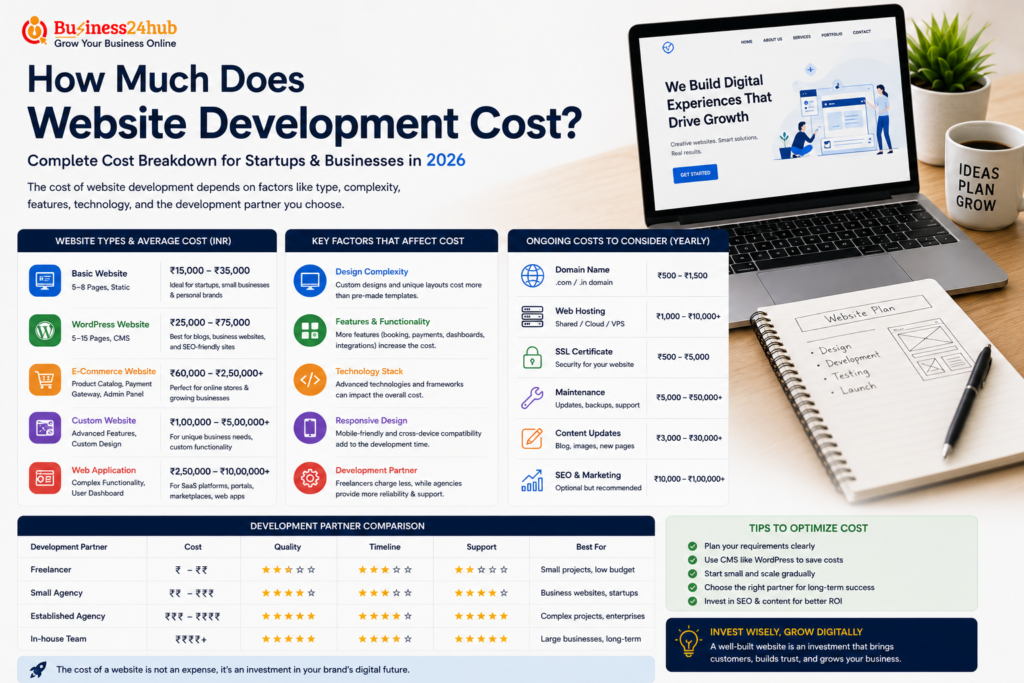
Key Factors That Drive Website Development Cost Up or Down
Number of pages and content volume. More pages generally mean more design, development, and content creation work, directly increasing cost, though this scales less than linearly once a template system is established for repeated page types.
Custom design versus template-based design. Fully custom design work, built from scratch around your specific brand, costs considerably more than customizing an existing professional template, though it typically produces a more distinctive, brand-aligned result.
Functionality and features. Each additional feature, such as a booking system, live chat integration, multi-language support, or membership areas, adds development time and therefore cost, with complexity compounding particularly when features need to interact with each other.
Third-party integrations. Connecting your website to external tools like payment gateways, customer relationship management platforms, email marketing software, or analytics systems adds both initial development cost and sometimes ongoing maintenance considerations as those integrations evolve.
Content creation needs. If you need professional copywriting, photography, or video production created specifically for the site, this adds meaningfully to total project cost beyond the technical development work alone.
Timeline urgency. Rush projects requiring compressed timelines often carry premium pricing, since they typically require additional resources or overtime work to meet an accelerated deadline compared to a standard project schedule.
Ongoing maintenance and support. Many quotes focus only on initial build cost while overlooking ongoing hosting, security updates, content updates, and technical support, which represent a real recurring cost separate from the one-time development fee.
Hidden Costs Startups Often Overlook
Domain and hosting fees. While relatively small individually, domain registration and hosting costs are recurring annual expenses that should be budgeted separately from the one-time development cost, typically ranging from a few hundred to a few thousand rupees annually for hosting, depending on traffic and performance needs.
SSL certificates and security. Basic SSL certificates are often included free with modern hosting providers, but more advanced security needs, particularly for e-commerce sites handling payment information, may require additional investment.
Premium plugins and software licenses. Many websites rely on premium plugins, themes, or third-party software licenses that carry their own ongoing subscription costs, separate from the initial development fee paid to a freelancer or agency.
Content updates after launch. Unless you have someone on your team capable of making ongoing content updates independently, you may need to budget for continued freelancer or agency involvement for changes after the initial launch, particularly relevant for businesses without internal technical or design capacity.
SEO and digital marketing setup. Basic on-page SEO is sometimes included in development quotes, but more comprehensive SEO strategy, content creation, and ongoing optimization typically represent a separate, additional investment beyond the website build itself.
Realistic Budget Ranges by Startup Stage
Pre-validation stage (testing an idea). At this stage, a simple landing page costing between ten and forty thousand rupees, or even a free DIY solution, is typically sufficient and appropriate, since the goal is testing demand rather than building a polished, comprehensive web presence.
Early-stage, post-validation. Once you’ve confirmed demand and are building a more established presence, a budget of one to three lakh rupees for a well-designed business website, or two to four lakh rupees for a basic e-commerce store, represents a reasonable, sustainable investment for most early-stage startups.
Growth stage with confirmed traction. Startups with confirmed product-market fit and growing revenue can reasonably invest more significantly, often three to ten lakh rupees for a more sophisticated website or web application, particularly if the platform itself plays a central role in the product or revenue generation.
Scaling stage with significant funding or revenue. At this stage, custom platforms, complex web applications, or enterprise-level infrastructure investments exceeding ten lakh rupees may be entirely appropriate, justified by the scale of operations and revenue the platform needs to support.
How to Get an Accurate Quote
When requesting quotes from freelancers or agencies, vague requests like “I need a website” almost always produce vague, hard-to-compare quotes. Instead, prepare a clear brief covering the specific number and type of pages needed, any required features or integrations, whether you need original content creation or will provide your own, your timeline expectations, and any specific design references or competitor sites you admire.
Request itemized quotes breaking down design, development, content, and any ongoing maintenance costs separately, rather than accepting a single bundled number that makes it difficult to understand exactly what you’re paying for. This also makes it far easier to compare quotes fairly across multiple freelancers or agencies, since you’re comparing the same defined scope rather than potentially different assumptions about what’s included.
Common Mistakes Startups Make With Website Budgets
Choosing the cheapest available option without considering long-term scalability often results in a website that needs significant rework or a full rebuild within a year or two, ultimately costing more in total than investing slightly more upfront for a more durable foundation.
Underestimating ongoing costs by focusing exclusively on the one-time development fee frequently leads to budget surprises once hosting, maintenance, content updates, and software licensing costs accumulate over the following months.
Requesting quotes without a clear, specific brief makes it difficult to compare options fairly and often results in scope creep, where the final project ends up costing significantly more than the initial quote once “small” additional requests accumulate during development.
Over-investing in a highly custom, expensive platform before validating genuine business demand can drain capital that would be better allocated toward product development or customer acquisition during the earliest, most uncertain stage of a startup’s life.
Assuming a higher price automatically guarantees better quality, without reviewing actual portfolio work, client references, or technical capability, can lead to overpaying for a result that doesn’t actually match the promised value.
A Practical Example: Budgeting for a Real Startup Website
Consider an early-stage Delhi-based startup selling a subscription meal-planning service, needing a website that explains their offering, showcases sample meal plans, and allows visitors to sign up for a free trial. Given they’re still validating demand, they choose a freelancer-built, eight-page business website rather than a more expensive custom platform, budgeting around seventy thousand rupees for design and development.
This includes a homepage, an About page explaining their founding story, a how-it-works page, a sample meal plans page, a pricing page, and a sign-up flow connecting to their existing subscription management tool through a straightforward integration. They separately budget around eight thousand rupees annually for hosting and domain costs, and allocate an additional fifteen thousand rupees for professional food photography, recognizing that compelling visuals matter significantly for a meal-planning brand specifically.
As the business grows and validates strong demand over the following year, they revisit their website budget, this time investing in a more robust e-commerce-style platform supporting more sophisticated subscription management and personalization features, budgeting closer to three lakh rupees for this more substantial second-stage build, justified by confirmed revenue and a clearer understanding of exactly which features genuinely matter to their growing customer base.
Frequently Asked Questions
1. How much does website development cost in India in 2026?
The Website Development Cost in India in 2026 depends on the type of website, required features, design complexity, and development platform. A basic business website may cost between ₹10,000 and ₹50,000, while custom websites and eCommerce platforms can range from ₹50,000 to several lakhs.
2. What factors affect Website Development Cost in India in 2026?
Several factors influence Website Development Cost in India in 2026, including the number of pages, custom design, CMS selection, eCommerce functionality, third-party integrations, SEO optimization, hosting, domain registration, and ongoing maintenance.
3. Is WordPress cheaper than custom website development?
Yes. WordPress is generally more affordable because it offers ready-made themes and plugins, reducing development time. When comparing Website Development Cost in India in 2026, custom-built websites usually cost more due to advanced features and personalized development.
4. Does Website Development Cost include domain and hosting?
Not always. Some web development agencies include domain registration and hosting in their packages, while others charge separately. Before finalizing a project, clarify what is included in the Website Development Cost in India in 2026.
5. How much does an eCommerce website cost in India in 2026?
An eCommerce website typically costs between ₹40,000 and ₹3,00,000 or more, depending on features such as payment gateways, inventory management, product filters, customer accounts, and custom integrations. These features significantly impact the Website Development Cost in India in 2026.
6. Are there any ongoing costs after website development?
Yes. Besides the initial Website Development Cost in India in 2026, businesses should budget for domain renewal, hosting, SSL certificates, maintenance, security updates, backups, content updates, and digital marketing services.
7. How can startups reduce Website Development Cost in India in 2026?
Startups can lower their Website Development Cost in India in 2026 by choosing a scalable CMS like WordPress, starting with essential features, using responsive templates, avoiding unnecessary customizations, and working with an experienced web development company that offers transparent pricing.
Conclusion
Website development cost in India in 2026 isn’t a single number — it’s a range shaped by exactly what you’re building, who builds it, and how much complexity your specific business genuinely needs at its current stage. The right approach isn’t chasing the cheapest possible option or assuming more expensive automatically means better, but matching your investment realistically to your validated needs and growth stage.
The startups that spend wisely on web development aren’t necessarily the ones with the biggest budgets. They’re the ones that understand exactly what they’re paying for, request clear and comparable quotes, budget honestly for ongoing costs beyond the initial build, and scale their investment deliberately as their business and confirmed needs actually grow, rather than guessing at a number before understanding what their website truly needs to accomplish.
Need Website for Your Business?
🟡Business24Hub provides complete IT, web development, software development, digital marketing, branding, SEO, mobile app development, and business consulting services to startups, entrepreneurs, SMEs, and enterprises across India.
🟡For other Legal and Trademark related services Visit
👉 Money Recovery Cases
👉 Property Disputes
👉 Business & Licence Registrations
🟡 Protect Your Rights
👉 Domestic Violence Legal Support
👉 Stridhan Recovery
👉 Mutual Consent Divorce
👉 Contested Divorce Filing
👉 Child Custody and Maintenance
👉 Matrimonial Property Settlement
👉 NRI Divorce Services
👉 Alimony and Maintenance
📞 Call Now: +91 8595439395
🕐 Free Consultation: Monday to Saturday, 10 AM to 6 PM

I’m Aryan Yadav, passionate about SEO and Digital Marketing with a strong interest in helping businesses grow online. I enjoy learning new strategies, exploring digital trends, and creating ideas that deliver value. I believe in continuous growth, creativity, and building meaningful results through smart work and dedication.

