

Views: 0
Learn Email and Content Marketing Integration, with a step-by-step framework, lead magnet ideas, and conversion tactics.
Table of Contents
- 1 Introduction
- 2 Why Blogs Remain a Powerful Email List Growth Tool in 2026
- 3 Understanding the Blog-to-Email Relationship
- 4 Step 1: Audit Your Blog’s Current List-Building Potential
- 5 Step 2: Match Lead Magnets to Specific Blog Topics
- 6 Step 3: Place Opt-In Forms Where Readers Actually Convert
- 7 Step 4: Use Content Upgrades Instead of Generic Sign-Up Forms
- 8 Step 5: Prioritize Optimization on High-Traffic Posts First
- 9 Step 6: Build Topic Clusters That Funnel Toward List Growth
- 10 Step 7: Use Exit-Intent and Scroll-Triggered Popups Strategically
- 11 Step 8: Repurpose Blog Content Into Email Sequences
- 12 Step 9: Track Blog-to-List Conversion Rate, Not Just Traffic
- 13 Step 10: A/B Test Opt-In Copy, Design, and Placement
- 14 Common Mistakes Startups Make Connecting Blogs and Email
- 15 A Practical Example: Blog-Driven List Growth in Action
- 16 Tools That Support Blog-to-Email Integration in 2026
- 17 Frequently Asked Questions
- 18 FAQs
- 19 Conclusion
- 20 Email and Content Marketing Integration for Your Business?
Introduction
A blog without an email list is a leaky bucket. Visitors arrive, read something genuinely useful, and then leave, often never to return, simply because there was no clear, compelling reason for them to stay connected to your brand. Meanwhile, an email list without fresh content to fuel it tends to stagnate, with subscribers slowly disengaging from a brand that has nothing new or valuable to say.
The real opportunity lies in connecting the two deliberately. In 2026, with organic social reach increasingly unreliable and email remaining one of the few channels startups fully own, blog content has become one of the most cost-effective tools for consistent email list growth, when integrated correctly. This guide breaks down exactly how startups should connect blog content and email list building into a single, deliberate growth system, rather than treating them as two separate marketing efforts running in parallel without much overlap.
Why Blogs Remain a Powerful Email List Growth Tool in 2026
It’s tempting to assume blogging has lost relevance in an era dominated by short-form video and social content, but for email list growth specifically, blogs still offer something most other formats can’t match: depth, search visibility, and a natural moment to ask for an email address once genuine value has already been delivered.
Unlike a fifteen-second video, a blog post gives a reader enough time and context to genuinely understand the value you’re offering, building the kind of trust that makes handing over an email address feel like a reasonable next step rather than an intrusive request. Blogs also benefit from long-term organic search traffic, meaning a single well-optimized post can continue attracting new potential subscribers for months or years after publishing, unlike most social content that disappears from relevance within days.
Understanding the Blog-to-Email Relationship
The connection between blog content and email list growth isn’t simply about slapping a generic “subscribe to our newsletter” form onto every page and hoping for the best. It’s about understanding that a blog post’s job is to deliver value and build enough trust that a reader wants more, while the email opt-in’s job is to capture that interest at exactly the right moment, with an offer specific enough to feel worth the exchange.
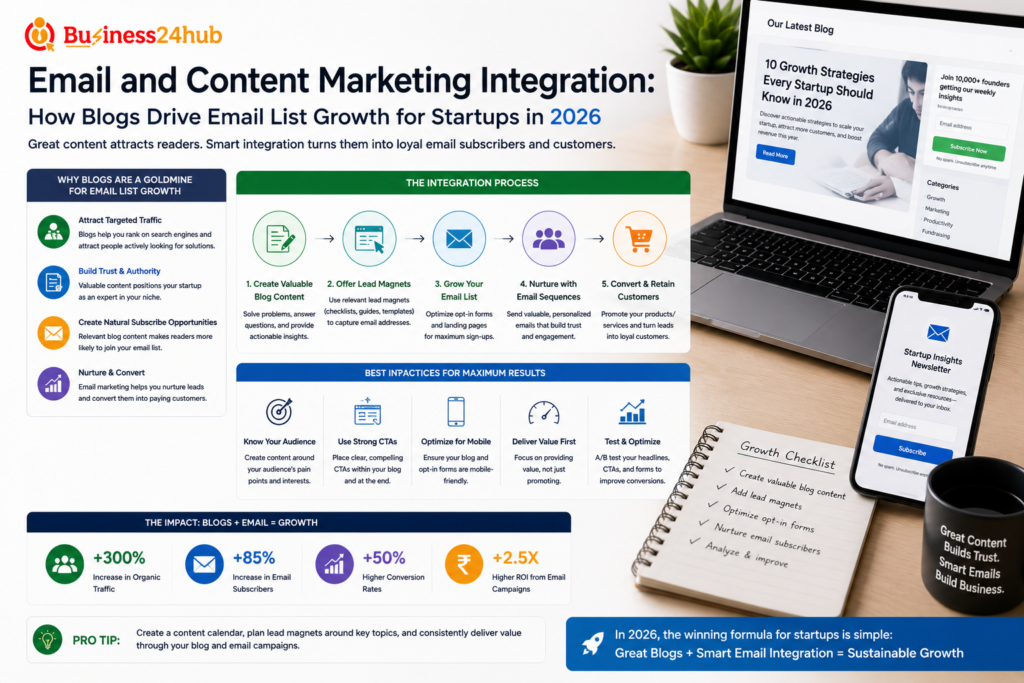
When this relationship is built deliberately, blog content essentially becomes your top-of-funnel list-building engine, while email becomes the mechanism that nurtures those new subscribers toward eventually becoming customers, exactly as outlined in a broader content and email funnel strategy. The blog attracts and earns trust; email retains that relationship and moves it forward.
Step 1: Audit Your Blog’s Current List-Building Potential
Before making changes, review your existing blog content and current email capture setup honestly. Which posts already receive meaningful organic traffic? Where are opt-in forms currently placed, and how generic or specific is the offer being made? Most startups discover their highest-traffic posts have either no dedicated opt-in offer at all, or a single generic newsletter sign-up that doesn’t clearly relate to the specific content the reader just consumed.
This audit typically reveals your biggest, fastest opportunity: posts already attracting solid traffic but converting almost none of it into email subscribers simply because the capture mechanism wasn’t designed with that specific content’s audience in mind.
Step 2: Match Lead Magnets to Specific Blog Topics
A generic newsletter offer converts far fewer readers than a lead magnet directly tied to what they just read. If someone just finished a detailed blog post about pricing strategies for a SaaS product, a specific pricing calculator or template feels like a natural, valuable next step, while a vague “subscribe for updates” feels disconnected from what actually brought them to the page.
Build lead magnets around your highest-traffic content clusters specifically. This might mean a downloadable checklist summarizing a how-to guide, a more detailed template expanding on a framework mentioned in the post, or an exclusive deeper resource that builds directly on the topic already proven to attract genuine reader interest. The tighter the match between content and offer, the higher your conversion rate from reader to subscriber will be.
Step 3: Place Opt-In Forms Where Readers Actually Convert
Where you place your email capture form matters as much as what you’re offering. A form buried only in a sidebar or footer, areas readers frequently skip entirely, will underperform regardless of how compelling the actual offer is. Effective placement typically includes an inline form roughly midway through longer content, appearing exactly when a reader has engaged enough to demonstrate genuine interest but hasn’t yet finished and potentially left the page.
A second, often highly effective placement is at the very end of a post, capturing readers who finished the content and are deciding what to do next. Many startups also see strong results from a content-specific call-to-action embedded naturally within the text itself, directly referencing the lead magnet in context rather than relying purely on a generic form widget disconnected from the surrounding content.
Step 4: Use Content Upgrades Instead of Generic Sign-Up Forms
A content upgrade is a specific lead magnet offered as a natural extension of the exact post a reader is currently consuming, and it consistently outperforms generic site-wide newsletter offers. Rather than asking every visitor across your entire blog to subscribe to the same generic newsletter, offer a downloadable summary, template, or bonus resource specifically tied to the individual post they’re reading right now.
This approach requires more upfront content creation effort, since you’re essentially building a small, specific offer for each major piece of content rather than one generic offer reused everywhere. The payoff is a meaningfully higher opt-in rate, since the offer feels custom-built for the reader’s exact current interest rather than a one-size-fits-all request.
Step 5: Prioritize Optimization on High-Traffic Posts First
Not every blog post deserves equal optimization effort when it comes to email capture. Identify your highest-traffic existing posts through your analytics platform, and prioritize building strong, specific lead magnets and well-placed opt-in forms for these pages first, since even a modest improvement in conversion rate on high-traffic content will outperform a perfectly optimized opt-in on a post almost nobody visits.
This prioritization also applies to future content planning. Before investing significant time into a new blog post, consider whether the topic has genuine potential to attract meaningful organic traffic over time, since a post’s value for email list growth depends heavily on consistent visibility, not just the quality of the writing itself.
Step 6: Build Topic Clusters That Funnel Toward List Growth
Rather than treating each blog post as an isolated piece, organize content into topic clusters built around a central theme, with each related post linking to others within the same cluster. This keeps readers engaged across multiple pieces of content rather than reading one post and leaving immediately, increasing the number of opportunities they encounter a relevant opt-in offer before exiting your site entirely.
A well-structured cluster might include a comprehensive pillar guide on a core topic, supported by several related posts diving deeper into specific subtopics, each offering its own tightly relevant content upgrade. A reader exploring multiple posts within the same cluster encounters multiple, increasingly specific opportunities to subscribe, significantly increasing overall list growth compared to a single isolated opt-in attempt on one page.
Step 7: Use Exit-Intent and Scroll-Triggered Popups Strategically
While intrusive, poorly timed popups can hurt user experience and even search rankings on mobile, well-implemented exit-intent and scroll-triggered opt-ins can meaningfully boost list growth without significantly damaging the reading experience, when used thoughtfully. Exit-intent popups, triggered when a reader shows signs of leaving the page, capture attention at a moment when they’ve already consumed most or all of the content but haven’t yet committed to subscribing.
Scroll-triggered opt-ins, appearing after a reader has scrolled through a meaningful portion of an article, target genuinely engaged readers rather than interrupting someone who just arrived and hasn’t yet decided whether the content is worth their time. Avoid full-screen interstitials immediately on page load, particularly on mobile, since these create poor user experience and have been specifically associated with negative search ranking signals.
Step 8: Repurpose Blog Content Into Email Sequences
The relationship between blogs and email shouldn’t be limited to capturing the subscriber — it should extend into how you nurture them afterward. Repurpose strong-performing blog content directly into welcome sequences and nurture emails, rather than creating entirely separate email content from scratch for every new subscriber touchpoint.
A detailed blog post can often be broken into a short series of follow-up emails, each expanding on one specific section or insight, giving new subscribers a reason to continue engaging with your brand beyond the single post that originally brought them in. This approach also significantly reduces the content creation burden on your team, since existing blog material gets extended value rather than requiring an entirely separate email content pipeline.
Step 9: Track Blog-to-List Conversion Rate, Not Just Traffic
Traffic numbers alone don’t tell you whether your blog is actually contributing to list growth effectively. Track the specific conversion rate from blog visitor to email subscriber for each major post or content cluster, allowing you to identify which content genuinely converts well versus which simply attracts traffic without translating into list growth.
This data often reveals surprising patterns, such as a moderate-traffic post converting at a significantly higher rate than your highest-traffic page, suggesting either a stronger topic-to-offer match or simply a more engaged, relevant audience reaching that particular piece of content. Use these insights to refine which topics and formats you prioritize in future content planning, rather than judging content success purely by raw visitor numbers.
Step 10: A/B Test Opt-In Copy, Design, and Placement
Small changes to your opt-in form’s copy, design, and placement can produce meaningfully different conversion results, and these differences are rarely obvious without deliberate testing. Test variations in your call-to-action wording, the specific framing of your lead magnet’s value, button color and form design, and exact placement timing within longer content.
Run these tests systematically, changing one variable at a time where possible, and let genuine performance data guide your decisions rather than personal preference about which version “looks better.” Over time, these incremental improvements compound into significantly stronger overall list growth from the exact same blog traffic you’re already generating.
Common Mistakes Startups Make Connecting Blogs and Email
Using a single generic newsletter opt-in across the entire blog, regardless of individual post topic or reader intent, is one of the most common and limiting mistakes, leaving significant conversion potential unrealized across content that could support much more specific, compelling offers.
Focusing heavily on blog traffic growth while neglecting opt-in optimization entirely is another frequent gap, since dramatically increasing visitors to a blog with poor conversion mechanisms in place produces far less list growth than modestly increasing traffic while also strengthening conversion rate.
Treating blog content and email content as entirely separate efforts, created by different processes with no deliberate connection between them, wastes an obvious opportunity to repurpose strong content across both channels rather than duplicating creation effort unnecessarily.
Over-relying on intrusive, poorly timed popups, particularly full-screen interstitials on mobile, can damage both user experience and search performance, undermining the very traffic that list growth efforts depend on in the first place.
Failing to follow up new subscribers with genuinely relevant content tied to what originally attracted them frequently leads to high unsubscribe rates shortly after sign-up, since a mismatch between the original blog content and ensuing the generic email content quickly reveals the connection wasn’t as thoughtfully built as the initial opt-in moment suggested.
A Practical Example: Blog-Driven List Growth in Action
Consider a startup selling accounting software for freelancers, publishing a detailed blog post on how freelancers should handle quarterly tax estimates. Initially, the post used only a generic “subscribe to our newsletter” form in the sidebar, converting a very small fraction of its steady organic traffic into email subscribers.
After auditing performance, the team builds a specific content upgrade, a quarterly tax calculator template directly tied to the post’s content, replacing the generic sidebar form with an inline opt-in roughly halfway through the article and a second prompt at the post’s conclusion. They also build two related cluster posts, one covering common tax deductions freelancers miss and another covering invoicing best practices, each linking back to the original post and offering its own tightly relevant content upgrade.
Within a few months, blog-to-subscriber conversion rate on the original post increases significantly compared to the previous generic approach, and new subscribers entering through this specific tax-focused content receive a short three-email follow-up sequence, repurposed directly from the blog content itself, expanding on related tax-saving tips before introducing the product naturally as a relevant solution. Tracking reveals these tax-content subscribers show notably higher engagement and eventual conversion rates compared to subscribers acquired through less targeted, generic list-building efforts elsewhere on the site.
Tools That Support Blog-to-Email Integration in 2026
Most modern email marketing platforms now offer built-in opt-in form builders supporting content-specific offers, inline placement, and exit-intent or scroll-triggered triggers without requiring separate, complex integrations. These native tools are often sufficient for startups in the early stages of building out a more deliberate blog-to-email strategy.
For more advanced needs, dedicated lead capture and conversion optimization tools offer deeper A/B testing capabilities and more sophisticated targeting based on specific reader behavior, such as which posts or topics a visitor has previously engaged with. Analytics platforms connected directly to your email tool allow you to track the full journey from blog visit to subscriber to eventual customer, providing the kind of connected data needed to genuinely understand which content is driving real list growth and business impact, rather than relying on disconnected, surface-level metrics from each tool in isolation.
Frequently Asked Questions
FAQs
1. What is Email and Content Marketing Integration?
Email and Content Marketing Integration is the practice of combining valuable blog content with email marketing campaigns to attract, engage, and convert subscribers. For startups in 2026, this strategy helps build stronger customer relationships while growing a high-quality email list.
2. How do blogs help grow an email list for startups?
Blogs attract organic traffic through SEO, giving startups opportunities to capture visitors’ email addresses using lead magnets, newsletters, and subscription forms. Email and Content Marketing Integration ensures that blog readers become long-term email subscribers.
3. Why is Email and Content Marketing Integration important for startups in 2026?
Startups often have limited marketing budgets, making Email and Content Marketing Integration a cost-effective way to generate leads, nurture prospects, increase customer engagement, and improve conversion rates without relying solely on paid advertising.
4. What types of blog content generate the most email subscribers?
How-to guides, industry insights, case studies, free templates, checklists, and downloadable eBooks are among the most effective content formats. When paired with strong calls-to-action, Email and Content Marketing Integration can significantly boost email list growth.
5. What are the best ways to convert blog readers into email subscribers?
Startups can use pop-ups, inline subscription forms, exit-intent forms, gated content, exclusive newsletters, and free resources. These tactics make Email and Content Marketing Integration more effective by encouraging visitors to subscribe.
6. Which tools support Email and Content Marketing Integration?
Popular tools include Mailchimp, Brevo (formerly Sendinblue), HubSpot, ConvertKit, MailerLite, and WordPress email marketing plugins. These platforms automate subscriber collection, email campaigns, and performance tracking for better Email and Content Marketing Integration.
7. How can startups measure the success of Email and Content Marketing Integration?
Businesses should monitor email sign-up rates, blog traffic, click-through rates, open rates, subscriber growth, conversion rates, and ROI. Tracking these metrics helps startups optimize their Email and Content Marketing Integration strategy for sustained business growth.
Conclusion
Blogs and email marketing perform far better together than they do as separate, disconnected efforts. A blog without a deliberate list-building strategy leaves significant growth potential untapped with every visitor who reads and leaves without any way to stay connected, while an email list without fresh, relevant content to fuel ongoing engagement eventually stagnates regardless of how it was originally built.
The startups that grow their email lists most effectively in 2026 aren’t necessarily publishing the most blog content. They’re the ones thoughtfully matching specific lead magnets to specific content, placing opt-in opportunities where genuine reader interest is highest, and continuously refining based on real conversion data, turning every blog post into a deliberate, working part of their broader growth engine rather than content existing in isolation from the list-building strategy it could be powering.
Email and Content Marketing Integration for Your Business?
🟡Business24Hub provides complete IT, web development, software development, digital marketing, branding, SEO, mobile app development, and business consulting services to startups, entrepreneurs, SMEs, and enterprises across India.
🟡For other Legal and Trademark related services Visit
👉 Money Recovery Cases
👉 Property Disputes
👉 Business & Licence Registrations
🟡 Protect Your Rights
👉 Domestic Violence Legal Support
👉 Stridhan Recovery
👉 Mutual Consent Divorce
👉 Contested Divorce Filing
👉 Child Custody and Maintenance
👉 Matrimonial Property Settlement
👉 NRI Divorce Services
👉 Alimony and Maintenance
📞 Call Now: +91 8595439395
🕐 Free Consultation: Monday to Saturday, 10 AM to 6 PM

I’m Aryan Yadav, passionate about SEO and Digital Marketing with a strong interest in helping businesses grow online. I enjoy learning new strategies, exploring digital trends, and creating ideas that deliver value. I believe in continuous growth, creativity, and building meaningful results through smart work and dedication.

