

Views: 0
A detailed WordPress vs React comparison for startups in 2026, covering performance, SEO, cost, scalability, and a practical framework to help you choose right.
Table of Contents
- 1 Introduction
- 2 Understanding the WordPress vs React Debate
- 3 What Is WordPress?
- 4 What Is React?
- 5 WordPress vs React: Core Architecture Differences
- 6 Performance: WordPress vs React in 2026
- 7 SEO Considerations: WordPress vs React
- 8 Cost Comparison: WordPress vs React for Startups
- 9 Customization and Flexibility
- 10 Learning Curve and Team Requirements
- 11 Scalability for Growing Startups
- 12 Security Considerations
- 13 When Should a Startup Choose WordPress?
- 14 When Should a Startup Choose React?
- 15 Can You Combine WordPress vs React? The Headless Approach
- 16 Common Mistakes Startups Make in This Decision
- 17 A Quick Decision Framework
- 18 Frequently Asked Questions
- 19 Conclusion
- 20 Need Website for Your Business?
Introduction
Every founder building a website eventually runs into the same fork in the road: WordPress or React. It sounds like a simple technical decision, but the WordPress vs React choice actually shapes how fast you can launch, how much development cost you’ll carry long-term, and how easily your site will scale as your startup grows.
In 2026, this decision has become more nuanced than it used to be, with WordPress evolving well beyond its blogging roots and React powering everything from simple landing pages to complex web applications. This guide breaks down the WordPress vs React debate in practical, founder-friendly terms, so you can choose based on your actual business needs rather than developer preference or internet hype.
Understanding the WordPress vs React Debate
Before comparing features, it helps to understand what you’re actually comparing, because WordPress vs React isn’t really an apples-to-apples comparison on a technical level. WordPress is a complete content management system, handling everything from content storage to page rendering to plugin management out of the box. React, on the other hand, is a JavaScript library for building user interfaces, not a complete website solution by itself.
This distinction matters enormously when evaluating WordPress vs React for a startup, because choosing React typically means building or assembling additional infrastructure around it, while WordPress arrives largely ready to use. Understanding this difference upfront prevents an unfair comparison later in the decision process.
What Is WordPress?
WordPress is an open-source content management system powering a significant share of websites globally, known for its accessibility, extensive plugin ecosystem, and relatively gentle learning curve. It allows non-technical founders to build, edit, and manage a website without writing code, while still offering deep customization for teams with development resources.
For startups, WordPress’s biggest strength is speed of execution. A functional, professional-looking website can often go live within days using pre-built themes and plugins, covering everything from contact forms to e-commerce functionality to SEO tools, all without custom development.
What Is React?
React is a JavaScript library, originally developed by Meta, used to build fast, interactive user interfaces. Unlike WordPress, React doesn’t come with built-in content management, hosting, or page templates — it’s a foundation developers use to build custom web experiences from the ground up, often combined with other tools and frameworks to create a complete application.
React excels at building highly interactive, dynamic experiences, such as web applications with real-time updates, complex dashboards, or products requiring smooth, app-like interactions that go beyond what a traditional content website typically needs.
WordPress vs React: Core Architecture Differences
The fundamental WordPress vs React difference comes down to architecture. WordPress follows a traditional, server-rendered model, where each page is generated by the server and sent to the browser largely complete. React typically follows a client-rendered or hybrid model, where the browser plays a larger role in building the page dynamically using JavaScript.
This architectural difference has real consequences. WordPress’s traditional model tends to be simpler to set up and more forgiving for non-technical teams, while React’s model offers more flexibility and interactivity but generally requires stronger development expertise to implement correctly and maintain over time.
Performance: WordPress vs React in 2026
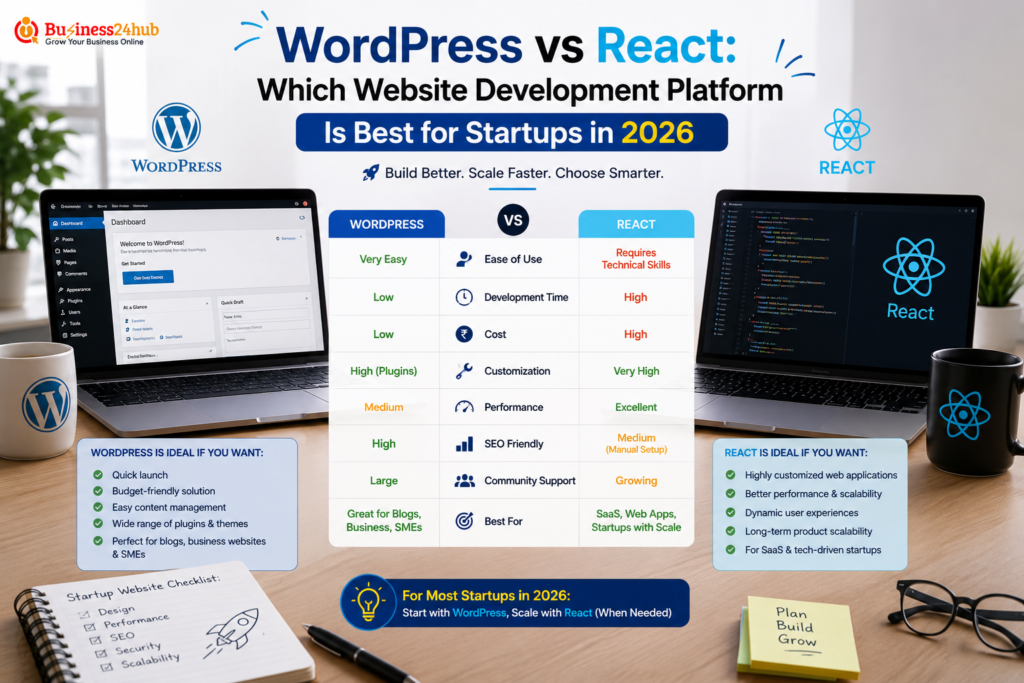
Performance is often where the WordPress vs React conversation gets heated, and the honest answer is that both can perform excellently or poorly depending entirely on implementation quality, not the underlying technology alone.
A poorly optimized WordPress site, loaded with excessive plugins and unoptimized images, can load slowly regardless of the platform’s underlying capability. Similarly, a poorly structured React application with excessive client-side rendering and bloated JavaScript bundles can perform worse than a lean, well-optimized WordPress site. Generally speaking, React-based sites have more potential for top-tier performance, particularly for highly interactive experiences, but only when built by developers who genuinely understand performance optimization rather than simply choosing React because it’s currently popular.
SEO Considerations: WordPress vs React
For startups relying on organic search growth, the WordPress vs React decision carries meaningful SEO implications. WordPress has a significant advantage here out of the box, with mature SEO plugins handling technical details like sitemaps, meta tags, and schema markup with minimal manual configuration.
React-based sites can absolutely rank well in 2026, but typically require additional setup, such as server-side rendering or static site generation through frameworks built on top of React, to ensure search engines can properly crawl and index dynamically rendered content. Without this additional layer, a purely client-rendered React site can face real indexing challenges that a standard WordPress installation simply doesn’t encounter by default.
Cost Comparison: WordPress vs React for Startups
Cost is frequently the deciding factor in the WordPress vs React decision for early-stage startups. WordPress development is generally far cheaper upfront, with a functional website often achievable for ten thousand to sixty thousand rupees using existing themes and plugins, or even less through DIY approaches.
React development, particularly when built custom from scratch with proper architecture, server-side rendering, and ongoing maintenance considerations, typically costs significantly more, often starting from eighty thousand rupees and scaling well into several lakhs depending on complexity. For cash-conscious startups, this cost gap alone often settles the WordPress vs React debate in WordPress’s favor during early validation stages.
Customization and Flexibility
When comparing customization potential, the WordPress vs React conversation shifts in React’s favor for highly specific, complex requirements. WordPress’s plugin-based customization works well for common needs but can become restrictive, clunky, or conflict-prone when trying to build genuinely unique, complex functionality outside what existing plugins support well.
React offers essentially unlimited customization potential, since you’re building functionality directly rather than working within a pre-existing system’s constraints. This flexibility comes at a cost, though, since every piece of functionality WordPress provides out of the box needs to be deliberately built or integrated when working with React instead.
Learning Curve and Team Requirements
A practical, often underestimated factor in the WordPress vs React decision is what your team can actually manage long-term. WordPress’s visual editing interface allows non-technical founders or marketing team members to update content, publish blog posts, and make minor design changes without needing a developer for every small adjustment.
React-based websites typically require ongoing developer involvement for even relatively simple content updates, unless a separate content management layer is specifically built or integrated alongside the React frontend. For startups without dedicated, ongoing development resources, this difference significantly affects how sustainable each option feels beyond initial launch.
Scalability for Growing Startups
As startups scale, both platforms can handle growth, but the WordPress vs React scalability conversation depends heavily on what kind of growth you’re planning for. WordPress scales well for content-heavy growth, such as expanding blog content, adding new informational pages, or growing a content marketing strategy.
React tends to scale better for product complexity, such as adding sophisticated user dashboards, real-time features, or increasingly app-like functionality that goes beyond what a traditional content website needs to support. Startups anticipating significant product complexity down the line often find React’s architecture better positioned for that future, even if it requires more investment early on.
Security Considerations
Security is another practical dimension of the WordPress vs React comparison. WordPress’s popularity, combined with its extensive plugin ecosystem, makes it a frequent target for automated attacks, requiring consistent updates, security plugins, and good hosting practices to stay protected.
React applications, particularly custom-built ones, don’t carry the same plugin-related vulnerability surface, but security still depends entirely on how the broader application and any backend services are built and maintained. Neither platform is inherently more secure in absolute terms — both require ongoing attention, just focused on different specific risks.
When Should a Startup Choose WordPress?
WordPress tends to be the stronger choice when your startup needs to launch quickly with limited budget, when your website is primarily content-focused rather than highly interactive, when your team includes non-technical members who need to manage content independently, and when you’re still validating your business model and need flexibility to make frequent changes without ongoing developer costs.
When Should a Startup Choose React?
React becomes the stronger choice when you’re building a genuinely interactive product or web application rather than a content website, when you have access to skilled development resources for both initial build and ongoing maintenance, when highly custom functionality is central to your value proposition, and when you’re confident enough in your product direction to invest in a more substantial upfront build rather than a quickly assembled WordPress site.
Can You Combine WordPress vs React? The Headless Approach
Increasingly in 2026, the WordPress vs React decision doesn’t have to be entirely binary. A growing number of startups use what’s called a headless WordPress setup, where WordPress manages content in the backend while a React-based frontend handles the actual user-facing experience, combining WordPress’s content management strengths with React’s performance and interactivity advantages.
This hybrid approach requires more development expertise than a standard WordPress installation, but it’s becoming a popular middle ground for startups wanting WordPress’s content flexibility without sacrificing the highly interactive, app-like frontend experience React enables. For startups with the resources to support this added complexity, it can offer genuine advantages over choosing purely one side of the WordPress vs React divide.
Common Mistakes Startups Make in This Decision
Choosing React purely because it feels more modern or technically impressive, without an actual product need for its interactivity, often leads to unnecessarily high development costs and timelines for what could have been a straightforward WordPress site.
Choosing WordPress for a product requiring complex, highly interactive functionality, then fighting against the platform’s limitations through excessive, conflicting plugins, frequently produces a fragile, hard-to-maintain result compared to building the right tool for the actual requirement from the start.
Underestimating ongoing maintenance needs on either side of the WordPress vs React decision is another common gap, since both platforms require continued attention, whether that’s WordPress core and plugin updates or React dependency management and hosting considerations.
A Quick Decision Framework
Ask yourself a few direct questions. Is your website primarily informational and content-driven, or does it need to function more like an interactive application? Content-driven leans WordPress; application-like leans React. Do you have ongoing access to skilled developers, or does your team need to manage updates independently? Independent management leans WordPress; dedicated developer access opens up React as a realistic option. What’s your budget and timeline right now? Tighter constraints generally favor WordPress’s faster, cheaper path to launch.
If most answers point toward content, speed, and budget constraints, WordPress is likely your better starting point. If they point toward complex interactivity, available development resources, and a confirmed product direction, React deserves serious consideration.
Frequently Asked Questions
1. Which is better for startups in 2026: WordPress or React?
The answer depends on your business goals. If you need a fast, affordable, and SEO-friendly website, WordPress vs React often favors WordPress. However, if you’re building a custom web application with advanced features, React is usually the better choice. Understanding WordPress vs React helps startups choose the right platform based on budget and scalability.
2. Is WordPress more SEO-friendly than React?
Yes, WordPress is generally easier for SEO because it offers plugins, built-in blogging capabilities, and simple metadata management. In the WordPress vs React comparison, React websites may require additional configuration such as server-side rendering or static site generation to achieve similar SEO performance.
3. Which platform is more cost-effective for a startup?
For most startups, WordPress is the more budget-friendly option. It requires less development time and has thousands of ready-made themes and plugins. In the WordPress vs React debate, React projects typically involve higher development and maintenance costs due to custom coding.
4. Can React websites rank well on Google?
Yes. React websites can perform exceptionally well in search engines when implemented correctly with technologies like server-side rendering (SSR) or static site generation (SSG). When evaluating WordPress vs React, SEO success depends more on proper implementation than the framework itself.
5. Which platform offers better scalability for growing businesses?
React provides greater flexibility and scalability for startups planning to build complex dashboards, SaaS platforms, or highly interactive applications. In the WordPress vs React comparison, WordPress scales well for content-driven websites, while React is better suited for custom software solutions.
6. Should a startup choose WordPress or React for an MVP?
If your goal is to launch quickly and validate your idea, WordPress is often the better choice. It enables rapid development with lower costs. In the WordPress vs React discussion, React becomes more beneficial when your MVP requires custom functionality, real-time interactions, or complex user experiences.
7. Can a startup use both WordPress and React together?
Absolutely. Many businesses use a headless CMS approach where WordPress manages content and React powers the frontend. This hybrid solution combines the content management strengths of WordPress with the performance and flexibility of React, making WordPress vs React less of a competition and more of a complementary strategy for modern startups.
Conclusion
There’s no universally correct answer in the WordPress vs React debate — only the right answer for your startup’s specific stage, budget, and product complexity. If you need to launch quickly, manage content independently, and keep costs low while validating your business, WordPress remains a genuinely strong choice in 2026. If your product depends on rich interactivity and you have the development resources to support a more substantial build, React offers capabilities WordPress simply isn’t designed to match.
The startups that make the right call in the WordPress vs React decision aren’t choosing based on which platform sounds more impressive. They’re matching the platform to their actual product needs, team capabilities, and growth stage, with the flexibility to evolve that choice, including hybrid approaches, as their business matures.
Need Website for Your Business?
🟡Business24Hub provides complete IT, web development, software development, digital marketing, branding, SEO, mobile app development, and business consulting services to startups, entrepreneurs, SMEs, and enterprises across India.
🟡For other Legal and Trademark related services Visit
👉 Money Recovery Cases
👉 Property Disputes
👉 Business & Licence Registrations
🟡 Protect Your Rights
👉 Domestic Violence Legal Support
👉 Stridhan Recovery
👉 Mutual Consent Divorce
👉 Contested Divorce Filing
👉 Child Custody and Maintenance
👉 Matrimonial Property Settlement
👉 NRI Divorce Services
👉 Alimony and Maintenance
📞 Call Now: +91 8595439395
🕐 Free Consultation: Monday to Saturday, 10 AM to 6 PM

I’m Aryan Yadav, passionate about SEO and Digital Marketing with a strong interest in helping businesses grow online. I enjoy learning new strategies, exploring digital trends, and creating ideas that deliver value. I believe in continuous growth, creativity, and building meaningful results through smart work and dedication.

