

Views: 0
A complete 2026 guide to building an email and content marketing funnel that nurtures startup leads into paying customers, with stages, tools, and a practical framework.
Table of Contents
- 1 Introduction
- 2 What Is an Email and Content Marketing Funnel?
- 3 Why Startups Need This Funnel More Than Established Brands
- 4 Stage One: Awareness — Attracting the Right Leads
- 5 Stage Two: Capture — Converting Visitors Into Leads
- 6 Stage Three: Nurture — Building Trust Through Sequenced Email
- 7 Stage Four: Engagement — Deepening the Relationship With Content
- 8 Stage Five: Conversion — Moving From Trust to Purchase
- 9 Stage Six: Retention — Turning Customers Into Repeat Buyers and Advocates
- 10 Building the Content That Powers Every Stage
- 11 Email Automation and Tools for 2026
- 12 Measuring Funnel Performance
- 13 Common Mistakes Startups Make With Their Funnel
- 14 A Practical Example: How This Looks for a Real Startup
- 15 Frequently Asked Questions
- 16 Conclusion
- 17 Need a Email and Content Marketing Funnel for Your Business?
Introduction
Getting someone’s email address is easy. Getting them to trust your brand enough to actually pull out their card and pay you is an entirely different challenge — and it rarely happens after a single email or one good blog post. It happens through a sequence, a deliberate journey that moves someone from curious stranger to confident customer, one touchpoint at a time.
That journey is your nurture funnel, and in 2026, with inboxes more crowded and attention spans thinner than ever, startups can’t afford to treat email and content marketing as separate, disconnected efforts. The startups winning long-term customer relationships are the ones building a single, cohesive funnel where content earns attention and email converts that attention into action. This guide walks through exactly how to build that funnel, stage by stage.
What Is an Email and Content Marketing Funnel?
An email and content marketing funnel is the structured path a potential customer travels from first discovering your brand to becoming a paying customer, guided primarily through valuable content and a connected sequence of emails rather than aggressive, one-off sales pitches.
Unlike a single sales email or a single blog post working in isolation, a funnel connects every piece of content and every email into a deliberate sequence, with each step designed to move a lead slightly closer to a purchase decision. For startups specifically, this matters because most early-stage customers aren’t ready to buy the first time they encounter your brand — a funnel is what keeps the relationship alive long enough for that readiness to develop naturally.
Why Startups Need This Funnel More Than Established Brands
Established brands often benefit from existing trust, word-of-mouth, and repeat customers who already know what to expect. Startups have none of that built-in advantage. Every single lead has to be educated, convinced, and reassured essentially from zero, which is exactly what a well-built nurture funnel is designed to do efficiently and at scale.
Without a structured funnel, startups typically rely on founders manually following up with leads one by one, which simply doesn’t scale past a handful of early customers. A properly built email and content funnel allows a startup with a tiny team to nurture hundreds or thousands of leads simultaneously, delivering the right message at the right time without requiring constant manual effort for every single prospect.
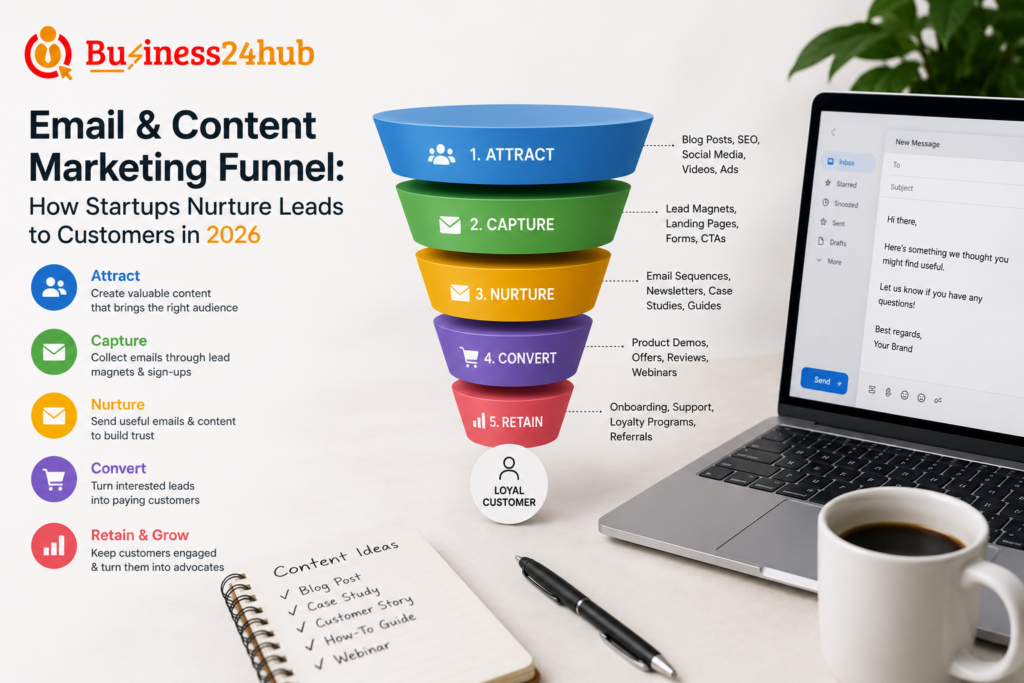
Stage One: Awareness — Attracting the Right Leads
The funnel begins before someone even joins your email list, at the moment they first discover your brand through content. This typically happens through blog posts answering questions your ideal customer is actively searching for, social media content that stops the scroll, or paid campaigns driving traffic to a specific landing page.
The goal at this stage isn’t to sell anything. It’s to provide genuine value that positions your brand as credible and relevant to the problem your ideal customer is experiencing. Content at this stage should be educational and broadly helpful, addressing the kind of question someone would type into Google long before they’re aware your specific product exists as a potential solution.
Stage Two: Capture — Converting Visitors Into Leads
Awareness alone doesn’t build a list. You need a clear, compelling reason for someone to hand over their email address, typically called a lead magnet. Effective lead magnets for startups in 2026 include detailed guides or templates solving a specific problem, free tools or calculators relevant to your industry, exclusive webinars or workshops, or early access to a product feature or community.
The strength of your lead magnet directly determines your capture rate. A vague, generic offer like “subscribe to our newsletter” converts far fewer visitors than a specific, valuable resource directly tied to the problem that brought them to your content in the first place. Place capture forms strategically within high-performing content, not just on a single, easily ignored homepage pop-up.
Stage Three: Nurture — Building Trust Through Sequenced Email
Once someone joins your list, the real nurturing work begins. This is typically structured as a welcome sequence, a series of automated emails sent over the days and weeks following sign-up, designed to build familiarity and trust before any direct sales pitch.
A well-built nurture sequence usually opens with a warm welcome email delivering on whatever was promised at sign-up, followed by emails that share your brand’s story and values, highlight genuinely useful content or quick wins related to the subscriber’s problem, and gradually introduce social proof through testimonials or case studies. Each email should provide standalone value, not just exist as a stepping stone toward a sales pitch, since a sequence that feels purely transactional tends to drive unsubscribes rather than trust.
Stage Four: Engagement — Deepening the Relationship With Content
Nurturing isn’t limited to the welcome sequence. Ongoing content, whether through a regular newsletter, fresh blog content, or social media, keeps your brand present in a subscriber’s life between major touchpoints, reinforcing trust gradually over weeks and months rather than expecting a decision after just a handful of initial emails.
This stage is also where segmentation becomes valuable. Not every subscriber has the same interests, problems, or stage of readiness. Tracking which content subscribers engage with, which links they click, and which topics they show interest in allows you to tailor future content and emails more precisely, rather than sending identical messaging to your entire list regardless of individual behaviour.
Stage Five: Conversion — Moving From Trust to Purchase
Once a lead has received consistent value and demonstrated engagement, it’s time to introduce a clear, low-friction path to purchase. This might be a limited-time offer, a personalized demo invitation, a case study directly relevant to their specific situation, or simply a well-timed email addressing common objections that might be holding them back.
The conversion stage works best when it doesn’t feel like a sudden shift in tone from everything that came before. If your previous emails have been genuinely helpful and trust-building, a direct offer at this stage feels like a natural next step rather than an abrupt sales pitch, which significantly improves how it’s received and how likely someone is to act on it.
Stage Six: Retention — Turning Customers Into Repeat Buyers and Advocates
The funnel doesn’t end at the first purchase. Retention-focused email and content keep customers engaged after conversion, reducing churn and increasing lifetime value, both of which directly affect how much you can sustainably spend acquiring new customers in the first place.
Post-purchase content typically includes onboarding sequences helping new customers get value from their purchase quickly, occasional check-ins offering additional resources or support, and requests for reviews or referrals once enough positive experience has been established. Many startups underinvest in this stage, focusing almost entirely on new lead acquisition, despite retention typically being significantly more cost-effective than acquiring an entirely new customer.
Building the Content That Powers Every Stage
Each funnel stage requires a different type of content, and planning this in advance prevents the common problem of having plenty of top-of-funnel blog content but nothing prepared for nurturing or conversion stages. Awareness-stage content should be broadly educational and discoverable through search or social media. Capture-stage content should be specific and immediately valuable enough to justify an email exchange. Nurture-stage content should build trust gradually through storytelling, education, and social proof. Conversion-stage content should directly address remaining objections and provide a clear, low-friction next step.
Mapping your existing content library against these stages often reveals significant gaps, typically an abundance of awareness content and a noticeable shortage of nurture and conversion-stage material, which is usually the content most directly responsible for actually driving revenue.
Email Automation and Tools for 2026
Modern email marketing platforms have made sophisticated funnel automation accessible even to very small startup teams. Look for platforms offering visual automation builders, allowing you to map out branching sequences based on subscriber behaviour rather than sending identical emails to everyone regardless of their actions.
Segmentation capabilities matter significantly here too, allowing you to trigger different follow-up content based on whether someone opened a previous email, clicked a specific link, or showed interest in a particular topic. Many platforms in 2026 also incorporate AI-assisted subject line testing and send-time optimization, which can meaningfully improve open rates with minimal additional manual effort once set up correctly.
Measuring Funnel Performance
Each stage of your funnel has distinct metrics worth tracking separately rather than judging the entire funnel by one blended number. Awareness stage performance is typically measured through traffic, reach, and engagement on content. Capture stage performance is measured through conversion rate on lead magnets and opt-in forms. Nurture and engagement stages are measured through email open rates, click-through rates, and content engagement over time. Conversion stage performance is measured through the percentage of nurtured leads that ultimately become paying customers, along with the average time that transition takes.
Tracking these stages separately reveals exactly where leads are dropping off. A startup might discover their awareness content performs excellently, with little capture stage friction, but loses the majority of leads during the nurture stage, signalling a need to strengthen email content rather than simply trying to drive more top-of-funnel traffic.
Common Mistakes Startups Make With Their Funnel
Sending a sales pitch too early, often immediately after someone joins an email list, is one of the most common and damaging mistakes, since it skips the trust-building work that makes a later sales pitch actually effective.
Treating every subscriber identically, regardless of how they entered the funnel or what content they’ve engaged with, is another frequent issue, leading to generic messaging that fails to address each subscriber’s specific interests or stage of readiness.
Focusing almost entirely on new lead acquisition while neglecting nurture and retention content is a particularly costly gap, since this is often where the highest-value, most overlooked revenue opportunity actually sits for an existing list.
Inconsistent sending, whether through long unexplained gaps or sudden bursts of unrelated emails, tends to erode trust and increase unsubscribe rates, compared to a predictable, well-paced rhythm subscribers come to expect and welcome.
A Practical Example: How This Looks for a Real Startup
Consider an early-stage startup selling an online course platform for independent educators. Their awareness stage content includes blog posts answering common questions independent educators search for, such as how to price an online course effectively. Their lead magnet is a detailed course pricing template, directly tied to that awareness content.
Their nurture sequence opens with a welcome email delivering the template, followed by emails sharing a founder’s story about why they built the platform, a case study from an early educator who grew their income using the platform, and a few standalone tips on building an audience before launching a course. Their conversion email, sent roughly two weeks into the sequence, offers a personalized walkthrough call, framed as a natural next step after several emails of genuine, related value rather than an abrupt pitch. Post-purchase, a simple onboarding sequence helps new users set up their first course quickly, followed by a request for a testimonial once they’ve had a positive early experience.
Frequently Asked Questions
1. What is an email and content marketing funnel?
An email and content marketing funnel is a step-by-step process that guides potential customers from discovering your brand to making a purchase. It combines valuable content with targeted email campaigns to educate, engage, and convert leads into loyal customers.
2. Why is an email marketing funnel important for startups in 2026?
Startups often have limited marketing budgets. An email marketing funnel helps nurture leads automatically, improve customer relationships, increase conversions, and generate higher ROI compared to many other digital marketing channels.
3. What types of content should startups include in their marketing funnel?
Startups should use blog posts, lead magnets, newsletters, case studies, product guides, video tutorials, customer testimonials, webinars, and personalized email sequences to educate prospects and move them through the buying journey.
4. How many emails should be included in a lead nurturing sequence?
There is no fixed number, but most successful startups use a sequence of 5–10 emails. These emails typically include a welcome message, educational content, social proof, product benefits, special offers, and a clear call-to-action.
5. Which metrics should startups track to measure email funnel performance?
Important metrics include email open rate, click-through rate (CTR), conversion rate, unsubscribe rate, bounce rate, lead-to-customer conversion, customer lifetime value (CLV), and overall ROI from email campaigns.
6. Can automation improve an email and content marketing funnel?
Yes. Marketing automation helps send personalized emails based on user behavior, segment audiences, score leads, schedule follow-ups, and deliver the right content at the right time, improving engagement and conversions while saving time.
7. What are the best practices for building a high-converting marketing funnel in 2026?
Focus on audience segmentation, AI-powered personalization, mobile-friendly emails, valuable content, compelling subject lines, clear calls-to-action, regular A/B testing, and continuous optimization based on analytics. Consistently delivering relevant content helps build trust and convert more leads into paying customers.
Conclusion
An email and content marketing funnel isn’t a one-time campaign — it’s an ongoing system that, once built thoughtfully, continues nurturing new leads into customers long after the initial setup work is done. For startups in 2026, this kind of structured, value-first nurturing is often the difference between a list that sits largely unengaged and one that consistently converts into real, sustainable revenue.
The startups that build the strongest long-term customer relationships aren’t the ones sending the most emails or publishing the most content. They’re the ones thoughtfully mapping each stage of the customer journey, delivering genuinely useful content and emails at exactly the right moment, and continuously refining the funnel based on where real leads are actually dropping off, rather than guessing what should theoretically work.
Need a Email and Content Marketing Funnel for Your Business?
🟡Business24Hub provides complete IT, web development, software development, digital marketing, branding, SEO, mobile app development, and business consulting services to startups, entrepreneurs, SMEs, and enterprises across India.
🟡For other Legal and Trademark related services Visit
👉 Money Recovery Cases
👉 Property Disputes
👉 Business & Licence Registrations
🟡 Protect Your Rights
👉 Domestic Violence Legal Support
👉 Stridhan Recovery
👉 Mutual Consent Divorce
👉 Contested Divorce Filing
👉 Child Custody and Maintenance
👉 Matrimonial Property Settlement
👉 NRI Divorce Services
👉 Alimony and Maintenance
📞 Call Now: +91 8595439395
🕐 Free Consultation: Monday to Saturday, 10 AM to 6 PM

I’m Aryan Yadav, passionate about SEO and Digital Marketing with a strong interest in helping businesses grow online. I enjoy learning new strategies, exploring digital trends, and creating ideas that deliver value. I believe in continuous growth, creativity, and building meaningful results through smart work and dedication.

