

Views: 1
A practical, India-focused guide to Google Ads budget planning for startups in 2026, covering benchmarks, allocation strategy, common mistakes, and a step-by-step planning framework.
Table of Contents
- 1 Introduction
- 2 Why Generic Budget Advice Doesn’t Work
- 3 Step 1: Define What You’re Actually Trying to Achieve
- 4 Step 2: Understand Your Customer Acquisition Cost Ceiling
- 5 Step 3: Research Realistic Cost-Per-Click Benchmarks for Your Industry
- 6 Step 4: Calculate a Minimum Viable Testing Budget
- 7 Step 5: Allocate Budget Across the Funnel, Not Just One Campaign Type
- 8 Step 6: Factor In Seasonal and Industry-Specific Fluctuations
- 9 Step 7: Set a Realistic Monthly Budget Based on Stage
- 10 Step 8: Build in a Buffer for Optimization, Not Just Spend
- 11 Step 9: Decide Between Manual Oversight and Automated Bidding Strategically
- 12 Step 10: Monitor Key Metrics Beyond Just Spend
- 13 A Sample Budget Allocation Framework
- 14 Common Mistakes Indian Startups Make With Google Ads Budgets
- 15 Tools to Help Plan and Manage Your Budget
- 16 Frequently Asked Questions (FAQs)
- 17 Conclusion
- 18 Need help with Google Ads Budget Planning for Your Business?
Introduction
“How much should I spend on Google Ads?” is one of the most common questions founders ask, and it’s also one of the hardest to answer with a single number. Spend too little, and your campaigns never collect enough data to optimize properly. Spend too much without a clear strategy, and you’ll burn through runway chasing clicks that never convert.
In 2026, with rising cost-per-click rates across most Indian industries and increasingly sophisticated automated bidding systems, budget planning has become both more important and more nuanced than simply picking a round number and hoping for the best. This guide breaks down exactly how Indian startups should think about Google Ads budgeting — not as a fixed figure, but as a structured, data-informed process tied directly to business goals.
Why Generic Budget Advice Doesn’t Work
Most generic advice floating around suggests spending a fixed percentage of revenue, often somewhere between five and ten percent, on marketing overall. While this can work as a loose benchmark for established businesses, it falls apart for early-stage startups, many of which have little or no revenue yet to base a percentage on.
The real starting point for budget planning isn’t a percentage — it’s your business goals, your customer’s lifetime value, and the realistic cost of acquiring a customer in your specific industry and city. A startup selling a high-ticket B2B software product needs a completely different budget approach than a D2C brand selling a low-cost consumer product, even if both are technically “startups” at a similar funding stage.
Step 1: Define What You’re Actually Trying to Achieve
Before assigning any rupee amount to a campaign, get specific about your goal. Are you trying to generate leads for a sales team to follow up on, drive direct e-commerce sales, build brand awareness ahead of a launch, or test demand for a new product before scaling further?
Each goal changes how you should think about budget. Lead generation campaigns are typically evaluated on cost per qualified lead. E-commerce campaigns are evaluated on return on ad spend. Awareness campaigns are evaluated on reach and impressions rather than direct conversions. Mixing these goals into a single budget without distinguishing between them usually leads to confused reporting and poor decision-making about where money is actually working.
Step 2: Understand Your Customer Acquisition Cost Ceiling
Before setting a Google Ads budget, you need a clear sense of how much you can afford to spend acquiring a single customer while still running a sustainable business. This is your customer acquisition cost ceiling, and it’s calculated by looking at your customer’s lifetime value and working backward.
If a customer is worth roughly fifteen thousand rupees in lifetime value to your business, spending twelve thousand rupees to acquire them through ads leaves very little room for profitability, even before accounting for product costs, support, and other overhead. A healthier target is often spending somewhere between fifteen and thirty percent of a customer’s lifetime value on acquisition, though this varies by industry and how quickly you need to recover that cost.
Without this number clearly defined, any Google Ads budget you set is essentially a guess, regardless of how confident it sounds.
Step 3: Research Realistic Cost-Per-Click Benchmarks for Your Industry
Cost-per-click rates in India vary dramatically by industry, competition level, and even city. As a general directional guide for 2026, highly competitive sectors like finance, insurance, legal services, and B2B software tend to see cost-per-click rates ranging from sixty to over two hundred rupees, while less competitive consumer categories often see costs in the fifteen to fifty rupee range.
Metro cities like Mumbai, Delhi, and Bangalore typically carry higher cost-per-click rates than Tier 2 and Tier 3 cities, simply due to higher competition for the same keywords. Before finalizing a budget, spend time in Google Ads’ Keyword Planner reviewing realistic cost estimates for your specific target keywords and locations, rather than relying on broad industry averages that may not reflect your actual market.
Step 4: Calculate a Minimum Viable Testing Budget
Every new Google Ads account needs an initial testing phase to gather enough data for the algorithm to optimize effectively and for you to understand what’s actually working. A common mistake startups make is under-funding this phase, then concluding “Google Ads doesn’t work for us” based on a sample size too small to draw any real conclusion from.
A reasonable minimum testing budget for most Indian startups in 2026 is enough to generate at least fifty to a hundred clicks per campaign variant within the first two to four weeks. Depending on your industry’s cost-per-click, this might mean a testing budget anywhere from fifteen thousand to fifty thousand rupees spread across your initial campaign structure, specifically earmarked for learning rather than expecting immediate profitability.
Step 5: Allocate Budget Across the Funnel, Not Just One Campaign Type
A common and costly mistake is putting an entire budget into a single bottom-of-funnel, high-intent campaign and expecting it to single-handedly drive growth. While bottom-funnel search campaigns targeting high-intent keywords typically deliver the strongest direct return, they also tend to have a ceiling in volume, especially in niche industries.
A more sustainable allocation spreads budget across the funnel: a larger portion, often fifty to sixty percent, toward high-intent search campaigns directly tied to conversion keywords; a smaller portion, around twenty to thirty percent, toward middle-funnel campaigns like display or YouTube ads that build familiarity with people not yet ready to convert; and the remainder toward remarketing campaigns targeting people who’ve already visited your site but haven’t converted yet, which typically deliver some of the lowest-cost conversions available.
Step 6: Factor In Seasonal and Industry-Specific Fluctuations
Indian markets have distinct seasonal patterns that directly affect both competition and cost-per-click. Festival seasons like Diwali, along with major sales events, see significantly increased competition and cost-per-click rates across e-commerce and consumer categories, sometimes rising thirty to fifty percent above baseline.
B2B and SaaS startups often see different patterns, with quieter competition during major holiday periods but potential spikes around financial year-end planning cycles when businesses are actively budgeting for new tools and services. Building seasonal flexibility into your annual budget plan, rather than spreading spend evenly across every month, allows you to capitalize on higher-intent periods and pull back during naturally quieter stretches.
Step 7: Set a Realistic Monthly Budget Based on Stage
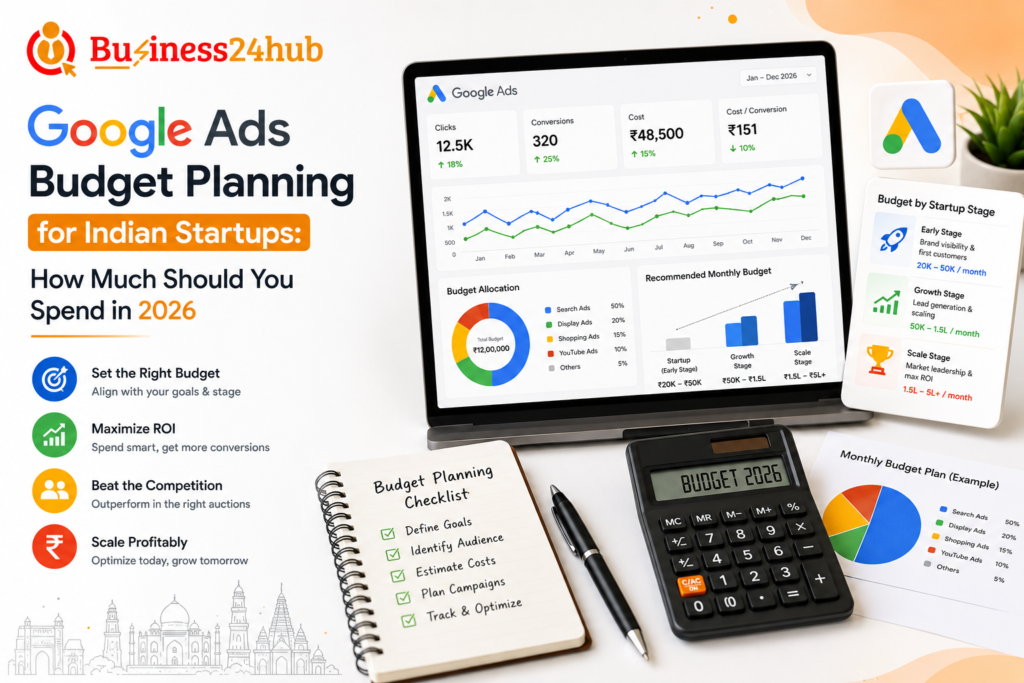
Budget needs shift significantly depending on your startup’s stage. In the very early validation stage, before product-market fit is confirmed, a modest budget of roughly twenty to forty thousand rupees per month is often sufficient to test demand and messaging without overcommitting resources to a strategy that might still pivot.
Once you’ve found early product-market fit and are focused on scaling a working acquisition channel, budgets often move into the range of fifty thousand to two lakh rupees per month, depending on funding and growth targets. Startups with confirmed unit economics and a clear path to profitability from paid acquisition may scale well beyond this, sometimes into several lakh rupees monthly, but this level of spend should only follow proven, consistent performance at smaller budgets first.
Step 8: Build in a Buffer for Optimization, Not Just Spend
A common planning mistake is allocating one hundred percent of a budget directly to ad spend with no room for the natural learning curve every campaign goes through. Performance in the first two to four weeks of a new campaign is rarely representative of its long-term potential, since Google’s algorithm needs time and data to optimize delivery and targeting.
Plan your budget with the expectation that early weeks will likely show a higher cost per conversion than your eventual target, and avoid the instinct to pull the plug entirely after a short, expensive initial period. Instead, build in a defined testing window, often four to six weeks, before making major budget decisions based on performance data.
Step 9: Decide Between Manual Oversight and Automated Bidding Strategically
Google’s automated bidding strategies, such as Maximize Conversions or Target CPA, have become significantly more capable in recent years and are often the default recommendation for most accounts in 2026. However, automated bidding performs best with sufficient conversion data and a reasonably generous budget, since the algorithm needs enough volume to learn effectively.
For very small budgets or brand-new accounts with limited historical data, starting with more manual control over bids and targeting, then gradually shifting toward automation as conversion data accumulates, often produces more predictable and controllable results than handing full control to automation from day one with minimal data to work with.
Step 10: Monitor Key Metrics Beyond Just Spend
Budget planning doesn’t stop once campaigns go live. Track cost per conversion against your predefined acquisition cost ceiling, return on ad spend for revenue-generating campaigns, and click-through rate as an early indicator of ad relevance and quality score, which directly influences how far your budget actually stretches.
Quality Score in particular deserves attention, since higher-quality, more relevant ads often achieve lower cost-per-click rates for the same ad auction position, effectively making your budget go further without increasing spend. Regularly reviewing search term reports to eliminate irrelevant or wasted spend on poorly matching queries is one of the simplest ways to improve budget efficiency without spending more.
A Sample Budget Allocation Framework
Here’s a practical way an early-growth-stage Indian startup might structure a monthly Google Ads budget of one lakh rupees. Roughly fifty-five thousand rupees could go toward high-intent search campaigns directly targeting bottom-funnel keywords. Around twenty-five thousand rupees could support middle-funnel awareness campaigns, such as YouTube or display ads introducing the brand to a relevant but cooler audience. The remaining twenty thousand rupees could be allocated to remarketing campaigns targeting website visitors and cart abandoners who haven’t yet converted.
This allocation isn’t fixed — it should shift based on what the data shows over time, but it offers a reasonable, balanced starting structure rather than concentrating an entire budget into a single high-intent campaign type.
Common Mistakes Indian Startups Make With Google Ads Budgets
Setting a budget based on what competitors are reportedly spending, without understanding your own unit economics or acquisition cost ceiling, often leads to overspending relative to what your specific business can sustainably afford.
Pulling budget from a campaign too early, often within the first one to two weeks, before the algorithm has had time to optimize delivery, is another frequent and costly pattern that prevents campaigns from ever reaching their actual performance potential.
Ignoring city-level and device-level performance differences within India is also common. A campaign performing well overall might be masking poor performance in specific cities or on certain devices, where budget could be reallocated toward better-performing segments instead.
Failing to separate brand awareness spend from direct-response spend in reporting often leads founders to judge an entire account’s performance using metrics that only apply to one type of campaign, leading to premature and sometimes incorrect conclusions about what’s actually working.
Finally, treating the initial budget as permanent rather than as a starting hypothesis to be tested and adjusted is a significant missed opportunity, since the most successful accounts typically go through multiple rounds of budget reallocation based on real performance data before settling into an efficient, scaled structure.
Tools to Help Plan and Manage Your Budget
Google’s own Keyword Planner remains the most direct source for realistic cost-per-click estimates specific to your target keywords and Indian locations. Google Ads’ built-in recommendations and performance planner tools can offer useful directional guidance, though they should be reviewed critically rather than followed blindly, since they’re designed with Google’s own interests in mind as well as yours.
Beyond Google’s tools, a simple spreadsheet tracking planned versus actual spend, cost per conversion, and return on ad spend by campaign type often provides more clarity than relying purely on the Google Ads dashboard, since it forces a regular, structured review against your original goals rather than just reacting to whatever the platform highlights.
Frequently Asked Questions (FAQs)
1. How much should an Indian startup spend on Google Ads in 2026?
There is no fixed budget for every startup. Most Indian startups begin with a monthly budget based on their industry, competition, business goals, and expected return on investment (ROI).
2. What factors affect a Google Ads budget?
Your budget depends on keyword competition, cost-per-click (CPC), target audience, geographic location, campaign objectives, and the products or services you are promoting.
3. What is the minimum budget required to run Google Ads?
Google Ads does not have a strict minimum spending requirement. However, startups should allocate enough budget to gather meaningful data and optimize campaign performance.
4. How can startups reduce Google Ads costs?
You can lower costs by targeting relevant keywords, improving Quality Score, using negative keywords, optimizing landing pages, and regularly monitoring campaign performance.
5. Should startups focus on Search Ads or Display Ads?
Search Ads are generally better for generating leads and sales because they target users actively searching for your products or services. Display Ads are useful for increasing brand awareness and remarketing.
6. How do I know if my Google Ads budget is delivering good results?
Track key performance metrics such as click-through rate (CTR), conversion rate, cost per conversion, return on ad spend (ROAS), and overall ROI to evaluate campaign success.:::
Conclusion
There’s no universal Google Ads budget that works for every Indian startup, because the right number depends entirely on your specific unit economics, industry competition, and growth stage — not a generic percentage or a number borrowed from another company’s case study. What matters most is building your budget from the ground up, starting with a clear acquisition cost ceiling, realistic cost-per-click research, and a structured testing phase, rather than picking a figure and hoping it works.
The startups that get the most value from Google Ads in 2026 aren’t necessarily the ones spending the most. They’re the ones spending deliberately, tracking the right metrics, and continuously reallocating budget toward what the data actually proves is working, rather than what felt like a reasonable guess when the campaign first launched.
Need help with Google Ads Budget Planning for Your Business?
🟡Business24Hub provides complete IT, web development, software development, digital marketing, branding, SEO, mobile app development, and business consulting services to startups, entrepreneurs, SMEs, and enterprises across India.
🟡For other Legal and Trademark related services Visit
👉 Money Recovery Cases
👉 Property Disputes
👉 Business & Licence Registrations
🟡 Protect Your Rights
👉 Domestic Violence Legal Support
👉 Stridhan Recovery
👉 Mutual Consent Divorce
👉 Contested Divorce Filing
👉 Child Custody and Maintenance
👉 Matrimonial Property Settlement
👉 NRI Divorce Services
👉 Alimony and Maintenance
📞 Call Now: +91 8595439395
🕐 Free Consultation: Monday to Saturday, 10 AM to 6 PM

I’m Aryan Yadav, passionate about SEO and Digital Marketing with a strong interest in helping businesses grow online. I enjoy learning new strategies, exploring digital trends, and creating ideas that deliver value. I believe in continuous growth, creativity, and building meaningful results through smart work and dedication.

