

Views: 1
Confused between a landing page vs full website for your startup? Explore costs, SEO impact, conversion rates, and a clear 2026 decision framework to choose right.
Table of Contents
- 1 Introduction
- 2 What Is a Landing Page?
- 3 What Is a Full Website?
- 4 Landing Page vs Full Website: Key Differences
- 5 When Should a Startup Choose Only a Landing Page in 2026?
- 6 When Does a Startup Need a Full Website?
- 7 Cost Comparison: Landing Page vs Full Website Development in 2026
- 8 SEO: Which Performs Better?
- 9 User Experience and Conversion Rate Differences
- 10 Scalability: Planning for Growth
- 11 The Hybrid Approach: Can You Have Both?
- 12 Common Mistakes Startups Make When Choosing
- 13 A Quick Decision Framework
- 14 Web Development Trends for Startups in 2026
- 15 Frequently Asked Questions (FAQs)
- 16 Conclusion
- 17 Need Professional Website Development Solutions for Your Business?
Introduction
Every founder eventually hits the same wall. You have an idea, a product, maybe even early customers — and now you need an online presence. The question that follows is deceptively simple: should you build a single landing page, or invest in a full website?
In 2026, this decision carries more weight than ever. With AI-powered website builders, rising customer expectations, and increasingly competitive search rankings, picking the wrong format can cost you time, money, and momentum you can’t afford to lose as a startup. This guide breaks down exactly what separates a landing page from a full website, when each makes sense, and how to make the right call for your specific stage of growth.
What Is a Landing Page?
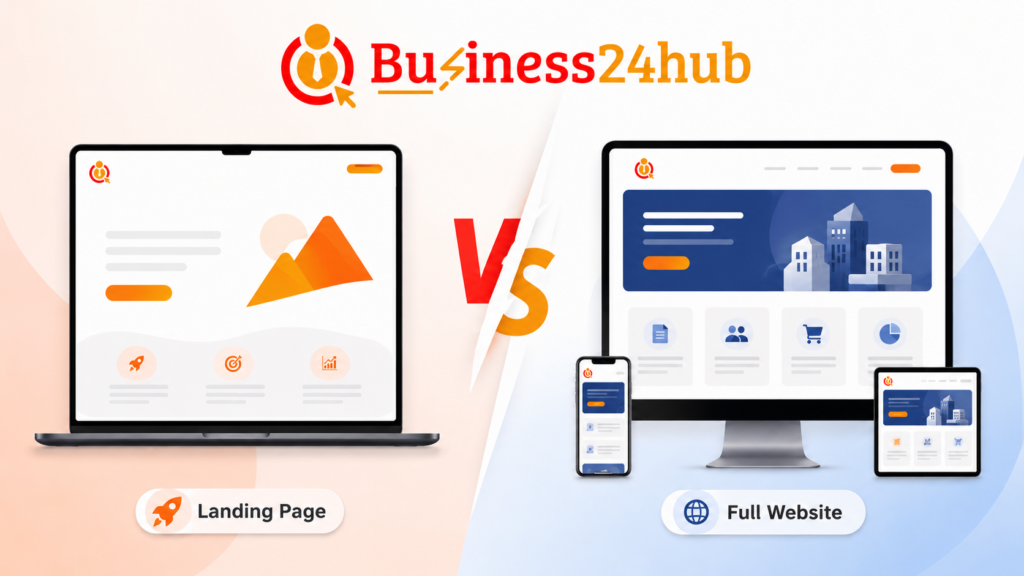
A landing page is a single, focused web page designed around one specific goal — usually capturing a lead, promoting a product launch, or driving a sign-up. Unlike a website, it doesn’t have multiple sections like About, Blog, or Careers. Everything on the page exists to push the visitor toward one action.
Typical landing page elements include a clear, benefit-driven headline, a short explanation of the value proposition, social proof such as testimonials or logos, one strong call-to-action repeated strategically, and a simple form or button for sign-ups, demo bookings, or waitlist entries.
Landing pages are built for speed and conversion. They strip away distractions so the visitor has only one decision to make. This is why most paid ad campaigns, product launches, and early-stage MVP validations rely heavily on landing pages rather than full websites.
What Is a Full Website?
A full website is a multi-page digital presence that represents your entire brand, not just one offer. It typically includes a homepage, an About page, a Services or Products page, a Blog, a Contact page, and often deeper sections like Case Studies, Pricing, or a Resource Hub.
A full website serves multiple purposes simultaneously. It builds long-term brand credibility, supports organic search growth through blog content and indexed pages, educates visitors who aren’t ready to convert immediately, houses detailed product or service information, and acts as a hub for customer support, documentation, and trust signals.
Unlike a landing page’s single-action focus, a website is built for exploration. Visitors can move between pages based on their own interests and stage in the buying journey.
Landing Page vs Full Website: Key Differences
Purpose: A landing page targets one specific conversion goal, while a full website supports broad brand presence and information.
Pages: A landing page is a single page, while a full website has multiple interconnected pages.
Build time: A landing page typically takes one to five days, while a full website can take two to eight weeks or longer.
Cost: Landing pages are far cheaper to build than full websites.
SEO potential: Landing pages have limited SEO potential since there’s only one URL, while full websites have strong SEO potential through multiple indexable pages.
Best use case: Landing pages work best for launches and ad campaigns, while full websites work best for long-term brand building and organic growth.
Maintenance: Landing pages need minimal ongoing maintenance, while full websites require continuous updates, content additions, and security monitoring.
Conversion focus: Landing pages concentrate on one call-to-action for very high conversion, while full websites distribute attention across multiple goals.
This comparison captures the surface-level difference, but the real decision depends on your startup’s current stage, goals, and budget — which is where most founders get stuck.
When Should a Startup Choose Only a Landing Page in 2026?
A landing page is the smarter choice in several common early-stage scenarios.
If you’re validating an idea before building the product, a landing page lets you test demand. You can run ads, collect emails, and measure interest without writing a single line of product code.
If you’re running a specific campaign or launch, such as a Product Hunt launch, a seasonal promotion, a webinar sign-up, or a single paid ad campaign, a dedicated landing page performs better because there’s zero distraction pulling visitors away from the conversion goal.
If your budget and timeline are extremely tight, a landing page can go live in days, letting you start collecting leads or pre-orders almost immediately, which matters a lot for early-stage startups with limited capital.
If you have one core offer rather than a full product suite, a multi-page website with sections nobody will click is wasted effort. It makes more sense to focus the entire page on that one offer.
If you’re targeting paid traffic rather than organic search, a landing page’s high conversion rate matters far more than SEO depth, since paid traffic doesn’t depend on search rankings.
When Does a Startup Need a Full Website?
As your startup matures, a full website becomes less of a luxury and more of a necessity.
If you’re relying on organic search for growth, you need multiple indexable, valuable pages. A single landing page simply cannot compete with a website that has a blog, service pages, and location pages targeting different search intents.
If you have multiple products, services, or customer segments, such as both B2B clients and individual consumers, a website lets you create dedicated paths for each, something a single landing page can’t do effectively.
If investors, partners, or enterprise clients need to evaluate you, a landing page can feel thin during due diligence. A full website with an About page, team bios, case studies, and a clear value proposition builds far more trust.
If you need to support content marketing through blogging, guides, or thought leadership content, you need a website structure that can house and organize that content long-term.
If customer support and documentation are part of your offering, as is common with SaaS startups, you’ll need help centers, FAQs, and documentation pages, all of which require a full website architecture.
Cost Comparison: Landing Page vs Full Website Development in 2026
Pricing varies depending on whether you build in-house, hire freelancers, or work with an agency, but here’s a realistic 2026 range.
For a landing page, DIY no-code tools can cost anywhere from free to around three to eight thousand rupees per month for premium plans. A freelancer-built landing page typically costs between eight thousand and thirty-five thousand rupees as a one-time fee, while an agency-built, high-conversion custom landing page can range from thirty-five thousand to over one lakh rupees.
For a full website with five to ten pages and custom design, a freelancer-built site usually costs between forty thousand and one and a half lakh rupees. An agency-built website with SEO setup, a content management system, and custom design typically ranges from one and a half lakh to five lakh rupees or more, while enterprise-grade websites with custom development can exceed five lakh rupees.
The gap is significant, which is exactly why many startups start with a landing page and expand into a full website once revenue or funding allows it. Trying to build a full website too early can drain capital that should be going toward product development or customer acquisition instead.
SEO: Which Performs Better?
This is one of the most misunderstood aspects of the landing page vs website debate. A landing page can rank for one or two specific keywords if optimized well, but it has a hard ceiling, since there’s only one page to work with.
A full website, on the other hand, can target dozens or even hundreds of keyword variations across multiple pages, including service pages, blog posts, location pages, comparison pages, and resource pages. Search engines reward sites with depth, internal linking, fresh content, and topical authority, all things a single landing page structurally cannot provide.
That said, landing pages aren’t useless for SEO. They can rank well for highly specific, often branded or long-tail search terms, especially when paired with strong backlinks and fast load speeds. But if organic search is meant to be a primary growth channel for your startup, a full website is almost always the better long-term investment.
User Experience and Conversion Rate Differences
Landing pages typically convert at a noticeably higher rate than individual website pages because there’s no competing navigation, no distracting menu, and no alternative path. The visitor lands, reads, and acts.
Full websites, by contrast, optimize for a different kind of experience, one where visitors explore at their own pace, build trust over multiple visits, and convert when they’re ready, which might be days or weeks after their first visit. This is especially relevant for high-ticket B2B products where the buying decision involves multiple stakeholders and a longer research period.
Neither model is better in absolute terms. A landing page wins on immediate conversion, while a full website wins on trust-building and long-term customer relationships.
Scalability: Planning for Growth
One factor founders frequently underestimate is scalability. A landing page is, by design, hard to scale. You can’t keep bolting on sections without it becoming a cluttered, unfocused page that hurts conversions.
A full website, especially one built on a flexible content management system, scales naturally. You can add new product pages, new blog categories, new landing pages for specific campaigns, and new geographic or language versions without rebuilding the whole foundation. If your startup has aggressive growth plans for the next twelve to twenty-four months, building on a scalable website architecture early can save significant redevelopment costs later.
The Hybrid Approach: Can You Have Both?
Yes, and in 2026, this is increasingly the smartest path for startups. The hybrid model works by maintaining a lean full website with around five to eight core pages for brand credibility, SEO, and general information, while also creating dedicated landing pages for specific campaigns, ad traffic, product launches, or seasonal promotions, hosted as separate pages within the same website structure.
This approach gives you the SEO and trust benefits of a full website, while still getting the high-conversion focus of landing pages for specific marketing pushes. Most mature SaaS and direct-to-consumer startups operate exactly this way, with a polished core website plus dozens of campaign-specific landing pages running in parallel.
Common Mistakes Startups Make When Choosing
Building a full website too early is one of the most common and costly startup mistakes. Spending months and a large chunk of seed funding on a ten-page website before validating the product can drain resources you need elsewhere.
Treating a landing page like a homepage is another frequent error. Cramming an About Us section, a Careers section, and a Blog into what should be a single-purpose landing page kills its conversion power.
Ignoring mobile experience is a costly oversight. In 2026, the majority of traffic for most startups comes from mobile devices, and a page that isn’t fully optimized for mobile loses conversions regardless of format.
Skipping analytics setup is another common mistake. Whether it’s a landing page or a full website, launching without tracking heatmaps, conversion goals, and traffic sources means you’re flying blind on what’s actually working.
Choosing based on trend rather than strategy is also risky. Some founders pick a format because that’s what successful startups do, without evaluating their own funnel, traffic source, or buyer journey.
A Quick Decision Framework
Before deciding, ask yourself a few key questions. Is your product validated, or are you still testing demand? If you’re still testing, a landing page makes more sense. Is your primary traffic source paid ads or organic search? Paid ads lean toward a landing page, while organic search needs a full website. Do you have one offer or multiple products and services? One offer leans toward a landing page, while multiple offerings lean toward a website. Will investors or enterprise clients be evaluating your site? If so, a full website is the safer choice. What’s your available budget and timeline right now? A tight budget or timeline favors starting with a landing page.
If most of your answers point toward early-stage validation, paid traffic, and limited budget, start with a landing page. If they point toward organic growth, multiple offerings, and stakeholder trust-building, invest in a full website, or at minimum a lean five-page site from day one.
Web Development Trends for Startups in 2026
A few shifts are shaping how startups approach this decision in 2026. AI website builders now let founders generate a functional landing page or basic website in hours, lowering the barrier for early-stage validation. Conversion-focused micro-sites are replacing bulky websites for product launches, blending the focus of a landing page with two or three supporting pages.
SEO is shifting toward topical authority, making multi-page websites with structured content clusters more important than ever for organic visibility. Speed and Core Web Vitals remain a ranking and conversion factor regardless of whether you choose a landing page or full website, since both need to load fast on mobile. Personalization at scale is becoming standard, with websites dynamically adjusting content based on visitor source, location, or behavior, something far easier to implement on a full website than a static landing page.
Frequently Asked Questions (FAQs)
1. What is the difference between a landing page and a full website?
A landing page is a single web page designed to achieve one specific goal, such as generating leads or promoting a product. A full website consists of multiple pages that provide detailed information about your business, services, products, and brand.
2. Is a landing page enough for a startup in 2026?
Yes, if your primary goal is to validate an idea, collect leads, or run marketing campaigns. However, startups planning long-term growth, SEO, and brand credibility should eventually invest in a full website.
3. Which is better for SEO: a landing page or a full website?
A full website is generally better for SEO because it allows you to publish multiple pages and blog posts targeting different keywords. A landing page has limited SEO potential but performs well for paid advertising campaigns.
4. When should I choose a landing page instead of a website?
Choose a landing page if you’re launching a new product, running paid ads, testing a business idea, promoting an event, or collecting customer inquiries with a single call-to-action.
5. How much does landing page development cost compared to a full website?
A landing page is usually more affordable because it includes only one page. A full website costs more due to multiple pages, advanced features, content management, and custom functionality.
6. Can I convert a landing page into a full website later?
Yes. Many businesses start with a landing page and later expand it into a complete website as their business grows, adding service pages, blogs, contact pages, and additional features.
7. How do I decide whether my startup needs a landing page or a full website?
Consider your business goals, budget, marketing strategy, and growth plans. If you need quick lead generation, choose a landing page. If you want long-term branding, organic traffic, and scalability, a full website is the better investment.
Conclusion
There’s no universal right answer to the landing page vs full website debate, only the right answer for your startup’s current stage. If you’re still validating your idea, running a specific campaign, or working with paid traffic and a tight budget, a landing page will serve you better and faster. If you’re building for long-term organic growth, managing multiple offerings, or need to build trust with investors and enterprise clients, investing in a full website is the smarter move.
The startups that scale efficiently in 2026 aren’t the ones that pick one format and stick to it forever. They’re the ones that match their website strategy to their actual growth stage, and evolve it as their business does.
Need Professional Website Development Solutions for Your Business?
🟡 Business24Hub provides complete IT, web development, software development, digital marketing, branding, SEO, mobile app development, and business consulting services to startups, entrepreneurs, SMEs, and enterprises across India.
🟡For other Legal and Trademark related services Visit
👉 Money Recovery Cases
👉 Property Disputes
👉 Business & Licence Registrations
🟡 Protect Your Rights
👉 Domestic Violence Legal Support
👉 Stridhan Recovery
👉 Mutual Consent Divorce
👉 Contested Divorce Filing
👉 Child Custody and Maintenance
👉 Matrimonial Property Settlement
👉 NRI Divorce Services
👉 Alimony and Maintenance
📞 Call Now: +91 8595439395
🕐 Free Consultation: Monday to Saturday, 10 AM to 6 PM

I’m Aryan Yadav, passionate about SEO and Digital Marketing with a strong interest in helping businesses grow online. I enjoy learning new strategies, exploring digital trends, and creating ideas that deliver value. I believe in continuous growth, creativity, and building meaningful results through smart work and dedication.

